



Timeline
- 1803Born in Naples to a French Napoleonic officer.
- 1822Enrolled at the Royal Institute of Fine Arts.
- 1840Became court painter to the Duchess of Berry.
- 1842Followed the Duchess of Berry to Florence.
- 1856Returned to Naples with his son Giuseppe.
- 1868His son Giuseppe died.
- 1874Died in Naples.
Notable Works
Tap to view larger.
Where to See Vincenzo Abbati
1 museum worldwide.
-
 1 works
Gallerie d'Italia – Milano
Milan, Italy
Tue–Sun 09:30–19:00, closed Mondays · €6 adults
Next stop
Browse the movements →
Every movement in the collection, from the Renaissance to Pop art.
Frequently Asked Questions
What is Vincenzo Abbati known for?
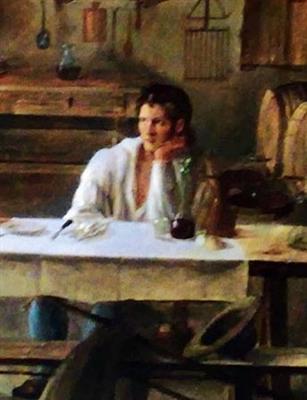
Vincenzo Abbati is known for his architectural interior paintings. These paintings are distinguished by their precise chiaroscuro and almost diagrammatic command of depth, which he developed from his training in perspective scenography.What should I know about Vincenzo Abbati's prints?
Vincenzo Abbati (1835[2]-1866[2]) was an Italian painter, associated with the Macchiaioli group. He is best known for his paintings, but prints of his work are also available. Abbati was born in Naples. He studied painting with his father, and later at the Academy of Fine Arts in Venice. He joined the Macchiaioli in Florence during the 1860s. The Macchiaioli were a group of Italian painters who rejected the academic style of painting, favouring a more realistic and impressionistic approach. They are named for their use of "macchia", meaning "stain" or "patch", referring to their technique of composing paintings from patches of colour. Abbati's subjects included scenes of everyday life, such as landscapes and interiors. He fought in the Italian Wars of Independence, losing an eye in the Battle of Capua. Abbati died in Florence at only 31 years of age. His paintings can be found in museums around the world. Prints offer an accessible way to engage with his artistic vision.What style or movement did Vincenzo Abbati belong to?
Vincenzo Abbati (1838[2]-1894[2]) was an Italian painter associated with the Macchiaioli movement. This group of artists, active in Tuscany during the mid-19th century, sought to reform Italian painting by rejecting academic conventions in favour of direct observation and the use of colour to create effects of light and shadow. Their name translates roughly as 'patchers' or 'macchia-makers', referring to their distinctive technique of applying patches of colour to canvas. The Macchiaioli are sometimes seen as Italian counterparts to the French Impressionists, though they emerged slightly earlier and had somewhat different artistic aims. Like the Impressionists, they valued painting *en plein air* (outdoors) and capturing the immediate visual experience. Abbati's works often depict scenes of everyday life, such as landscapes, gardens, and military subjects, rendered in a realistic style with attention to light and atmosphere.What techniques or materials did Vincenzo Abbati use?
Vincenzo Abbati was an Italian painter of the 19th century. Oil paint was a common medium for artists of his era. Oil paint is durable, but it tends to become transparent with age. For this reason, painters often used pale preparations to ensure luminosity. Dark grounds expedited work by acting as a middle tone when left exposed between opaque highlights and any dark, transparent shadows. Some artists felt that paler grounds had obvious advantages. However, they were more difficult to work on, as they made the calculation of tones difficult unless the entire surface was covered. Painters would begin with a graphite or chalk drawing to establish contours. These would be reinforced, and thin shadows executed in a dark brown fluid wash. Modelling was built up in carefully gradated tones of light and shade. Flesh areas were smoothed, and tones blended with a fan brush while the paint was still wet. Highlights and individual accents of thick paint were added last.When did Vincenzo Abbati live and work?
Vincenzo Abbati was an Italian artist who lived from 1838[2] to 1866. He is associated with the Macchiaioli group, Italian painters regarded as prefiguring some Impressionist practices. Abbati was born in Naples. He died young, at only 28 years of age, as a result of an injury sustained in battle. Although his career was short, Abbati produced a number of works. These included paintings of interiors, such as *Interno del Caffè Michelangiolo* and *Chiostro di Santa Maria Novella*. He also painted outdoor scenes. Abbati's paintings can be seen as part of the broader context of European painting during the mid-19th century. For example, 1862 saw Claude Debussy, the French composer, born; snapshot photography developed; and green oxide of chromium became available as an artist's pigment.Where can I see Vincenzo Abbati's work?
Vincenzo Abbati's works can be viewed in several museums. In the United States, these include the Metropolitan Museum of Art in New York, the Los Angeles County Museum of Art (LACMA), and the National Gallery of Art in Washington, D.C. Other locations include the Art Institute of Chicago; the Princeton University Art Museum; the Baltimore Museum of Art; the Harvard University Art Museums, Cambridge, Massachusetts; the Nelson-Atkins Museum of Art, Kansas City; the Philadelphia Museum of Art; the Pierpont Morgan Library, New York; the Saint Louis Art Museum; the Snite Museum of Art, University of Notre Dame; the University of Michigan Museum of Art, Ann Arbor; the Worcester Art Museum; and the Yale University Art Gallery, New Haven. European locations include the Staatliche Museen zu Berlin; the Ashmolean Museum, Oxford; and the Staatliche Graphische Sammlung, Munich. In Canada, Abbati's work is held at the Art Gallery of Ontario, Toronto, and the National Gallery of Canada, Ottawa.Where was Vincenzo Abbati from?
Vincenzo Abbati was Italian. More specifically, he came from Florence. Another Florentine artist, Lorenzo Bartolini, first studied at the Florentine Academy before moving to Paris in 1797. Vincenzo Brenna, an architect also from Florence, trained in both painting and architecture in Rome. There, he met Russian emissaries who hired him to work in Saint Petersburg for Paul I of Russia. The Renaissance Palazzo Pitti is located in Florence. Boccioni went to Rome in 1901, where he studied design and attended the Scuola Libera del Nudo at the Accademia di Belle Arti. Antolini was born in Castel Bolognese, in the region of Ravenna. Pompeo Batoni was born in Lucca, before he moved to Rome.Who did Vincenzo Abbati influence?
It is difficult to say precisely who Abbati influenced directly. However, we can consider the influence of artists who came before him, and those movements that followed. Titian, for example, had a wide influence. During the eighteenth century, many artists absorbed Titian’s style, either directly or through other painters. Antoine Watteau, an important eighteenth-century French artist, encountered Titian’s art this way. Figures such as Tintoretto and Veronese were also indebted to Titian, though they interpreted his work differently. Tintoretto amplified the drama of Titian, while Veronese was swayed by Titian’s use of compositional elements, figure types, and colour. Their paintings became avenues of approach to Titian for later generations of artists. Giovanni Battista Tiepolo, born in Venice, was the last great representative of the Venetian school of painting, and became the most famous Venetian artist after Titian. Caravaggio also had an impact on artists, including Dutchmen Hendrick ter Brugghen, Gerrit van Honthorst, and Rembrandt van Rijn; Frenchmen Simon Vouet, Valentin de Boulogne, and Georges de La Tour; and Spaniards Francisco Ribalta, Jusepe de Ribera, and Diego Velázquez.Who influenced Vincenzo Abbati?
Vincenzo Abbati, an Italian painter, was born in Naples in 1838[2]. He is associated with the Macchiaioli group, Italian painters active in Tuscany in the second half of the nineteenth century who broke with academic traditions. Abbati's artistic development occurred in a period influenced by several movements. Neoclassicism, with its emphasis on classical ideals, and Romanticism, which valued emotion and individualism, were both current. The Carracci Academy in Bologna, which promoted a style that moved away from Mannerist conventions, also had an impact on artists of the time. While specific individuals who directly influenced Abbati are not consistently documented, it is reasonable to assume that he was exposed to the work of artists such as Giovanni Fattori, another member of the Macchiaioli. He would also have known the work of members of the Carracci school; Francesco Albani and Ludovico Carracci.Why are Vincenzo Abbati's works important today?
Vincenzo Abbati (1838[2]-1894[2]) was an Italian painter, a member of the Macchiaioli group. This movement, active in Tuscany in the second half of the 19th century, anticipated some aspects of Impressionism by several decades. Abbati's works are appreciated today for their contribution to this important development in modern Italian art. The Macchiaioli artists, including Abbati, reacted against the academic painting styles of their time. They sought to represent reality directly, focusing on light, shadow, and colour. The name Macchiaioli derives from 'macchia', meaning 'stain' or 'patch', referring to their technique of composing paintings from patches of colour. Abbati's paintings often depict scenes of everyday life, such as landscapes and interiors, with a particular attention to the effects of light. His paintings are valued for their innovative approach to representation and their role in paving the way for future artistic movements.How did Vincenzo Abbati die?
Vincenzo Abbati died in 1874[2] at the age of 71.
Sources
Editorial draws on the following primary and tertiary references for Vincenzo Abbati.
- [1] museum Gallerie d'Italia – Milano Used for: museum holdings.
- [2] wikipedia Wikipedia: Vincenzo Abbati Used for: biography, birth dates, death dates, identifiers, movement attribution, nationality.
- [3] book Allison Lee Palmer, Historical Dictionary of Neoclassical Art and Architecture Used for: biography.
- [4] book Palmer, Allison Lee, Historical Dictionary of Neoclassical Art and Architecture Used for: biography.
- [5] book Masterpieces of western art : a history of art in 900 individual studies from the Gothic to the present day Used for: biography.
- [6] book Cropper, Elizabeth, 1944-, Nicolas Poussin : friendship and the love of painting Used for: stylistic analysis.
- [7] book Post-impressionism : cross-currents in European painting Used for: biography.
- [8] book Post-impressionism : cross-currents in European painting Used for: biography.
- [9] book Metropolitan Museum of Art (New York, N.Y.), The Age of Caravaggio Used for: biography, stylistic analysis.
Editorial overseen by Solis Prints. Sources verified 2026-10-21. Click a source for details, or hover over [N] in the page above to preview.
Editorial standardsMethodologyCorrectionsAI disclosureAbout the editorial team