



Utagawa Kunisada (Toyokuni III)
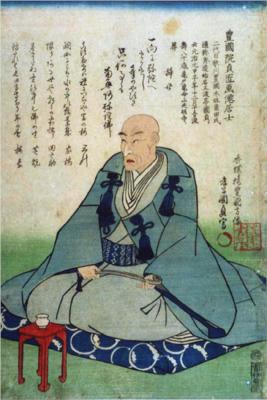
Timeline
- 1786Born in Honjo, Edo (modern Tokyo), the son of a wealthy ferry operator. His comfortable background allowed him to pursue artistic training from a young age.
- 1800Entered the studio of Utagawa Toyokuni I at the age of 14, joining the most commercially successful ukiyo-e workshop in Edo. He proved an exceptionally prolific student.
- 1810Established himself as a leading designer of kabuki actor prints in his mid-twenties in Edo. His portraits captured the theatrical intensity of performances at the Nakamura-za and Ichimura-za theatres.
- 1844Assumed the prestigious name Toyokuni III at the age of 58, asserting his position as head of the Utagawa school. He was by this point the most commercially successful ukiyo-e artist in Japan.
- 1865Died in Edo aged 79, having produced an estimated 20,000 to 25,000 print designs over his career. This staggering output made him the single most prolific ukiyo-e artist in history.
Notable Works
Tap to view larger.
Next stop
Browse the movements →
Every movement in the collection, from the Renaissance to Pop art.
Frequently Asked Questions
What is Utagawa Kunisada (Toyokuni III) known for?
Utagawa Kunisada is known for using the name Ichiytisai as his go. He often signed his pictures with “Gototei” (meaning “fifth ferry establishment’’).What is Utagawa Kunisada (Toyokuni III)'s most famous work?
It is difficult to name Utagawa Kunisada's single most famous work, as he was a prolific artist who produced thousands of prints during his career. Kunisada was a central figure in the Utagawa school of ukiyo-e (woodblock prints), and he is known for his diverse output; this includes portraits of actors (yakusha-e), beautiful women (bijin-ga), and scenes from history and literature (musha-e). He was active from the early 19th century until his death in 1865, a period of significant change in Japan. Kunisada's work reflects the popular culture and tastes of the time, and his prints were widely circulated among the general public. His artistic output was immense, and he collaborated with other artists and pupils. He left a substantial body of work that continues to be studied and appreciated today.What should I know about Utagawa Kunisada (Toyokuni III)'s prints?
Utagawa Kunisada (1786-1865) was a prolific and successful print artist of the late Edo period. Born in Edo, his family operated a ferry service, providing him with financial security. He became a student of Toyokuni around 1801, receiving the "kuni" element for his artist name. Kunisada's earliest known work dates to 1807; it is the series "Twelve Hours of the Courtesans". He initially gained recognition through book illustrations, surpassing his teacher Toyokuni in commissions by 1809. He went on to produce numerous beauty and actor prints, also designing some warrior prints. By 1814, he had founded his own studio. Kunisada used several art names throughout his career, including Gototei, Ichiyūsai, and Kōchōrō. In 1844, he was granted the name Toyokuni, and is now known as Toyokuni III. He signed his works "Toyokuni II", not recognising the previous holder of that name. He was commonly called "Yanagishima Toyokuni", after the area where he lived. Kunisada designed over 20,000 pictures, mainly ōban format prints, but also fan prints and surimono. He dominated the market for actor prints in the 1850s and early 1860s. His later prints are known for high-quality printing and complex designs. His pupils included Kunichika and Sadahide.What techniques or materials did Utagawa Kunisada (Toyokuni III) use?
Utagawa Kunisada (1786-1865), also known as Toyokuni III, was a prolific print artist of the late Edo period. He headed the Utagawa school for almost forty years. Kunisada's primary technique was woodblock printing, a process that relies on specific materials and methods. The choice of wood is fundamental to woodblock print success. Japanese artists favoured wild mountain cherry (yamazakura), which grew near the sea, particularly on the Izu peninsula near Tokyo. This wood has a fine, even grain, is easy to carve, cohesive, and does not splinter. The blocks are cut down the grain, allowing for flowing lines. Harder wood parts are for keyblocks; softer parts are for colour blocks, as they take colour better. Kunisada designed primarily in the ōban format, but he also produced fan prints and surimono. High-quality printing, with advanced techniques and complex designs, is significant in his later prints. He stopped illustrating books in the late 1840s, and his most productive year was 1852, with almost one thousand compositions.Where can I see Utagawa Kunisada (Toyokuni III)'s work?
Utagawa Kunisada's prints can be viewed in several locations. The Japan Ukiyo-e Museum in Matsumoto holds a number of his works, such as the c.1831 "Clearing Mist at Asakusa", from the series, Eight Views of Edo and the 1862, Act 8 print from the series, Treasury of Loyal Retainers. The National Museum of Ethnology, Leiden, The Netherlands, possesses the 1811 print of the actor Sawamura Gennosuke I. The Asian Art Museum, National Museums in Berlin, holds the c.1822 "The Manpachi in Ryōgoku", from the series A Collection of Restaurants Renown in These Days, the 1864 sumo wrestler print, and the c.1811 "Act eight” (Hachi danme), from the series “Perspective images of the Treasury of Loyal Retainers”. Other institutions include the Library of Congress which holds the 1877 "New edition of children at play”. Private collections, such as the Arendie and Henk Herwig Collection and the Peter Rieder Collection, also contain Kunisada prints. Kunisada designed fan prints and created over sixty paintings, in addition to the more common ōban format prints.Who did Utagawa Kunisada (Toyokuni III) influence?
Establishing direct influence is difficult, but Utagawa Kunisada's artistic style and subject matter had an impact on the development of *ukiyo-e* and later art movements. As one of the most prolific *ukiyo-e* artists, his designs were widely circulated. Kunisada's work contributed to the evolving tradition of modern painting. In the late 19th century, painters and writers constructed artistic lineages to validate contemporary artistic endeavours. They sought connections to artists with similar styles, creating a sense of artistic ancestry. Manet, a modern artist of the 19th century, found his aesthetic through engagement with the style of Frans Hals. Van Gogh also engaged with the art of Hals and Manet. This formed a lineage of painters, each building on the accomplishments of the other. Hals came to be discussed in Impressionist terms, because various modern painters engaged with Impressionism.
Sources
Editorial draws on the following primary and tertiary references for Utagawa Kunisada (Toyokuni III).
- [1] book Andreas Marks, Japanese Woodblock Prints Used for: stylistic analysis.
- [2] book Japanese woodblock prints in miniature: The genre of surimono Used for: stylistic analysis.
Editorial overseen by Solis Prints. Sources verified 2026-09-04. Click a source for details, or hover over [N] in the page above to preview.
Editorial standardsMethodologyCorrectionsAI disclosureAbout the editorial team