



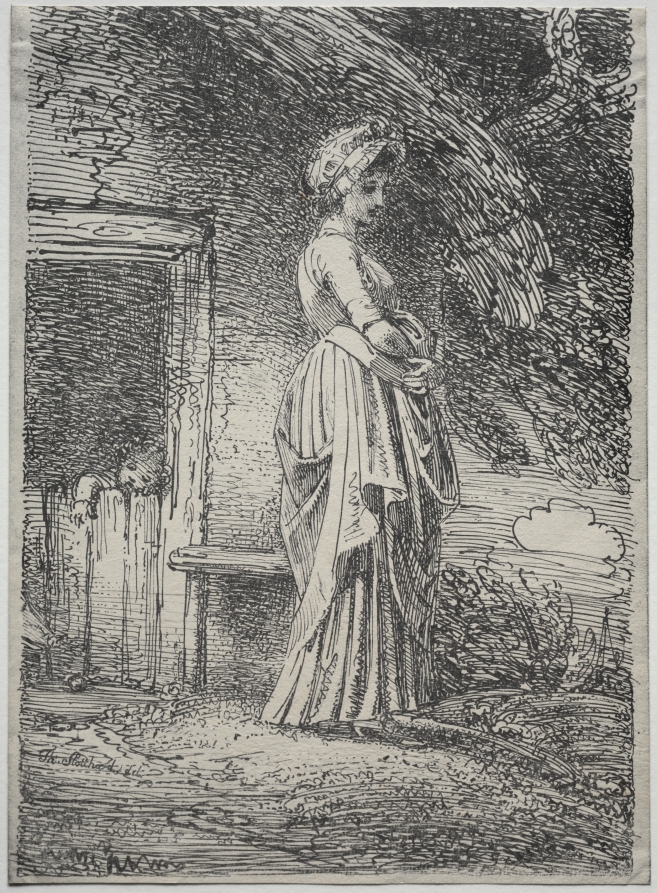


Thomas Stothard
Stothard began his career as an apprentice to a silk weaver in Spitalfields. This early training in pattern design influenced his later work for silversmiths and publishers. He designed the Wellington Shield, a massive piece of silver plate presented to the Duke of Wellington. While many artists of his era sought fame through large oil paintings, Stothard found his most consistent success in the world of book illustration. He produced thousands of designs for pocket editions of poetry and novels.

Biography
His style is defined by a light touch and a preference for soft, flowing lines. Stothard often placed his figures in shallow spaces, a technique that made his work ideal for the flat surface of a printed page. He avoided the heavy shadows and dramatic lighting common in the works of his contemporaries. Instead, he used clear outlines and balanced compositions. Works like The Lost Apple and his various Caryatid studies demonstrate his ability to translate classical forms into a clear, gentle language.
Modern collectors value Stothard for his clarity and the decorative quality of his compositions. His prints do not overwhelm a room with dark themes or aggressive scale. They offer a sense of calm and order. Because he worked closely with engravers, his designs translate perfectly to modern print reproductions. His depictions of domestic scenes, such as Mother and Two Children, provide a quiet glimpse into late eighteenth-century sensibilities without the distraction of heavy-handed moralising.
Notable Works
Tap to view larger.
Next stop
Browse the movements →
Every movement in the collection, from the Renaissance to Pop art.
Related Artists



Frequently Asked Questions
When was Thomas Stothard born?
Thomas Stothard was born in 1755 and died in 1834.What is Thomas Stothard known for?
Thomas Stothard is known for thomas Stothard was a prolific British illustrator and Royal Academician known for his graceful book designs and classical compositions.