


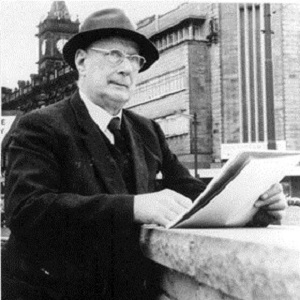
Lowry painted matchstick people on grey days in industrial Lancashire, and that description, while accurate, has been used to diminish him for seventy years. The art establishment treated him as a naive painter, a regional curiosity. He was neither.
Timeline
Biography
He was born in Rusholme, Manchester, and lived with his parents in Pendlebury, surrounded by cotton mills and terraced streets. He studied art part-time for over twenty years while working full-time as a rent collector and clerk for the Pall Mall Property Company. He did not retire from the day job until he was sixty-five. His mother, who dominated his emotional life, died in 1939. He painted Going to the Match the same year.
The paintings show mill towns, factory gates, crowds streaming through streets, parks, football grounds, and seaside promenades. The figures are simplified to near-abstraction: dark vertical strokes with round heads, moving in currents like particles in a fluid. The skies are white or grey. The buildings are dark. The overall palette has maybe five colours. The composition is always clear.
He was offered a knighthood, the CBE, the Companion of Honour, and five honorary degrees. He refused them all. He rejected the OBE in 1955 and the CBE in 1961. He turned down a knighthood in 1968. He was offered the Companion of Honour in 1972 and refused it. No British artist has refused more honours.
He never married. He lived alone after his mother's death in increasingly cluttered houses full of clocks and Pre-Raphaelite paintings he had collected. He died in 1976, at eighty-eight. His work sells for millions now. He would have found the prices baffling.
Notable Works


See L.S. Lowry’s Work in Person


Artists You’ll See Alongside L.S. Lowry
These artists’ works appear in the same museum collections.





Can't visit in person?
Browse L.S. Lowry Prints →