



Timeline
- 1906Painted "Gartenstrasse early in the morning" aged 22.
- 1907Painted "Autumn Landscape in Oldenburg" aged 23.
- 1930Painted "Pier at Night" aged 46.
- 1935Painted "Evening in the Room" aged 51.
- 1956Painted "Still Life (Sanseveria and Jar)" aged 72.
- 1969Painted "Garden in Winter" aged 85.
Notable Works
Tap to view larger.
Next stop
Expressionism →
Explore the artists and ideas of Expressionism.
Karl Schmidt-Rottluff prints
Hand-finished archival prints from Karl Schmidt-Rottluff's body of work.
 Two Women - Karl Schmidt-Rottluff
From £37.00
Two Women - Karl Schmidt-Rottluff
From £37.00
 Dr Rosa Schapire - Karl Schmidt-Rottluff
From £37.00
Dr Rosa Schapire - Karl Schmidt-Rottluff
From £37.00
 Autumn Landscape in Oldenburg - Karl Schmidt-Rottluff
From £37.00
Autumn Landscape in Oldenburg - Karl Schmidt-Rottluff
From £37.00
 Sun over the Pine Forest - Karl Schmidt-Rottluff
From £37.00
Sun over the Pine Forest - Karl Schmidt-Rottluff
From £37.00
 Woman with a Bag - Karl Schmidt-Rottluff
From £37.00
Woman with a Bag - Karl Schmidt-Rottluff
From £37.00
 The Factory - Karl Schmidt-Rottluff
From £28.00
The Factory - Karl Schmidt-Rottluff
From £28.00
Related Artists

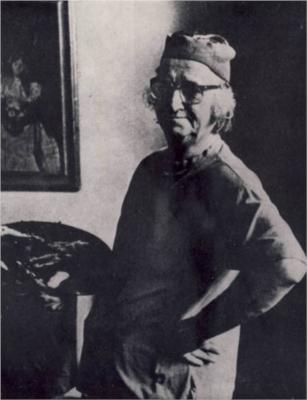


Take Karl Schmidt-Rottluff home.
See all Karl Schmidt-Rottluff prints →Frequently Asked Questions
What is Karl Schmidt-Rottluff's most famous work?
It is difficult to name one single "most famous work" by Karl Schmidt-Rottluff. He produced paintings, prints, and sculptures throughout his career. Schmidt-Rottluff was associated with German Expressionism, and his paintings often feature dark colours and forceful forms. His paintings from around 1908 to 1917 are well known. These include *Midday in the Moor (Dangast)* (1908), *Flowering Trees* (1909), *Farmhouse in Dangast* (1910), and *Fir Trees in Front of a White House* (1911). He also produced woodcuts, such as *Dunes and Pier* (1917), *Head of a Woman* (1918), and *Walk to Emmaus* (1918). During the Second World War, the Nazi regime persecuted Schmidt-Rottluff, removing his paintings from German galleries and forbidding him to paint. After the war, his work was reinstated, and he lived in East Germany.What should I know about Karl Schmidt-Rottluff's prints?
Karl Schmidt-Rottluff, a painter and printmaker, was a founder of the Brücke group in Dresden in 1905. Printmaking was fundamental to his style, simplifying and abstracting it. He made 663 prints, almost all between 1905 and 1927, with nearly 450 being woodcuts. Until 1912, he often printed by hand in small editions. After 1912, he used professional printers, sometimes under commission from publishers like Pan-Presse, J. B. Neumann, and Kurt Wolff. Schmidt-Rottluff favoured northern subjects. He created many prints during summers spent in Dangast (a fishing village) from 1908 to 1912, and later in remote Baltic coastal towns such as Nidden and Hohwacht. Even after moving to Berlin in 1911, he avoided Brücke's focus on urban modernity. Instead, he depicted radically stylised nudes and heads, influenced by Cubism and African and Oceanic art. While conscripted in May 1915, he served three years on the Eastern front, and though shattered nerves prevented him from painting, he continued to make woodcuts. Near the end of the war, he turned to biblical themes.What style or movement did Karl Schmidt-Rottluff belong to?
Karl Schmidt-Rottluff is associated with German Expressionism, as a leading member of the Die Brücke group (The Bridge). This group had direct links with French Symbolist painting and theory. Schmidt-Rottluff corresponded with Cuno Amiet, a Swiss artist who had worked with the French Symbolist painter Emile Bernard. Schmidt-Rottluff had strong ties to northern Germany. By 1911, Schmidt-Rottluff moved from Dresden to Berlin. His works began to reflect the vitality and eroticism of African art. He made wood sculptures and contributed prints to journals such as Der Sturm and Die Aktion. His paintings from this period show forceful handling of colour. For example, Gap in the Dyke uses dominant reds contrasted with deep blues. The composition is at one with emotion, as Schmidt-Rottluff sought "to capture what I see and feel and to find the purest expression for that."What techniques or materials did Karl Schmidt-Rottluff use?
Karl Schmidt-Rottluff employed varied techniques and materials throughout his career. Early on, his paintings featured dark, saturated colours and forceful forms, executed with heavy brushstrokes. He applied paint in layered planes, using contrasting hues to reflect his personal sensitivities. Around 1910, influenced by Neo-Impressionism and Vincent van Gogh, Schmidt-Rottluff shifted away from thick paint application. During a summer spent in Dangast with Erich Heckel, he began using flatter applications of broad colour bands. In works such as *Gap in the Dyke*, the handling of colour creates vitality; for instance, the red in the foreground connects to the black fence and extends to the evening clouds. Schmidt-Rottluff also believed in the importance of craft and materials. He advocated for complete mastery of craft, specifically construction techniques that require particular materials, and the elimination of false materials. He felt painters and sculptors should build on a foundational knowledge of materials, while searching for their own artistic paths.What was Karl Schmidt-Rottluff known for?
Karl Schmidt-Rottluff (1884-1976) was a German Expressionist painter and printmaker. His works often feature forceful applications of colour and simplified forms. Schmidt-Rottluff's paintings from this period, such as *Midday in the Moor* (1908) and *Farmhouse in Dangast* (1910), demonstrate his dynamic style through layered planes and contrasting hues. These paintings do not represent colours found in nature; instead, they reflect the artist's state of mind. Another painting, *Flowering Trees*, also shows his use of heavy brushstrokes and contrasting colours. Schmidt-Rottluff was a leading figure in German Expressionism. He made woodcuts, such as *Dunes and Pier* (1917), *Head of a Woman* (1918), and *Walk to Emmaus* (1918). He also worked in other printmaking media, producing lithographs such as *Nude* (1911) and woodcuts such as *Villa with Tower* (1911). During the Second World War, the Nazis persecuted Schmidt-Rottluff, removing his paintings from German galleries and forbidding him to paint. His work was reinstated in 1945, and he lived in East Germany from that time.When did Karl Schmidt-Rottluff live and work?
Karl Schmidt-Rottluff was born in Rottluff, Germany, in 1884. He died in West Berlin in 1976. A painter and printmaker, Schmidt-Rottluff co-founded the Brücke group in Dresden in 1905, along with architecture students Ernst Ludwig Kirchner, Fritz Bleyl, and Erich Heckel. From 1910 to 1911, he maintained a studio in Hamburg. He preferred northern views, many from summers in Dangast (1908 to 1912), a fishing village, and later from Baltic coastal towns Nidden and Hohwacht. After moving to Berlin in 1911, Schmidt-Rottluff began depicting stylised nudes and heads, influenced by Cubism and African and Oceanic art. Conscripted in May 1915, he served three years on the Eastern front. During World War II, the Nazis persecuted Schmidt-Rottluff, removing his paintings from German galleries and forbidding him to paint. In 1945, his work was reinstated. He then lived in East Germany.Where can I see Karl Schmidt-Rottluff's work?
Karl Schmidt-Rottluff's paintings can be viewed in several museum collections. These include the Brucke Museum and the Nationalgalerie in Berlin; the Kunsthalle and Sammlung Bottcherstrasse in Bremen; the Ludwig Museum and Wallraf-Richartz Museum in Cologne; and the Folkwang Museum in Essen. Other locations are the Kunsthalle in Hamburg; the Niedersachsisches Landesmuseum in Hanover; the Stadtische Kunsthalle in Mannheim; the Bayerische Staatsgemaldesammlungen in Munich; the Stiftung Ada und Emil Nolde in Seebull; and the Von der Heydt Museum in Wuppertal. One example is *Midday in the Moor (Dangast)*, 1908, which is held in the collection of the Landesmuseum Oldenburg. Another, *Farmhouse in Dangast*, 1910, is in the Staatliehe Museen Preussischer Kulturbesitz, Nationalgalerie, Berlin. *Flowering Trees*, 1909, is in a private collection.Where was Karl Schmidt-Rottluff from?
Karl Schmidt-Rottluff was born in 1884 in Rottluff, Germany, a town that provided the inspiration for his adopted surname; his given name was Karl Schmidt. He died in West Berlin in 1976. Schmidt-Rottluff was one of the four architecture students who founded the artist group Brücke in Dresden in 1905; the others were Ernst Ludwig Kirchner, Fritz Bleyl, and Erich Heckel. From 1910 to 1911, he maintained a studio in Hamburg, a city with several important supporters of his work. The artist favoured northern views, many created during summers spent in Dangast (a fishing village) from 1908 to 1912, and later in remote Baltic coastal towns such as Nidden and Hohwacht. Even after he moved to Berlin in 1911, he avoided Brücke subjects of urban modernity. Instead, he began depicting radically stylised nudes and heads, influenced by Cubism and African and Oceanic art. In 1933, the Nazis expelled him from the Prussian Academy of Arts and prohibited him from painting and exhibiting. The Nazis confiscated 608 of his works from public collections. His Berlin studio and many works were destroyed during the Second World War.Who did Karl Schmidt-Rottluff influence?
Karl Schmidt-Rottluff, a leading figure in German Expressionism, was part of the Die Brücke group. The group included Erich Heckel, Ernst Ludwig Kirchner, and others. Schmidt-Rottluff's connections extended beyond Germany; he corresponded with Cuno Amiet, a Swiss artist who linked Die Brücke to French Symbolism. Schmidt-Rottluff's style evolved. Early influences included Vincent van Gogh and Neo-Impressionism, seen in his application of colour. His time with Heckel in Dangast in 1910 marked a period where both artists moved away from thick paint application, favouring flatter colour fields. By 1911, after Schmidt-Rottluff moved to Berlin, African art began to inform his work. Schmidt-Rottluff's work was later condemned by the Nazis, and his paintings were removed from German galleries. His art was reinstated in 1945, after which he lived in East Germany.Who influenced Karl Schmidt-Rottluff?
Karl Schmidt-Rottluff, born in 1884, was influenced by several artists and movements. Early on, Neo-Impressionism and Vincent van Gogh affected his style, leading him away from thickly applied paint to flatter, broader colour fields. Schmidt-Rottluff's connections with other artists also shaped his artistic path. He corresponded with Cuno Amiet, a Swiss artist who provided direct links to French Symbolist painting and theory. Amiet had previously worked with the French Symbolist painter Émile Bernard. In 1905, Schmidt-Rottluff met Ernst Ludwig Kirchner, and together with Erich Heckel and Fritz Bleyl, they formed the artists' association Brücke. During a stay in Alsen in 1906, he encountered Emil Nolde. In 1912, he met Lyonel Feininger. These relationships and encounters exposed him to various artistic ideas and approaches.Who was Karl Schmidt-Rottluff?
Karl Schmidt-Rottluff (1884-1976) was a German Expressionist artist. He was born in Rottluff and died in Berlin. Schmidt-Rottluff, like Erich Heckel, spent the summer of 1910 in Dangast. During this period, he moved away from thickly applied paint. He adopted a flatter application of broad bands of colour, influenced by Neo-Impressionists and Vincent van Gogh. His work *Gap in the Dyke* and Heckel’s *Windmill* show their shared artistic ground from the early period of the Die Brücke group. Schmidt-Rottluff's paintings often feature dark, saturated colours and forceful forms. He employed heavy brushstrokes in layered planes of contrasting hues to reflect his personal sensitivities. *Flowering Trees* (1909) is an example of this style. Other paintings include *Midday in the Moor* (1908), *Farmhouse in Dangast* (1910), and *Pharisees* (1912). During the Second World War, the Nazis persecuted Schmidt-Rottluff, removing his paintings from German galleries and forbidding him to paint. His work was reinstated in 1945, after which he lived in East Germany.Why are Karl Schmidt-Rottluff's works important today?
Karl Schmidt-Rottluff (1884-1976) was a German Expressionist painter and printmaker. He is significant as a member of the artist group Die Brücke (The Bridge), formed in Dresden in 1905. Other members included Erich Heckel, Ernst Ludwig Kirchner, and Max Pechstein. Die Brücke aimed to break from academic artistic traditions and explore new modes of expression. Schmidt-Rottluff corresponded with Cuno Amiet, a Swiss artist with links to French Symbolism, which influenced the group. Schmidt-Rottluff had strong connections to northern Germany. By 1911, he relocated from Dresden to Berlin. His artworks started to show the impact of African art. He created wood sculptures and contributed prints to journals, such as Der Sturm and Die Aktion. His art is characterised by dark, saturated colours and forceful forms. During the Second World War, the Nazis persecuted Schmidt-Rottluff, removing his paintings from German galleries and forbidding him to paint. His work was reinstated in 1945, and he lived in East Germany from that time.
Sources
Editorial draws on the following primary and tertiary references for Karl Schmidt-Rottluff.
- [1] wikidata Wikidata: Q161143 Used for: identifiers.
Editorial overseen by Solis Prints. Sources verified 2026-09-27. Click a source for details, or hover over [N] in the page above to preview.
Editorial standardsMethodologyCorrectionsAI disclosureAbout the editorial team