



1622–1690[1]
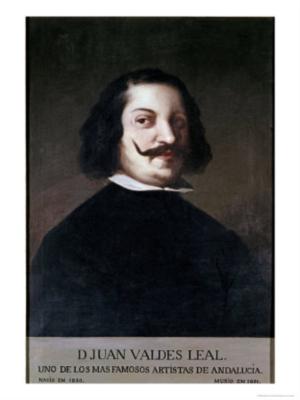
Juan de Valdes Leal
Notable Works
Tap to view larger.
Next stop
Browse the movements →
Every movement in the collection, from the Renaissance to Pop art.
Frequently Asked Questions
What is Juan de Valdes Leal's most famous work?
Juan de Valdes Leal (1622[1]-1690[1]) was a Spanish painter and engraver from Seville. He may have been trained in Cordoba by Antonio del Castillo. His earliest commission was a Saint Andrew for the Church of San Francisco (1644[1]). Valdes Leal's art reached its peak from the late 1650s to the early 1670s. His style is known for its expressiveness and unusual dramatism, particularly within the context of Sevillian painting. He employed a nervous brushstroke, with colour that is sometimes almost strident. Light flickers across the surfaces, and correct drawing is sacrificed to emotive intensity. He is well known for *Hieroglyphs of Death and Salvation*, grim sermons on the impermanence of life. These include *Finis gloriae mundi*, located in the Hospital de la Caridad, Seville. The judgment of the soul is expressed by scales, tying thematically to the intent of the church's decoration. The painting relates to Matthew 25:34-36, where Christ promises heaven to those who have practiced the Seven Works of Mercy. Charity is presented as the virtue that may tip the scales and save a Christian soul.What techniques or materials did Juan de Valdes Leal use?
Juan de Valdes Leal was a Spanish painter and engraver. He is believed to have trained in Cordoba with Antonio del Castillo. His earliest known commission was a painting of St Andrew for the Church of San Francisco (1644[1]). His paintings are characterised by sharp contrasts of light and shade. He often presented important moments of faith in concrete, realistic terms. In his religious paintings, Valdes Leal used broken brushstrokes, violent colours, and leaned toward macabre subjects. One example is *Hieroglyphics of the End of Life* (1672). His first important commission was a series of paintings about the history of Saint Clare for the Convent of Santa Clara in Carmona (1652-53). These paintings display unrestrained movement of figures, brilliant colouring, and flashes of light. The figures are arranged with contrasting diagonals; the violence of the action is present in the gestures and expressions. Contact with painters of the School of Madrid, and with Venetian and Flemish painting, may have reinforced his inclination toward colour and a looser technique.What was Juan de Valdes Leal known for?
Juan de Valdes Leal (1622[1]-1690[1]) was a Spanish painter and engraver, born in Seville. He trained in Cordoba with Antonio del Castillo. His earliest commission was a painting of St Andrew for the Church of San Francisco (1644[1]). Valdes Leal is known for his emphatic expressiveness. His figures do not display conventional beauty, but rather emotiveness. This is apparent in his first signed picture, Saint Andrew (1647), where the saint's hands resemble those of a fisherman. His skill in still life is also on display in this work. In 1652-53, he completed a series of paintings about St Clare for the Convent of Santa Clara in Carmona. One of these, Defeat of the Saracens at Assisi, shows his characteristic unrestrained movement, brilliant colouring, and flashes of light. By 1658, Valdes Leal had returned to Seville. He befriended Bartolomé Esteban Murillo and helped him establish the Sevillian academy of art in 1660. His Allegory of Vanitas (1660) signals his interest in macabre subjects. In 1672, he created Hieroglyphs of Our Last Days for the Hospital de la Caridad, some of his most celebrated pieces. He stands out for his bitter, desperate religious feeling.When did Juan de Valdes Leal live and work?
Juan de Valdes Leal was born in Seville in 1622[1] and died there in 1690[1]. Although born in Seville, he is believed to have trained in Cordoba with painter Antonio del Castillo. His earliest commission was in 1644[1] for the Church of San Francisco, also in Cordoba. This painting depicted St Andrew in front of his cross. In 1653, he created six works portraying the life of St Clare for the Convent of Santa Clara in Carmona. One painting in this series, Miraculous Defeat of the Saracens, is now in the Museo de Bellas Artes, Seville. Between 1657 and 1658, Valdes Leal created the altarpiece for the Church of the Shod Carmelites in Cordoba, depicting the Ascension of Elijah. He settled in Seville in 1657. In 1660, he created a pair of allegorical paintings contrasting worldly vanities with the path to salvation. He participated in the foundation of a drawing academy that year, becoming its president three years later. In 1672, he created Hieroglyphics of the End of Life for the Charity Hospital in Seville.Where can I see Juan de Valdes Leal's work?
Juan de Valdes Leal's paintings can be viewed in several locations. In Seville, Spain, his works *In ictu oculi* and *Finis gloriae mundi* are located in the Hospital de la Caridad. The Museo Provincial de Bellas Artes in Seville holds his *Temptation of Saint Jerome* and *Fray Hernando de Talavera*. Elsewhere in Spain, the Church of the Carmelites in Cordoba contains his *Saint Apollonia and a Carmelite Saint*. The Museo de Bellas Artes in Valencia has his *Miraculous Defeat of the Saracens*. The Prado in Madrid possesses his *Christ Carrying the Cross*. Outside of Spain, Valdes Leal's *Immaculate Conception* is in London's National Gallery. The Wadsworth Atheneum in Hartford, Connecticut, displays his *Allegory of Vanity*. The University of Michigan Museum of Art in Ann Arbor, Michigan, has his *Annunciation*. His *Mary Magdalene* is in Villamanrique de la Condesa.Where was Juan de Valdes Leal from?
Juan de Valdes Leal was from Seville, a city in southern Spain. It is believed he received training in Cordoba, studying with painter Antonio del Castillo. His earliest commission was for a painting of St Andrew shown in front of his cross, for the Church of San Francisco (1644[1]). In 1653, he completed six works depicting the life of St Clare for the Convent of Santa Clara in Carmona. One painting from this series, Miraculous Defeat of the Saracens, depicts the deliverance of the convent of San Damiano in 1240 from Emperor Frederick II's troops, an event said to be brought about by St Clare's prayers. Between 1655 and 1658, Valdés painted the multipicture retable of the church of the Carmelite convent in Cordoba. The central painting is Elijah in the Chariot of Fire. Valdés Leal's personal style is evident in these works, with lively brushwork and an almost uncontrolled drawing style. He remained in Cordoba until 1656, after which he returned to Seville, his native city, where he continued to work until his death.Who did Juan de Valdes Leal influence?
Juan de Valdés Leal's painting style represents one alternative to the dominant aesthetic in Spanish art after the mid-17th century. His approach, characterised by impressionism and colourism, can be traced to Venetian painting. His art differs markedly from that of artists such as Zurbarán. The sensuous colouring, lively action, and emotive expression in Valdés Leal's works, such as *Temptation of Saint Jerome* (1657[1]), contrast with Zurbarán's more austere and concise style. A trip to Madrid around 1655 exposed Valdés Leal to the painters of the School of Madrid, as well as Venetian and Flemish paintings in the royal collection. This is thought to have reinforced his inclination toward colourism and a looser technique. His exposure to the works of Murillo and Herrera the Younger in Seville further affirmed his artistic vision. His style is particularly evident in the multipicture retable (1655-1658[1]) of the church of the Carmelite convent in Cordoba, especially in the central painting, *Elijah in the Chariot of Fire*. The lively brushwork and feverish agitation of forms reveal the emotive side of his art.Who influenced Juan de Valdes Leal?
Juan de Valdes Leal (1622[1]-1690[1]) was a Spanish painter and engraver. He was born in Seville, but is believed to have trained in Cordoba with Antonio del Castillo. His early paintings of the 1650s are characterised by sharp contrasts of light and shade. These paintings display a desire to present important moments of faith, mysteries, and heroes in concrete terms. He received commissions from monasteries and settled in Seville in 1657[1]. Although born in the same city as Murillo, Valdes Leal represents the opposite side of religious painting. While Murillo is sunny and endearing, Valdes Leal is gloomy and dramatic. His style breaks with the long series of Spanish painters influenced by Italian art. Even the reference to Caravaggio is developed emphatically; stress is laid on the brushwork rather than on the light, with fluid compositions. His work displays impressionism and colourism, ultimately traceable to Venetian painting. The dynamic quality of Valdés's painting is clear, despite the fact that its composition was inspired by Zurbarán's representations.
Sources
Editorial draws on the following primary and tertiary references for Juan de Valdes Leal.
- [1] wikipedia Wikipedia: Juan de Valdes Leal Used for: biography, birth dates, death dates, identifiers, movement attribution, nationality.
Editorial overseen by Solis Prints. Sources verified 2026-10-23. Click a source for details, or hover over [N] in the page above to preview.
Editorial standardsMethodologyCorrectionsAI disclosureAbout the editorial team