



John Ruskin
- Pre-Raphaelite Brotherhood
- freethought
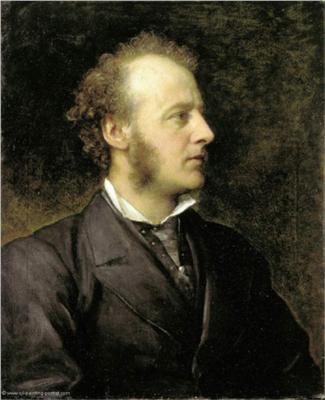
Ruskin was not primarily an artist. He was an art critic, a writer, a social reformer, a geologist, a professor, and the most influential voice in Victorian aesthetics. But he drew and painted watercolours with a precision and sensitivity that would have made a career for someone who had fewer things to say.

Biography
He was born in London to wealthy parents. His father was a sherry merchant. His mother was devoutly evangelical. He was educated at home, taken on European tours from childhood, and entered Christ Church, Oxford, where he won the Newdigate Prize for poetry. He published the first volume of Modern Painters in 1843, at twenty-four, originally as a defence of Turner against hostile critics. It grew into a five-volume treatise on landscape painting, geology, botany, and the moral purpose of art.
The Stones of Venice (1851-53) contained the chapter 'On the Nature of Gothic' that changed William Morris's life and, through Morris, the direction of British design. Ruskin argued that the irregularities in medieval craftsmanship were evidence of human freedom and dignity. The argument was about labour as much as aesthetics.
His personal life was difficult. His marriage to Effie Gray was annulled on grounds of non-consummation. She married John Everett Millais. He developed an attachment to the young Rose La Touche that was, at minimum, inappropriate. He suffered mental breakdowns in later life and spent his last decade in silence at Brantwood, his house in the Lake District.
His watercolours of rocks, feathers, buildings, and landscape details are extraordinarily precise and observant. He drew what he saw, and he saw more than most people.
Timeline
- 1845Painted "Study of the Marble Inlaying on the Front of the Casa Loredan".
- 1849Painted "Arch from the Façade of the Church of San Michele".
- 1859Painted "Copy of a Girl in Van Dyck's portrait of The Wife of Colyn de Nole and her daughter".
- 1866Painted "The Chateau of Neuchatel at dusk, with Jura mountains beyond".
- 1877Painted "Copy of the Head of St Ursula from Carpaccio".
- 1882Painted "Spiral relief from the north transept door, Rouen Cathedral".
Notable Works
Tap to view larger.
Where to See John Ruskin
4 museums worldwide.
-
16 works
Birmingham Museums Trust
Birmingham, United Kingdom
Tue–Sun 10:00–17:00, closed Mondays (except bank holiday Mondays and during Birmingham school holidays)
-
21 works
Yale Center for British Art
New Haven, United States
Tue–Sat 10:00–17:00, Sun 12:00–17:00; closed Mon · Free
-
8 works
National Gallery of Art
Washington D.C., United States
Mon–Sat 10:00–17:00, Sun 11:00–18:00 · Free
-
1 works
Isabella Stewart Gardner Museum
Boston, United States
Mon, Wed, Fri 11:00–17:00, Tue closed, Thu 11:00–21:00, Sat–Sun 10:00–17:00 · $25 adults


Next stop
Browse the movements →
Every movement in the collection, from the Renaissance to Pop art.
John Ruskin prints
Hand-finished archival prints from John Ruskin's body of work.


Related Artists


.jpg)


Take John Ruskin home.
See all John Ruskin prints →Frequently Asked Questions
Did john ruskin live in the lake district?
John Ruskin spent his last decade in silence at Brantwood, his house in the Lake District.Did john ruskin marry again?
John Ruskin's marriage to Effie Gray was annulled, but it is not mentioned if he remarried.Did john ruskin remarry?
John Ruskin's marriage to Effie Gray was annulled, but it is not mentioned if he remarried.How did john ruskin die?
John Ruskin died in 1900 at the age of 81.John ruskin art movement?
John Ruskin was associated with the Arts and Crafts Movement. *The Stones of Venice* was a seminal book for the architects of this movement.Major works of john ruskin?
One of John Ruskin's major works was *The Stones of Venice* (1851-53).Was john ruskin a christian?
The passages mention that John Ruskin saw Rubens as an example of the limitations of the Reformation. He believed that the Reformers introduced errors and created a gap between an older faith and rationalism.Where did john ruskin live?
John Ruskin was born in London. He also had a house with a garden in one of London's greenest areas.Who was john ruskin's wife?
John Ruskin was married to Euphemia 'Effie' Gray, who was a distant cousin. Their marriage was later annulled.Why did john ruskin marry effie gray?
The passages suggest that John Ruskin's parents engineered a courtship between him and a distant cousin, Miss Euphemia Gray.Why is john ruskin famous?
John Ruskin is known for his accessibility, eloquence, and international popularity as a Victorian architectural critic and apologist. He is also recognised for his contribution to medieval Revival.