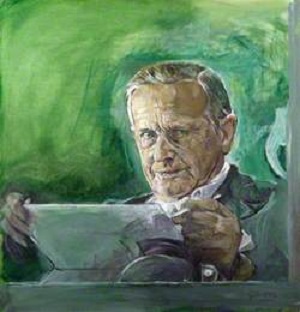
Key facts
- Lived
- 1781–1834, British
Notable Works
Tap to view larger.
Frequently Asked Questions
What is George Cooke's most famous work?
It is difficult to name a single "most famous" work by George Cooke, as his notability rests on a lifetime of diverse artistic output. George Cooke (1796-1872) trained as a lawyer before turning to portrait painting. He spent years living among native American Indians, creating portraits and advocating for the preservation of Indian tribes. In 1841, he published "Manners...of the North American Indians", which contained around 300 of his engravings. His painting "Ambush for Flamingoes" (circa 1857) is in the collection of the Carnegie Museum of Art, Pittsburgh. It depicts a hunter and servant waiting behind a bush, poised to shoot a flock of flamingoes. The painting uses the hunter as a reminder of how the beauty of nature can be swiftly destroyed by man. Catlin presented the flamingoes in different poses, to express variety and movement.What should I know about George Cooke's prints?
Prints were an important part of visual culture, becoming widespread in Western Europe from the fifteenth century. The original print is an image conceived by the artist as a print, executed solely as a print, usually in a numbered edition, and signed. Each print in the edition is an original, printed from a plate, stone, screen, block or other matrix created for that purpose. There is no one original print from which copies are made. Each print is inked and pulled individually; it is a multi-original medium. The number of prints in the edition is decided by the artist. The sequential numbering provides an accounting for the number of prints in the edition. Each print has a specific number; i.e. 12/25 (the edition is 25, the particular print is number 12). The edition claim is written as a pair of numbers on the left bottom margin of the print itself: it consists of a print number and an edition number written as a group with a short separating line between them. The print number is written above or to the left, the edition size is written below or to the right. The title of the print is written in the middle of the bottom margin of the print. The signature (and/or chop mark) is on the right of the bottom margin of the print. Edition descriptions are always signed in pencil.What style or movement did George Cooke belong to?
George Cooke, active in the 19th century, is associated with American art of that period. Determining a single style or movement for Cooke can be complex, as many artists assimilated different approaches. Considering the timeframe, Cooke's work might be viewed in relation to the Hudson River School, a group of US artists creating paintings of the natural world. The Hudson River School painters presented romanticised views, but Cooke's specific relation to this movement requires analysis of his individual works, their subjects, and their stylistic characteristics. Examining Cooke's artistic output, his techniques, and his relationship to other artists of the time would be needed to place him accurately within the art-historical context. Without further information, it is difficult to assign him definitively to a particular movement.What techniques or materials did George Cooke use?
Technical knowledge is essential to the study of art history. Artists make choices that exist outside the limits of their materials. Constable used preliminary sketches and oil studies. He made a pencil under-drawing, then established mass with washes of subdued colour. He commenced a thin but opaque building-up of the surface, adding details. Glazings of burnt red lakes and transparent earths added depth to shadows. Freely knifed and brushed touches of off-white gave the quality of reflective light. Gainsborough used a pale ground, perhaps relating to his interest in transparencies lit from behind. His impulsive brushwork ranged from brown washes to bravura scumbles and thick impasto. He painted the flesh tones with a bold stroke of red paint. Touches of black paint, rich in medium, were applied over scumbled strokes of white ribbon. He achieved luminosity in his flesh tones by painting thinly, allowing the pale colour of the ground to shine through. He used a pure white pigment, Cremona white, bound in poppy oil.When did George Cooke live and work?
George Romney was an English painter born in 1734 in Lancashire, Cumbria. He received his early education in a small town before apprenticing with his father, a cabinetmaker. In 1755, Romney furthered his artistic training in Kendal, studying with local painter Christopher Steele. He quickly gained recognition and established himself as a portraitist. During this period, he married and had two children. In 1762, Romney relocated to London, aiming to expand his career as a portrait painter. He enjoyed considerable success and was considered a fashionable portraitist, even compared to Reynolds and Gainsborough. After a visit to Rome, he wanted to paint ambitious historical works, but this ambition was never realised. Romney's popularity declined in the 1790s, leading him to leave London and return to his native Kendal, where he died in 1802.Where can I see George Cooke's work?
Many museums hold works by George Cooke. In the United States, these include the Charles Hosmer Morse Museum of American Art (Winter Park, Florida), the Los Angeles County Museum of Art (Los Angeles), the Metropolitan Museum of Art (New York), the Minneapolis Institute of Arts, the Museum of Modern Art (New York), and the Virginia Museum of Fine Arts (Richmond). In Canada, his work can be seen at the Royal Ontario Museum in Toronto. In the United Kingdom, Cooke's art is held at the Bakelite Museum (Williton), the Brighton Museum & Art Gallery, the Geffrye Museum (London), the Manchester Art Gallery, the National Museums of Scotland (Edinburgh), Towneley Hall Art Gallery (Burnley, Lancashire), the Fitzwilliam Museum (Cambridge), the National Museum of Wales (Cardiff), the National Gallery of Scotland (Edinburgh), the Scottish National Gallery of Modern Art (Edinburgh), the Burrell Collection (Glasgow), Jersey Museum and Art Gallery (St Helier), and the Leeds City Art Gallery.Where was George Cooke from?
George Stubbs, considered the best animal painter of the 18th century, was born in Liverpool. His father was a merchant, and Stubbs initially worked in the family business. Upon his father’s death, Stubbs became apprenticed to a local engraver. During the 1740s, he worked as an itinerant portrait painter while also studying anatomy at the York County Hospital. A significant moment came in 1754, when Stubbs travelled to Italy. He began to combine his anatomical interests with his artistic interest in animals. This approach raised animal portraiture to a new level. His painting *A Monkey* (1774; private collection) was exhibited at the Royal Academy of London. It depicts a monkey grasping a peach, and it is more than just an empirical study. It also presents a deeper emotional study of an animal foraging for food. The painting shows Stubbs’s balance between the wild aspects of animal life and the restrained nobility of wild beasts. This combination of science and art was common during the neoclassical era.Who did George Cooke influence?
George Cooke drew lessons from the works of such artists as Jacob Ruisdael, Jan Wijnants, and Albert Cuyp. Cooke's drawing after Ruisdael's *La Forêt* provided a foundation for his later works, *Drinkstone Park* and probably also inspiration for *Cornard Wood*. This influence can be seen in the meticulous rendering of foliage and grass, in the effects of chiaroscuro, and in the overall conception of the painting. This makes use of the compositional schemata of Ruisdael's wooded views, with the suggestion of depth achieved by a break in the dense trees, opening up a view towards the horizon, with a rural road turning into the forest, and with the figures of a traveller and peasants at work. *Wooded View with Shepherd and Sheep* is a reworking of the Ruisdael/Wijnants model as well. Among the imitators of Ruisdael in Germany was Christian Dietrich, followed by many German artists before 1800. Meindert Hobbema was copied by Johann Christian Reinhart, Friedrich Mueller (known as Teufelsmueller), and Ferdinand Kobell.Who influenced George Cooke?
George Cooke's artistic development involved various influences. Claude Lorraine Nursey, a pupil of David Wilkie, instructed Cooke on Wilkie's painting methods. This involved finishing each section of a painting in a single session, without dead-colouring. Cooke applied this method, analysing paintings to see if they had been executed in this way. He also tried to emulate the purity of work seen in the quattrocento artists, linking this to the discipline of fresco painting. Cooke also gained knowledge from Henry Rogers, a portrait painter in the City and a pupil of Beechey, who was, in turn, a pupil of Reynolds. Rogers shared secrets of pigments and oil mediums. Cooke received lessons from Rogers that instilled habits which he later had to correct. Cooke's exposure to various techniques and masters shaped his artistic approach, leading him to experiment and refine his own style.