

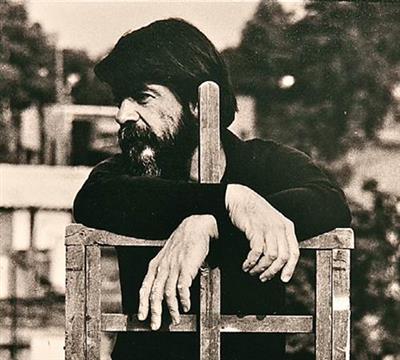
Fernando García Ponce
Fernando García Ponce was born in Mérida, Yucatán in 1933[1] and trained first as an architect before becoming one of the central figures in Mexico's Generación de la Ruptura. That generation defined itself against the social-political orthodoxy of the great muralists, Rivera, Siqueiros, and Orozco, insisting that painting could be formally rigorous and spiritually ambitious without carrying a nationalist programme.
Biography
His earliest training came from the Spanish painter Enrique Climent, who took him on as his sole student. The influence showed: García Ponce's early work absorbed analytical Cubism through Juan Gris before turning, in the late 1950s, towards Parisian Informalism and American Abstract Expressionism. What distinguished his own synthesis was the structural bias his architectural studies had instilled. He preferred geometry over organic form, structure over spontaneity, and spent his career pursuing what he called depersonalisation and the search for purity.
Works such as Natural Death (1959[1]), Painting A-63 (1963), and Horizontal Composition with Red Point (1986) trace this arc from early lyrical abstraction towards a cooler, more architectonic language. His collages were equally considered, building space through precisely placed planes rather than gestural accumulation. His brother, the novelist and critic Juan García Ponce, wrote extensively about Fernando's work, placing it within a wider argument about Mexico's artistic maturity and its right to a purely aesthetic ambition.
García Ponce died of a heart attack in Mexico City on 11 July 1987[1], aged 53. The brevity of the obituaries was in some ways a measure of how effectively the Ruptura generation had won its argument: abstract painting in Mexico had become unremarkable, which was precisely the point.
Timeline
- 1933Born in Mérida, Yucatán.
- 1950In the late 1950s, he turned towards Parisian Informalism and American Abstract Expressionism.
- 1959His early work absorbed analytical Cubism through Juan Gris. He painted "Natural Death".
- 1963He created the work "Painting A-63".
- 1986He created the work "Horizontal Composition with Red Point".
- 1987Died of a heart attack in Mexico City, aged 53.
Notable Works
Tap to view larger.
Next stop
Browse the movements →
Every movement in the collection, from the Renaissance to Pop art.
Frequently Asked Questions
How did Fernando García Ponce die?
García Ponce died of a heart attack in Mexico City on 11 July 1987[1], at the age of 53. His death occurred at a time when abstract painting in Mexico had become commonplace, reflecting the success of the Ruptura generation's arguments.What is Fernando García Ponce known for?
García Ponce is known for his role in Mexico's Generación de la Ruptura, which advocated for abstract painting free from nationalist and social-political constraints. He pursued depersonalisation and the search for purity in his art. His brother, Juan García Ponce, contextualised his work within Mexico's artistic maturity.What was Fernando García Ponce's art style?
Initially, García Ponce's art style absorbed analytical Cubism through Juan Gris, then shifted towards Parisian Informalism and American Abstract Expressionism in the late 1950s. His architectural studies influenced his preference for geometry over organic form and structure over spontaneity. His collages built space through precisely placed planes, rather than gestural accumulation.When did Fernando García Ponce die?
Fernando García Ponce died in 1987[1] at the age of 54.Who was Fernando García Ponce?
Fernando García Ponce was a central figure in Mexico's Generación de la Ruptura, a group that opposed the nationalist programmes of muralists like Rivera, Siqueiros, and Orozco. He believed that painting could be formally rigorous and spiritually ambitious without being tied to a nationalist agenda. His brother, Juan García Ponce, was a novelist and critic who wrote about his work.
Sources
Editorial draws on the following primary and tertiary references for Fernando García Ponce.
- [1] wikipedia Wikipedia: Fernando García Ponce Used for: biography, birth dates, death dates, identifiers, movement attribution, nationality.
- [2] book guggenheim-beforepicassoaft00swee Used for: biography.
- [3] book guggenheim-latinamericanpai00catl Used for: biography.
- [4] book guggenheim-twopri00weis Used for: biography.
Editorial overseen by Solis Prints. Sources verified 2026-08-31. Click a source for details, or hover over [N] in the page above to preview.
Editorial standardsMethodologyCorrectionsAI disclosureAbout the editorial team