

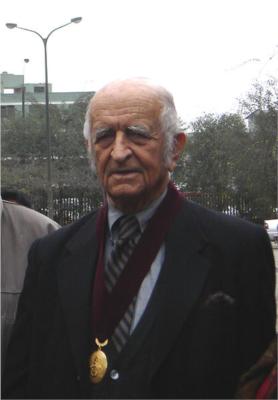
Fernando de Szyszlo
Fernando de Szyszlo Valdelomar spent seven years in postwar Europe before returning to Peru to become his country's most consequential abstract painter. Born in Lima in 1925[1] to a Polish geographer father and a Mestizo Peruvian mother, he studied plastic arts at the Pontifical Catholic University of Peru before leaving for Paris and Florence in 1948. At the Café de Flore he met Octavio Paz, André Breton, and absorbed the currents of Cubism, Surrealism, and Informalism that were reshaping Western painting.
Biography
What distinguished Szyszlo from his contemporaries was his refusal to regard abstraction as a purely European idiom. Returning to Peru in the mid-1950s, he developed a practice that drew on pre-Columbian cosmology, Andean ritual imagery, and indigenous colour, translating these references into non-representational form. Works from his long Huanacauri series take their title from a sacred mountain in Inca mythology; his encaustic on canvas Huanacauri II (1964, 62¾ × 51 in.) entered the Guggenheim collection from the Fundación Neumann in Caracas in 1966.
By the 1960s his reputation had crossed the continent. He exhibited at the Venice Biennale (1958), the Carnegie International in Pittsburgh (1958), and the Guggenheim International (1963). He taught at Cornell University in 1962 and at Yale in 1965. In his own words, his search was for "an image that reflects what it is to exist — I and my situation" — a synthesis that placed universalist formal language at the service of specifically Peruvian experience.
His work entered the permanent collections of MoMA, the Guggenheim, the Museum of Fine Arts Houston, and major Latin American institutions. He received Peru's Order of the Sun in 2011. He died in Lima on 9 October 2017, following a domestic accident at his home. He was 92.
Timeline
- 1925Born in Lima, Peru. His father was a Polish geographer, and his mother was Mestizo Peruvian.
- 1948Left for Paris and Florence to study art.
- 1950Met Octavio Paz and André Breton at the Café de Flore in Paris.
- 1958Exhibited at the Venice Biennale.
- 1958Exhibited at the Carnegie International in Pittsburgh.
- 1962Taught at Cornell University.
- 1963Exhibited at the Guggenheim International.
- 1964Created "Huanacauri II", which later entered the Guggenheim collection.
- 1965Taught at Yale University.
- 2011Received Peru's Order of the Sun.
- 2017Died in Lima, Peru, at 92, following an accident at his home.
Notable Works
Tap to view larger.
Next stop
Browse the movements →
Every movement in the collection, from the Renaissance to Pop art.
Related Artists


Frequently Asked Questions
What is Fernando de Szyszlo known for?
Fernando de Szyszlo is known for his abstract paintings that incorporate pre-Columbian cosmology, Andean ritual imagery, and indigenous colour. He translated these references into non-representational form, distinguishing him from his contemporaries. His work is held in the permanent collections of MoMA, the Guggenheim, and the Museum of Fine Arts Houston.What was Fernando de Szyszlo's art style?
Fernando de Szyszlo's art style is abstract, drawing on pre-Columbian cosmology, Andean ritual imagery, and indigenous colour. He synthesised universalist formal language with specifically Peruvian experience. Works from his long Huanacauri series take their title from a sacred mountain in Inca mythology.When was Fernando de Szyszlo born?
Fernando de Szyszlo was born in 1925[1].Who was Fernando de Szyszlo?
Fernando de Szyszlo Valdelomar was Peru's most consequential abstract painter, who spent seven years in postwar Europe before returning to his home country. Born in Lima in 1925[1], Szyszlo absorbed the currents of Cubism, Surrealism, and Informalism while in Paris and Florence. He taught at Cornell University in 1962 and at Yale in 1965.
Sources
Editorial draws on the following primary and tertiary references for Fernando de Szyszlo.
- [1] wikipedia Wikipedia: Fernando de Szyszlo Used for: biography, birth dates, death dates, identifiers, movement attribution, nationality.
- [2] book guggenheim-guggenheimintern1964allo Used for: biography.
- [3] book guggenheim-latinamericanpai00catl Used for: biography.
- [4] book guggenheim-twopri00weis Used for: biography.
Editorial overseen by Solis Prints. Sources verified 2026-08-29. Click a source for details, or hover over [N] in the page above to preview.
Editorial standardsMethodologyCorrectionsAI disclosureAbout the editorial team