



Fedir Krychevsky
Few Ukrainian painters navigated the twentieth century's violence with such precarious survival as Fedir Krychevsky. Born on 22 May 1879[1] in Lebedyn to a Jewish country doctor who had converted to Orthodox Christianity, he trained first in Moscow (graduating in 1901[1]) and then in St Petersburg (1910), before spending a year studying in Western Europe. He returned to build something unprecedented: a Ukrainian national art school.
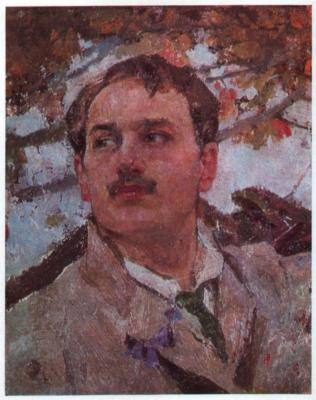
Biography
In 1914[1] he became director of the Kyiv Art School, and when the brief window of Ukrainian independence opened after 1917 he co-founded and served as rector of the Ukrainian State Academy of Arts, the first institution dedicated specifically to Ukrainian artistic identity. He had already organised the first strictly Ukrainian art exhibitions in 1911 and 1913, at a time when such cultural assertion carried political risk.
His mature style fused Secessionist formal discipline with Ukrainian folk motifs and Orthodox icon painting, producing work unlike anything produced elsewhere in the Soviet orbit. The triptych "Life" (1925[1]-29) distils his approach: three large panels treating love, achievement, and loss through flattened, hieratic figures drawn equally from Art Nouveau and traditional imagery. For three decades he was among the most significant figures in Ukrainian painting, with over a thousand works to his name.
During the Nazi occupation of Kyiv his colleagues concealed his Jewish heritage, a protection that saved him from the Babi Yar massacre of 1941[1]. Soviet authorities arrested him regardless and forced him into internal exile at Irpin. He died there on 30 July 1947[1], reportedly of starvation, kept alive in his final months only by food brought by his former student Tetyana Yablonska.
Timeline
- 1879Born in Lebedyn on 22 May to a Jewish country doctor who had converted to Orthodox Christianity.
- 1901Graduated from art school in Moscow, Russia.
- 1910Graduated from art school in St Petersburg, Russia.
- 1911Organised one of the first strictly Ukrainian art exhibitions.
- 1914Became director of the Kyiv Art School.
- 1917Co-founded the Ukrainian State Academy of Arts and served as its rector.
- 1929Completed the triptych "Life" (begun in 1925).
- 1941His Jewish heritage was concealed by colleagues during the Nazi occupation of Kyiv.
- 1947Died in Irpin on 30 July, reportedly of starvation; he was kept alive in his final months by his former student Tetyana Yablonska.
Notable Works
Tap to view larger.
Next stop
Browse the movements →
Every movement in the collection, from the Renaissance to Pop art.
Frequently Asked Questions
What is Fedir Krychevsky's most famous work?
Without more specific source material, it is difficult to name Fedir Krychevsky's single most famous work. Krychevsky was a prolific artist who worked in varied media. He produced easel works in watercolour and gouache. He designed and illustrated journals in Kiev, including *Nashe minule*, *Narodnoye khoziaystvo Ukrainy*, *Zori*, *Solntse truda*, and *Mistetstvo*. Krychevsky created illustrations and book designs, starting in his school days (for example, *The Song of Roland*, 1903[1]). Later, he designed fairy tales and fables, often using silhouette drawings. Krychevsky also designed book covers, such as Fiodor Sologub’s *Book of Partings* (1908), and Dmitry Merezhkovsky’s *Gogol: Creative Work, Life and Religion*. He designed books such as G. Lukomsky’s *Old Architecture of Galicia* (1915) and S. Troinitsky’s *Coats of Arms of the Hetmans of Small Russia* (1915). Krychevsky also produced posters, designs for stamps, banknotes, textiles, wallpaper and flyleaf papers. He took part in the decoration of the exhibition *Lomonosov and the Age of Empress Elizabeth* (1912).What should I know about Fedir Krychevsky's prints?
Fedir Krychevsky (1879[1]-1947[1]) was a Ukrainian painter and designer who produced a range of graphic works. His prints include book illustrations, bookplates, posters, and designs for stamps, banknotes, textiles, and wallpaper. Krychevsky designed and illustrated journals in Kiev, such as *Nashe minule* (*Our Past*) and *Mistetstvo* (*Art*). From his school years onward, he designed and illustrated fairy tales and fables, often using black-and-white silhouette drawings combined with colour. Examples include *The Crane and the Heron* and *The Bear* (1907[1]). He also designed many book covers, such as Fiodor Sologub’s *Book of Partings* (1908). Krychevsky created illustrations for I. Kotliarevsky’s *Aeneid* (1919) and worked on *The Ukrainian ABC* in 1917 and 1919, though neither version was completed. These works show his broad artistic interests and output in graphic art, though details of his printmaking techniques are not described in the reference passages.What style or movement did Fedir Krychevsky belong to?
Fedir Krychevsky (1879[1]-1947[1]) worked in a style that combined elements of Ukrainian folk art with modern European trends. Some art historians call this style Ukrainian modernism. He is also sometimes described as an art nouveau artist. Krychevsky's work often featured monumental forms and a decorative use of colour, drawing inspiration from Byzantine and Ukrainian icon painting. Krychevsky taught at the Ukrainian State Academy of Arts, where he encouraged students to develop their own national style, based on a combination of international trends and local traditions. He explored symbolism and national romanticism in his paintings, such as 'The Betrothed' (1910[1]) and 'Life' (1925-1927[1]), which reflected Ukrainian history and culture. Krychevsky's synthesis of different artistic influences contributed to the development of a distinct Ukrainian artistic identity during the early 20th century.What was Fedir Krychevsky known for?
Fedir Krychevsky was a painter, designer, and illustrator. He designed for journals such as *Nashe minule*, *Narodnoye khoziaystvo Ukrainy*, *Zori*, *Solntse truda*, and *Mistetstvo*. His illustration work began in his school period, with *The Song of Roland* (1903[1]) and the tales *The Brave George* (1904), *The Snow Maiden*, and *Gorshenia* (both 1906). Later, Krychevsky designed and illustrated fairy tales and fables, often using silhouette drawings in combination with colours. These included *The Crane and the Heron*, *The Bear* (1907), *The Terem*, *Mizgir* (1909), *Dance, Matthew: Don’t Spare Your Shoe* (1910), and B. Dix’s *Toys* (1911). He also designed book covers, such as Fiodor Sologub’s *Book of Partings* (1908) and Dmitry Merezhkovsky’s *Gogol: Creative Work, Life and Religion*. Krychevsky produced illustrations for I. Kotliarevsky’s *Aeneid* in 1919. In addition, he created bookplates, posters, and designs for stamps, banknotes, textiles, and wallpaper.When did Fedir Krychevsky live and work?
Fedir Krychevsky was an artist who lived and worked primarily in Ukraine during the first half of the 20th century. Krychevsky designed and illustrated journals in Kyiv, including *Nashe minule*, *Narodnoye khoziaystvo Ukrainy*, *Zori*, *Solntse truda*, and *Mistetstvo*. His initial forays into illustration and book design date back to his school days, with examples such as *The Song of Roland* (1903[1]), *The Brave George* (1904), *The Snow Maiden*, and *Gorshenia* (both 1906). He created designs and illustrations for numerous fairy tales and fables, often employing silhouette drawings in black or white combined with colours. Examples include *The Crane and the Heron*, *The Bear* (1907), *The Terem*, and *Mizgir* (1909). Krychevsky also designed book covers, such as Fiodor Sologub’s *Book of Partings* (1908) and Dmitry Merezhkovsky’s *Gogol: Creative Work, Life and Religion*.Where can I see Fedir Krychevsky's work?
Fedir Krychevsky's work is most accessible in Ukraine, although Ukrainian avant-garde art from his period is gaining recognition internationally. Galleries and museums in Ukraine are actively re-evaluating and incorporating Ukrainian artists, including Krychevsky, into both Ukrainian and European art histories. This involves a reappraisal of modernism, the avant-garde, medieval and baroque art, folk traditions, and dissident art. However, many achievements of Ukrainian artists between 1910[1] and 1930 were deliberately obscured from public view after the early 1930s. While some aspects resurfaced in the 1960s, full disclosure only became possible in the 1990s. This history is still being reconstructed, so definitive locations for viewing Krychevsky's work outside Ukraine are still developing.Who did Fedir Krychevsky influence?
Fedir Krychevsky was part of a generation of innovators who navigated tensions between new and traditional forms, and between international and national ideas. Krychevsky taught at the Ukrainian Academy of Arts (also called the Kyiv Art School or Kyiv Art Institute). Many artists were part of both "European" and "Ukrainian" art. Public awareness of the historic avant-garde has been an inspiration for many contemporary artists. In the decade after independence, many artists rejected realism and populism, because of their association with the Soviet regime. Younger artists embraced avant-gardism or turned to post-modernism. Krychevsky, along with artists such as Alexander Archipenko and Alexandre Bohomazov, has been restored to a position of prominence in Ukrainian cultural history. Others, such as Ivan Kavaleridze, Vadym Meller, and Mykhailo Boichuk, await definitive studies and recognition.Who influenced Fedir Krychevsky?
Fedir Krychevsky was influenced by a range of sources and artistic movements. The early 1900s saw many artists in Kyiv encountering the work of Mikhail Vrubel. Naum Gabo summarised Vrubel's influence on his generation as freeing 'the arts of painting and sculpture from the academic schemata'. Gabo equated Vrubel's impact to that of Cézanne in Western Europe, suggesting that even Cubism was not a complete surprise after Vrubel's innovations. Vrubel's 'broken' compositions, divided into geometric patterns, and his use of texture, produced a 'constructive' effect; this method appealed to artists such as Gabo, Rodchenko, and Tatlin. Krychevsky also appears in lists of artists associated with symbolism, futurism, and neo-Byzantinism. Krychevsky taught or was associated with the Ukranian Academy of Arts (also Kyiv Art School; Kyiv Art Institute).Who was Fedir Krychevsky?
Fedir Krychevsky (1879[1]-1947[1]) was a Ukrainian painter. He was also an influential teacher and helped to found the Ukrainian Academy of Arts in Kyiv. Krychevsky came from a large family; his father was a rural doctor. His brother Vasyl was also an artist, and designed the Ukrainian coat of arms and state seal. Krychevsky studied at the Moscow School of Painting, Sculpture and Architecture from 1901[1] to 1907. He then studied at the Academy of Arts in Saint Petersburg, from 1907 to 1910. He travelled to Paris and Italy in 1910-1911[1]. From 1914 to 1918, he was director of the Kyiv Art School. He taught at the Ukrainian Academy of Arts from 1917, and served as its rector from 1920 to 1922. Krychevsky taught at the Kyiv State Art Institute from 1922 to 1934, and at the Academy of Architecture from 1940 to 1941.How did Fedir Krychevsky die?
Fedir Krychevsky died in internal exile at Irpin on 30 July 1947[1]. The cause of death was reportedly starvation. His former student, Tetyana Yablonska, sustained him with food in his final months.What is Fedir Krychevsky known for?
Fedir Krychevsky is known for helping to establish a Ukrainian national art school. He co-founded the Ukrainian State Academy of Arts after a brief period of Ukrainian independence. Krychevsky also organised the first strictly Ukrainian art exhibitions in 1911[1] and 1913.When did Fedir Krychevsky die?
Fedir Krychevsky died in 1947[1] at the age of 68.
Sources
Editorial draws on the following primary and tertiary references for Fedir Krychevsky.
- [1] wikipedia Wikipedia: Fedir Krychevsky Used for: biography, birth dates, death dates, identifiers, movement attribution, nationality.
- [2] book Myroslav Shkandrij, Avant-Garde Art in Ukraine, 1910–1930 _ Contested Memory Used for: biography.
- [3] book Shkandrij, Myroslav, Avant-Garde Art in Ukraine, 1910–1930 _ Contested Memory Used for: biography.
- [4] book Peter. Leek, Russian Painting Used for: biography.
Editorial overseen by Solis Prints. Sources verified 2026-10-14. Click a source for details, or hover over [N] in the page above to preview.
Editorial standardsMethodologyCorrectionsAI disclosureAbout the editorial team