



Eugeniusz Zak
Eugeniusz Zak died at forty-one, leaving behind a body of work whose delicacy and strangeness were already shaping a younger generation of Polish artists. Born in 1884[1] in the Minsk Governorate to a Jewish family, he made his way to Paris by way of Munich, where he attended Anton Ažbe's private school, and then the Académie Colarossi and the École des Beaux-Arts under Jean-Léon Gérôme.
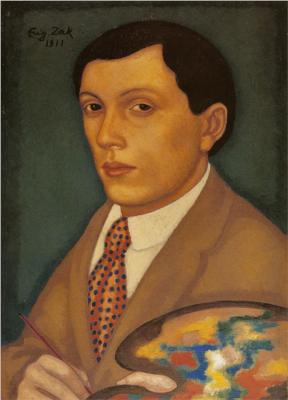
Biography
He arrived in the city at exactly the right moment. His debut at the Autumn Salon in 1904[1] brought immediate recognition, and he joined the jury just two years later. The French government purchased one of his paintings for the Musée du Luxembourg in 1910; his first solo show at Galerie Druet followed in 1911. By 1912 he was teaching at the Académie de La Palette, and the following year his work appeared at the Armory Show in New York, one of the defining exhibitions of early international modernism.
His paintings depict solitary or paired figures in dreamlike, indeterminate settings: elongated, still, with a proportion that critics noted as bearing a hermaphroditic beauty. The influence of the Nabis is clear in his use of flat areas and rhythmic line; his later work incorporated Impressionist colour. The elongations that would characterise Modigliani's mature work find an unlikely precursor here.
Zak returned to Poland in 1921[1] and co-founded the Rhythm group, gathering artists working across Post-Impressionist and Art Deco idioms. He died in Paris in January 1926[1]. His widow honoured his memory by opening the Galerie Zak, which became one of the capital's most respected galleries before its contents were looted by the Nazis during the Occupation.
Timeline
- 1884Born in the Minsk Governorate to a Jewish family.
- 1904Debuted at the Autumn Salon in Paris, achieving immediate recognition.
- 1906Joined the jury of the Autumn Salon.
- 1910The French government purchased one of his paintings for the Musée du Luxembourg.
- 1911Held his first solo show at Galerie Druet.
- 1912Began teaching at the Académie de La Palette.
- 1913His work was exhibited at the Armory Show in New York.
- 1921Returned to Poland and co-founded the Rhythm group, which gathered artists working across Post-Impressionist and Art Deco styles.
- 1926Died in Paris at 41. His widow later opened the Galerie Zak.
Notable Works
Tap to view larger.
Next stop
Browse the movements →
Every movement in the collection, from the Renaissance to Pop art.
Related Artists


Frequently Asked Questions
What is Eugeniusz Zak's most famous work?
It is difficult to identify one single work as Eugeniusz Zak's most famous. His career, though productive, was cut short by his early death. Zak's body of work includes paintings, drawings, and illustrations, and he moved through several styles. Zak is well known for his depictions of pastoral scenes and figures. These often feature a melancholic or dreamlike quality. His paintings frequently show groups of people in vaguely classical or theatrical dress, set in stylised versions of the Italian countryside. Among his notable paintings are "Shepherds in Arcadia" (circa 1918[1]), which typifies his Arcadian subjects, and "Amour pastoral". These paintings show his mature style, with elongated figures, muted colours, and a sense of gentle melancholy. Zak also produced many portraits and studies of figures, such as his "Breton Woman". These show his skill in capturing character and mood. Because Zak's style evolved during his career, and because he produced work in varied media, there is no single piece that overshadows all others. Instead, he is remembered for the overall character of his artistic output.What should I know about Eugeniusz Zak's prints?
Eugeniusz Zak (born 1884[1]; died 1926[1]) was a Polish artist who worked in France. Although not primarily known as a printmaker, Zak's artistic training and the economic realities of his time meant he engaged with printmaking, like many artists of his generation. In Polish art schools, poster design students were expected to explore various media, with painting, drawing, and printmaking all receiving significant attention. Economic factors also pushed artists towards poster design. Many painters, illustrators, and printmakers turned to poster work for income, bringing their individual artistic approaches to the medium. Printmaking and poster art became closely linked. Techniques like linocut, serigraphy, and photo-offset were used in both areas. By the 1970s, a tendency to sign posters grew as artists sought to express their individuality. When considering Zak's prints, it's important to understand the context of printmaking in Poland and more broadly, the status of "original" prints. The Professional Art Dealers Association of Canada defines an original print as an image conceived and executed solely as a print, usually in a numbered edition and signed by the artist. Each print is considered an original, and there is no single "original" from which copies are made.What style or movement did Eugeniusz Zak belong to?
Eugeniusz Zak's artistic style is often associated with a blend of Symbolism, Post-Impressionism, and what is sometimes called the School of Paris. Zak's mature works often present a dreamlike or melancholic atmosphere. During the late 19th and early 20th centuries, many artists moved away from strict academic traditions. They began exploring more subjective, emotional, and decorative approaches. Symbolism, for example, explored mythical and dreamlike themes. Post-Impressionism included varied personal styles reacting against Impressionism's naturalism. Artists associated with the School of Paris came from various countries; they contributed to a diverse artistic environment in Paris. Zak's paintings often feature stylised figures, muted colours, and a sense of gentle melancholy. These elements align with Symbolist and Post-Impressionist aesthetics. His connection to the Parisian art scene further situates him within this broad artistic context of early 20th-century modernism.What techniques or materials did Eugeniusz Zak use?
Eugeniusz Zak's artistic practice involved diverse media. He is known to have worked in oil paint, watercolour, drawing, and printmaking. Zak's paintings often feature a distinctive colour palette. Earth tones, muted blues, and soft pinks are common. His application of paint varies; some works display smooth, blended surfaces, while others show visible brushstrokes. In his drawings, Zak employed media such as charcoal, crayon, and pencil. These works often served as studies for larger compositions. They also stand alone as finished pieces. Zak also explored printmaking techniques, including etching and lithography. His prints allowed for wider distribution of his imagery. They also provided an opportunity to experiment with line and texture. These prints often echo the themes and figures found in his paintings and drawings. Zak's choices of technique and material were varied, suiting his aesthetic aims.What was Eugeniusz Zak known for?
Eugeniusz Zak (born 1884[1], died 1926[1]) was a Polish artist, associated with the École de Paris. He is known for his paintings, drawings, and illustrations. Zak's artistic style incorporated elements of Symbolism, Art Nouveau, and Classicism. His works often featured melancholic figures in pastoral settings. These figures, frequently depicted with elongated limbs and wistful expressions, evoke a sense of nostalgia and longing. Zak's colour palettes often included muted tones, which further contributed to the dreamy atmosphere of his compositions. He drew inspiration from Italian Commedia dell’Arte for his theatrical, often stylised, figures. Zak's career was relatively short; however, he achieved international recognition during his lifetime. His works were exhibited in Paris, Barcelona, Berlin, and other European cities. Zak's art remains popular, and his pieces are held in museum collections worldwide.When did Eugeniusz Zak live and work?
Eugeniusz Zak (born December 13, 1884[1]; died January 15, 1926[1]) was a Polish artist, associated with the École de Paris. His career spanned a short but productive period during the early 20th century. Zak was born in Mogielnica, Poland. He studied in Paris at the École des Beaux-Arts under Jean-Léon Gérôme. He also attended the Académie Colarossi. Zak debuted at the Salon d'Automne in 1904[1] and exhibited regularly at the Salon des Indépendants. Zak's early work shows the influence of Symbolism, but he later developed a more personal style, drawing inspiration from classicism and the Italian Renaissance. He is known for his depictions of pastoral scenes, often featuring figures in theatrical poses. Zak lived and worked primarily in Paris, but he also spent time in Brittany and Italy. He taught at the Académie de la Palette. Zak's work gained recognition during his lifetime, and he participated in numerous exhibitions throughout Europe. He died in Paris at the age of 41.Where can I see Eugeniusz Zak's work?
Eugeniusz Zak's work can be viewed in several museums in Europe and North America. In the United States, these include the Charles Hosmer Morse Museum of American Art (Winter Park, Florida), the Los Angeles County Museum of Art (Los Angeles), the Metropolitan Museum of Art (New York), the Minneapolis Institute of Arts, the Museum of Modern Art (New York), the Virginia Museum of Fine Arts (Richmond), and the Wolfsonian at Florida International University (Miami Beach). In Canada, his work can be seen at the Royal Ontario Museum in Toronto. In the United Kingdom, museums with relevant holdings are the Brighton Museum & Art Gallery, the Geffrye Museum (London), the Manchester Art Gallery, the National Museums of Scotland (Edinburgh), the Victoria & Albert Museum (London), and the Towneley Hall Art Gallery (Burnley, Lancashire). Other European museums include the Museu Calouste Gulbenkian (Lisbon), the Museo Art Nouveau y Art Déco (Salamanca, Spain), the Musée d’Art et d’Industrie (Roubaix, France), and the Musée de l’Ecole de Nancy (France).Where was Eugeniusz Zak from?
Eugeniusz Zak was born in Mogilno, Russian Poland, in 1884[1]. This town is near Krzemieniec, now part of Ukraine. His family was Jewish. Zak spent his childhood in Warsaw. He studied at the School of Fine Arts in Warsaw. Later, he went to Paris, where he attended the École des Beaux-Arts. His instructors included Jean-Léon Gérôme. Zak also studied at the Académie Colarossi in Paris. Zak lived in Paris for much of his career. He also travelled and worked in other locations. These included Brittany, Italy, and Poland. Zak died in Paris in 1926[1], at only 42 years old. He is considered a Polish artist, although he spent much of his life outside Poland. His early death cut short a promising career.Who did Eugeniusz Zak influence?
It is difficult to specify exactly who Eugeniusz Zak influenced. However, some information can be gleaned from analysis of the period and location in which he worked. Zak's work can be situated within a broader context of early twentieth-century European art, where artists often drew inspiration from various sources and movements. Artists in Russia, for example, encountered the avant-garde in different ways; some through exhibitions of American and French art held in Moscow in the early 1960s, others through private collections. The romanticisation of American painting led to the formation of artist groups interested in that culture. Abstract Expressionism was perceived as both a national and universal embodiment of personal and political integrity, much like French modernist painting before the revolution. This appreciation of Western art also applies to contemporary artists, where adaptation to international trends has led to marginalisation, rather than recognition of the specific conditions and value of their practices.Who influenced Eugeniusz Zak?
It is difficult to summarise the influences on Eugeniusz Zak. Looking at other artists, one could consider Mark Rothko, whose work has been described as having a transcendental approach. Rothko's paintings, with their floating rectangles, possess a meditative quality that some find magical and mysterious. The artist himself related his work to music, particularly Mozart. Music, since the nineteenth century, has been a significant influence on pictorial creativity. Rothko created a special art, and it is believed he will be important for centuries. However, another artist, when asked if he was influenced by Rothko, stated that his interest only paralleled Rothko's. He admired Rothko's seriousness, but found Barnett Newman more interesting because his work was less pretty. He felt Rothko's paintings were too holy and decorative, used for decorative purposes and overly beautiful in collectors' apartments.Who was Eugeniusz Zak?
Eugeniusz Zak (born 1884[1]) was a Polish artist, associated with early 20th-century schools and movements, including symbolism, expressionism, and art nouveau. He is known for his diverse artistic style, which fused modern European trends with his own cultural background. Zak was born in Mogilno, Poland, and he later moved to Paris, where he became part of the artistic community in Montparnasse. Zak's work often featured melancholic figures, pierrots, and pastoral scenes, rendered in muted colours and a distinctive, stylised manner. He exhibited widely in Europe, gaining recognition for his unique aesthetic and contributions to modern art. Zak died relatively young, in 1926[1], but his output remains significant. He is remembered as an important figure in the development of Polish modernism.Why are Eugeniusz Zak's works important today?
Eugeniusz Zak, a Polish artist who died in 1926[1], is now appreciated for his unique contribution to early 20th-century art. Zak's works often depict melancholic figures in idyllic settings, reflecting a sense of longing and nostalgia. His style blends elements of Symbolism, Art Nouveau, and early modernism, creating a distinctive aesthetic. Zak's importance lies in his ability to capture the mood of his time, a period of great social and political upheaval. His art provides insight into the cultural anxieties and aspirations of the early 20th century. Moreover, Zak's work is admired for its technical skill and artistic innovation. He experimented with different media and techniques, pushing the boundaries of traditional painting. His distinctive use of colour and form continues to inspire artists today. Zak's art offers a window into a world of beauty and contemplation, which resonates with contemporary audiences.
Sources
Editorial draws on the following primary and tertiary references for Eugeniusz Zak.
- [1] wikipedia Wikipedia: Eugeniusz Zak Used for: biography, birth dates, death dates, identifiers, movement attribution, nationality.
- [2] book Gurianova, Nina, Aesthetics of Anarchy Used for: biography.
- [3] book guggenheim-guhe00solo Used for: biography.
- [4] book Landauer, Susan, The not-so-still life : a century of California painting and sculpture Used for: biography.
Editorial overseen by Solis Prints. Sources verified 2026-08-29. Click a source for details, or hover over [N] in the page above to preview.
Editorial standardsMethodologyCorrectionsAI disclosureAbout the editorial team