



Eugene Lanceray
Eugene Lanceray was born into an artistic dynasty so extensive it reads like a roster of Russian cultural life. His father was the sculptor Eugeny Alexandrovich Lanceray; his grandfather the architect Nicholas Benois; his uncles the architects Leon Benois and the Mir iskusstva co-founder Alexandre Benois; his sister the painter Zinaida Serebriakova. He trained first in St Petersburg, then at the Académie Colarossi and the Académie Julian in Paris between 1896[1] and 1899, returning to Russia fully formed as a graphic artist and illustrator.
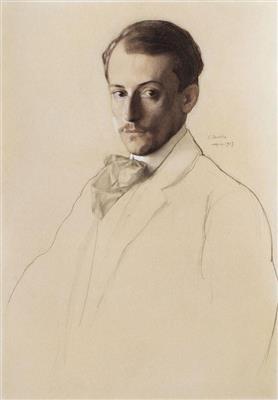
Biography
As a member of Mir iskusstva (World of Art), he contributed to the movement's journal and shared its preoccupation with 18th-century Russian history, the decorative arts, and Rococo aesthetics. His graphic work for book illustration and theatrical design was technically meticulous and consistently beautiful, rooted in historical research rather than invention.
His decision to remain in Russia after 1917[1] distinguished him from most of his Mir iskusstva colleagues, many of whom emigrated. He spent years in Dagestan and then in Tbilisi, teaching at the State Academy of Arts until 1934, before returning to Moscow. The Soviet state gave him room to work: the murals he produced for Moscow's Kazansky railway station between 1932 and 1946[1] are among his most ambitious achievements, large-scale historical compositions executed over more than a decade.
Named People's Artist of the RSFSR in 1945[1] and a Stalin Prize recipient, Lanceray navigated the Soviet cultural machine without surrendering the historical precision that had always defined his work. He died in Moscow in September 1946[1], a month after his seventy-first birthday.
Timeline
- 1875Born into an artistic family. His father was the sculptor Eugeny Alexandrovich Lanceray; his grandfather the architect Nicholas Benois; his uncles the architects Leon Benois and Alexandre Benois; his sister the painter Zinaida Serebriakova.
- 1896Began studies at the Académie Colarossi and the Académie Julian in Paris.
- 1899Returned to Russia, having trained in St Petersburg and Paris, as a graphic artist and illustrator.
- 1900Became a member of Mir iskusstva (World of Art), contributing to the movement's journal.
- 1917Decided to remain in Russia after the revolution.
- 1932Began work on murals for Moscow's Kazansky railway station.
- 1934Returned to Moscow after spending years in Dagestan and Tbilisi, where he taught at the State Academy of Arts.
- 1945Named People's Artist of the RSFSR.
- 1946Died in Moscow in September, aged 71. He had been working on murals for Moscow's Kazansky railway station since 1932.
Notable Works
Tap to view larger.
Next stop
Browse the movements →
Every movement in the collection, from the Renaissance to Pop art.
Frequently Asked Questions
How did Eugene Lanceray die?
Eugene Lanceray died in Moscow in September 1946[1], a month after his seventy-first birthday.What is Eugene Lanceray known for?
Eugene Lanceray is known for his graphic work in book illustration and theatrical design, which was technically meticulous and rooted in historical research. He is also known for his large-scale historical compositions, such as the murals he produced for Moscow's Kazansky railway station between 1932[1] and 1946[1]. He was named People's Artist of the RSFSR in 1945 and a Stalin Prize recipient.What was Eugene Lanceray's art style?
Lanceray's art style was characterised by technical meticulousness and historical precision. His work reflected a preoccupation with 18th-century Russian history, the decorative arts, and Rococo aesthetics, aligning with the artistic interests of the Mir iskusstva movement. His approach was rooted in historical research rather than invention.When did Eugene Lanceray die?
Eugene Lanceray died in 1946[1] at the age of 71.Who was Eugene Lanceray?
Eugene Lanceray was a Russian graphic artist and illustrator, born into a family of prominent artists and architects. He was a member of Mir iskusstva (World of Art) and known for his contributions to book illustration and theatrical design. He also taught at the State Academy of Arts in Tbilisi before returning to Moscow.
Sources
Editorial draws on the following primary and tertiary references for Eugene Lanceray.
- [1] wikipedia Wikipedia: Eugene Lanceray Used for: biography, birth dates, death dates, identifiers, movement attribution, nationality.
- [2] book Brodskaya Nathalia, Brodskaya Nathalia - Symbolism Used for: biography.
- [3] book Jennifer D. Milam, Historical Dictionary of Rococo Art Used for: biography.
- [4] book Masterpieces of western art : a history of art in 900 individual studies from the Gothic to the present day Used for: biography.
Editorial overseen by Solis Prints. Sources verified 2026-09-23. Click a source for details, or hover over [N] in the page above to preview.
Editorial standardsMethodologyCorrectionsAI disclosureAbout the editorial team