

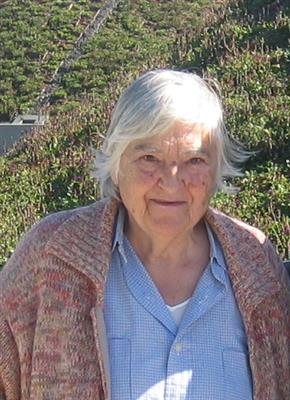
Etel Adnan
Etel Adnan came to painting because she refused to illustrate her Arabic poetry with French script. Born in Beirut in 1925[1] to a Syrian-Turkish father and a Greek Orthodox mother from Smyrna, she grew up speaking Greek, Turkish, and Arabic before French became the language in which she wrote. The solution to this linguistic impasse was to stop writing altogether and paint instead, a decision that eventually produced one of the most distinctive bodies of work in contemporary Arab art.
Biography
She studied French literature in Beirut, then philosophy at the Sorbonne, followed by postgraduate work at UC Berkeley and Harvard. Her literary career ran parallel to her visual practice: the novel Sitt Marie Rose (1982) brought her international recognition, and her poetry collection Time won the 2020 Griffin Prize. Yet it was her paintings and leporello books (accordion-fold works combining abstract image and text) that drew the attention of major institutions in her final decade.
Adnan applied oil paint directly from tubes, building dense, jewel-toned compositions in which landscape and abstraction press against each other. The Lebanese mountains recur throughout her work, alongside the Mediterranean light she carried into exile. She lived in Paris and California for much of her adult life.
International gallery recognition came remarkably late: documenta 13 in 2012, the Whitney Biennial in 2014, and MoMA's 2017 exhibition Making Space all arrived when she was in her late eighties. France made her Chevalier des Arts et des Lettres in 2014. She died in Paris in 2021 at the age of ninety-six, having spent the last years of her life among the most sought-after artists in the world.
Timeline
- 1925Born in Beirut to a Syrian-Turkish father and a Greek Orthodox mother from Smyrna.
- 1982Her novel, "Sitt Marie Rose", gained international recognition.
- 2012Work was exhibited at documenta 13.
- 2014Work was exhibited at the Whitney Biennial.
- 2014Became Chevalier des Arts et des Lettres in France.
- 2017Work was included in MoMA's exhibition "Making Space".
- 2020Her poetry collection "Time" won the Griffin Prize.
- 2021Died in Paris at the age of ninety-six.
Notable Works
Tap to view larger.
Next stop
Browse the movements →
Every movement in the collection, from the Renaissance to Pop art.
Related Artists


Frequently Asked Questions
What is Etel Adnan's most famous work?
Although Etel Adnan (1925[1]-2021) worked in several media, she is best known for her small, intensely coloured abstract paintings. These works often depict simplified forms, particularly mountains, and reflect her interest in colour theory and the natural world. Adnan's paintings gained wider recognition in the later part of her career. One painting that has become particularly associated with her is "Mount Tamalpais". This work, and others in the series, represents the California mountain near her home. She repeatedly depicted this subject in various colours and compositions, exploring its form and presence. These paintings are not precise depictions; instead, they capture the essence of the mountain through blocks of colour and bold lines. While "Mount Tamalpais" is a recurring theme, it is difficult to identify a single "most famous" work. Her paintings, as a whole, have contributed significantly to her reputation. Her artistic approach, combining abstraction and observation, has resonated with audiences and critics alike.What should I know about Etel Adnan's prints?
Etel Adnan (1925[1]-2021) was a Lebanese-American poet, essayist, and visual artist. While she worked in several media, she is particularly known for her paintings and prints. Adnan began making prints later in her career, adapting her established painting style. These prints often feature blocks of flat, intense colour arranged in geometric forms. This style is related to her interest in representing landscapes, particularly the light and colour of the natural world. Her paintings and prints share a similar aesthetic, with simplified shapes and bold hues. Although based in Paris for many years, Adnan maintained a strong connection to the Middle East. This is reflected in her work through her use of Arabic script in some pieces, and through her exploration of themes related to identity, memory, and place. Her prints, like her other works, often evoke a sense of place and atmosphere through colour and form. They offer a distilled representation of her artistic vision, making them accessible to a wider audience.What style or movement did Etel Adnan belong to?
It is difficult to assign Etel Adnan to a single artistic movement. Her practice resists easy categorisation. Some have linked her work to abstract expressionism, given her gestural brushwork and non-representational forms. This connection is based on the energetic application of paint and the focus on conveying emotion through colour and composition, rather than depicting recognisable subjects. Others see affinities with post-impressionism, particularly in her use of colour and simplified forms to capture the essence of a scene. This is evident in her paintings of Mount Tamalpais, where she repeatedly depicted the mountain using blocks of colour and bold outlines. Ultimately, Adnan's style is uniquely her own, drawing on various influences but remaining independent of any specific movement. Her work blends abstraction with elements of observation and personal expression.What techniques or materials did Etel Adnan use?
Etel Adnan worked across several media, including painting, drawing, and writing. She is perhaps best known for her small-format, abstract paintings using palette knives to apply oil paint to canvas. These works often feature blocks of colour, evoking natural forms. Adnan also created drawings in ink and watercolour. Her style in these works is similarly abstract, with an emphasis on line and colour. In addition to her visual art, Adnan was a celebrated poet and novelist, and language was important to her practice. She produced numerous artist's books, sometimes combining her writing and visual art. Adnan's materials were relatively simple: oil paint, canvas, ink, paper, and occasionally watercolour. However, her approach to these materials was distinctive, characterised by bold colour and simplified forms. She often worked on a small scale, creating intimate works that invite close viewing.What was Etel Adnan known for?
Etel Adnan (1925[1]-2021) was a Lebanese-American poet, essayist, and visual artist. Although she wrote in French, English, and Arabic, she is perhaps best recognised for her paintings. Adnan's paintings often feature blocks of flat colour applied with a palette knife. Many of these works depict Mount Tamalpais, in California. She began painting in the 1960s, while teaching philosophy in the United States. In addition to her paintings, Adnan created drawings, prints, and ceramics. She also designed numerous artist's books, sometimes incorporating her own writing. One example is *Journey to Mount Tamalpais* (1986), a combination of image and text. She is also known for her woven works, which she referred to as "leporellos". These portable screens combine her interests in colour and form.When did Etel Adnan live and work?
Etel Adnan was born in 1925[1] in Beirut, Lebanon, and died in Paris in 2021. Adnan was a Lebanese-American poet, essayist, and visual artist. She was raised in Beirut, then part of French-mandated Syria, and educated in French schools. In 1949, she travelled to Paris where she studied philosophy at the Sorbonne. She continued her postgraduate studies at the University of California, Berkeley, and at Harvard University. From 1958 to 1972, she taught philosophy at State University of New York at Geneseo. During this time, she began to paint, in response to her feelings about the Algerian War. Adnan returned to Lebanon and worked as a cultural editor for two daily newspapers, *Al Safa* and *L’Orient le Jour*. She lived in Beirut until 1976, when she moved to California. She resided in Paris from the 1980s until her death.Where can I see Etel Adnan's work?
Etel Adnan's work can be seen in many public collections and museums internationally. These include the Solomon R. Guggenheim Museum in New York, the Musée National d’Art Moderne, Centre Georges Pompidou, in Paris, and the Museum am Ostwall in Dortmund. Other locations include the San Francisco Museum of Art, the City Art Museum of St Louis, the Krannert Art Museum at the University of Illinois, and the Columbus Gallery of Fine Arts. Her art is also held in the collections of the National Gallery of Canada, Ottawa, the Albright-Knox Gallery, Buffalo, and the Arts Club of Chicago. In Europe, her work appears at the Aarhus Kunstmuseum (Denmark), the Amos Andersonin Taidemuseo (Helsinki), and the Arkiv for Dekorativ Konst (Lund, Sweden). Further afield, you can find Adnan's pieces at the Cincinnati Art Museum and the Cleveland Museum of Art, as well as the Fondation Maeght in Saint-Paul de Vence, France.Where was Etel Adnan from?
Without more specific biographical information, it's difficult to pinpoint Etel Adnan's precise place of origin. Some sources discuss the challenges of assigning nationality to artists, particularly within movements like Surrealism. The focus was often on individuality and universal human feeling, rather than national identity. As one critic noted, artists should not be defined by "local fashions, customs, ideas and visions" because "art has no homeland, no territory". However, correspondence between artists and writers in locations such as Beirut, Cairo, London, and Paris suggests a network of artistic exchange across different countries. Further research into Adnan's early life and artistic development would be needed to determine her specific place of origin and how it might have influenced her work.Who did Etel Adnan influence?
Etel Adnan's direct artistic influence is not extensively documented. However, some connections can be drawn through her engagement with colour, form, and abstraction, particularly in relation to earlier figures and later movements. Matisse is a useful reference point. Some critics suggest Matisse's work had an impact on American abstract painting through its materiality, its construction, and its "musical" control of coloured surfaces. Artists such as Robert Motherwell, Richard Diebenkorn, Frank Stella, and Tom Wesselmann are cited as examples of those who absorbed elements from Matisse's approach. Diebenkorn's Ocean Park series, for instance, is seen to echo aspects of Matisse's work from 1912-1917[1]. More generally, the interplay between decoration and abstraction, explored by artists such as Miriam Schapiro, offers another avenue for considering Adnan's position within a broader artistic conversation. The subversion of traditional painting techniques, as seen in the "Support-surface" group, also provides a context for understanding Adnan's experimental approach to materials and form.Who influenced Etel Adnan?
Etel Adnan's artistic development involved several influences. She was born in Beirut in 1925[1]. She studied philosophy in Paris and the United States. Her early writing was often political. Adnan's shift to visual art occurred in the 1950s, as she moved away from explicit political commentary. Living in California, the bright light and open spaces affected her. She began to paint, initially using pure colour. Paul Klee was an important influence. Adnan saw a Klee exhibition in the 1960s. She admired his use of colour and his ability to evoke emotion through simple forms. She also studied Japanese art, particularly the folding screen format. This inspired her to create her leporellos, accordion-folded books filled with drawings and writings. Though abstract, her paintings often suggest natural forms, especially mountains. Mount Tamalpais, north of San Francisco, was a frequent subject. Her work is characterised by flat planes of colour, applied with a palette knife. These elements combine to create a distinctive style that merges abstraction with elements from the natural world.Why are Etel Adnan's works important today?
Etel Adnan (1925[1]-2021) was a Lebanese-American poet, essayist, and visual artist. Although she began painting in the 1950s, her work gained wider recognition later in her life. This increased visibility has cemented her place in the contemporary art world. Adnan is particularly known for her abstract paintings, often featuring bold blocks of colour and strong geometric forms. These works, frequently small in scale, evoke a sense of place, particularly the light and atmosphere of the Mediterranean and California. She also created drawings, prints, and artist's books. Her leporellos (accordion-fold books) combine visual art and Arabic calligraphy. Adnan's diverse cultural background, encompassing Lebanon, France, and the United States, informs her artistic practice. Her writings often explore themes of displacement, memory, and identity. Her paintings offer a visual counterpart to these literary explorations. Interest in Adnan's art has grown since her inclusion in Documenta 13 (2012) and her retrospective at Mathaf: Arab Museum of Modern Art, Doha (2014). Her art is appreciated for its distinctive aesthetic and its engagement with complex cultural and political issues.What is Etel Adnan known for?
Adnan is known for her paintings, poetry, and leporello books, which combine abstract imagery with text. Her novel Sitt Marie Rose (1982) brought her international recognition, and her poetry collection Time won the 2020 Griffin Prize.
Sources
Editorial draws on the following primary and tertiary references for Etel Adnan.
- [1] wikipedia Wikipedia: Etel Adnan Used for: biography, birth dates, death dates, identifiers, movement attribution, nationality.
- [2] book guggenheim-guggenheimintern1964allo Used for: biography.
- [3] book guggenheim-transfsi00wald Used for: biography.
- [4] book guggenheim-twopri00weis Used for: biography.
Editorial overseen by Solis Prints. Sources verified 2026-10-16. Click a source for details, or hover over [N] in the page above to preview.
Editorial standardsMethodologyCorrectionsAI disclosureAbout the editorial team