



Ernst Wilhelm Nay
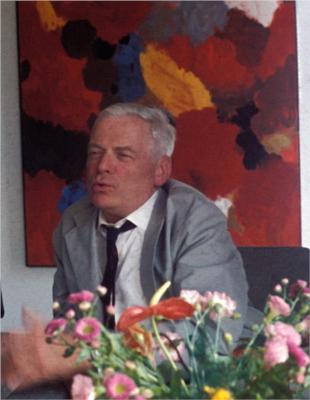
Ernst Wilhelm Nay spent much of his career navigating between the demands of historical catastrophe and the internal logic of colour. Born on 11 June 1902[3] in Berlin, he studied under Karl Hofer at the Berliner Hochschule für Bildende Künste, and in 1931[3] a grant from the Prussian Academy took him to Paris, where early contact with Picasso's circle left a lasting mark.
Biography
The Nazi regime labelled his work degenerate in 1937[3], removing his paintings from German museums. He continued working, but with the enforced isolation of a painter outside official culture. A posting to Brittany as a military map-maker during the war nonetheless produced some of his most lyrical canvases, capturing local light with a freedom that official doctrine would have forbidden.
After 1945[3], Nay's abstraction became more systematic. His career divided into recognisable phases: the mythological Hecate paintings of the late 1940s gave way in the 1950s to the Scheibenbilder, compositions dominated by overlapping disc forms that treated colour relationships with near-scientific rigour. Werner Haftmann's 1960 monograph established him as a central figure of European postwar abstraction, and he exhibited at documenta I, II, and III in Kassel as well as at the 1956 Venice Biennale.
His first American solo show came in 1955[3]. Late works, including the Augenbilder and the organic formations of 1965-68, continued the dialogue with colour theory he had been conducting for four decades. He died in Cologne on 8 April 1968[3], leaving a body of work that took another two decades of retrospectives to fully absorb.
Timeline
- 1902Born in Berlin on 11 June.
- 1931Received a grant from the Prussian Academy that took him to Paris; contact with Picasso's circle influenced him.
- 1937His work was labelled degenerate by the Nazi regime, and his paintings were removed from German museums.
- 1945After the war, Nay's abstraction became more systematic.
- 1950Created the Hecate paintings in the late 1940s, followed by the Scheibenbilder in the 1950s.
- 1955Had his first American solo show.
- 1956Exhibited at the Venice Biennale.
- 1960Werner Haftmann's monograph established him as a central figure of European postwar abstraction.
- 1968Died in Cologne on 8 April.
Notable Works
Tap to view larger.
Where to See Ernst Wilhelm Nay
1 museum worldwide.
-
 2 works
Harvard Art Museums
Cambridge, United States
Tue–Sun 10:00–17:00, closed Mondays · Free
Next stop
Browse the movements →
Every movement in the collection, from the Renaissance to Pop art.
Related Artists


Frequently Asked Questions
What is Ernst Wilhelm Nay known for?
Ernst Wilhelm Nay is known as an important representative of abstract painting in post-war Germany. His career divided into recognisable phases, such as the Hecate paintings and the Scheibenbilder.What is Ernst Wilhelm Nay's most famous work?
Ernst Wilhelm Nay (1902[3]-1968[3]) is known as an important figure in post-war German abstract painting. He moved away from figurative subjects, such as still lifes and mythological themes, over three decades. By the mid-1950s, he had abandoned representational motifs entirely, focusing on abstract painting. For Nay, painting meant 'forming a picture with colour'. His abstractions do not contain coded messages; they exist as painting for its own sake. The colour and material quality of the paint are the most important formal elements. One example is Yellow Chromatic (1964[3]). The title suggests that the colour fields, daubs, and circle segments relate to harmony. Colour and form exist in tension, creating contrasts and harmonies. Expressive motion generates a sense of space.What should I know about Ernst Wilhelm Nay's prints?
Ernst Wilhelm Nay (1902[3]-1968[3]) was a German artist known for his contributions to abstraction after the Second World War. Lists of monographs and catalogues raisonnés of graphic works do not include one for Nay. However, many general texts on 20th-century prints include him. Prints became more popular in Germany after 1919[3], due to hyperinflation. As currency values crashed, art became a secure investment. Prints, being more affordable than paintings or sculptures, were accessible to a wider population. Some collectors bartered goods for prints. The multiple-image format of portfolios allowed artists to explore complex themes. Publishers produced deluxe and popular editions to accommodate different budgets. Before World War I, print runs typically numbered between ten and forty. Afterwards, editions rose to at least forty or fifty, sometimes reaching one hundred or more. Some artists, like Kirchner, preferred to print their own work to maintain quality control, resulting in smaller, less uniform editions. Other artists collaborated with professional printers for larger, more consistent editions. Critics saw the woodcut as a German art form, rooted in the past, that distinguished them from other nations.What style or movement did Ernst Wilhelm Nay belong to?
Ernst Wilhelm Nay (1902[3]-1968[3]) is regarded as a significant figure in post-war German abstract painting. His artistic journey involved a gradual move away from figurative subjects, such as still lifes and mythological themes. By the mid-1950s, he had abandoned representational motifs completely, embracing purely abstract painting. Nay himself stated that, for him, 'Painting means forming a picture with colour'. Nay's abstract works do not contain hidden meanings. Instead, they focus on painting as an end in itself. The colouristic and material qualities of the paint are of utmost importance. His works often explore the relationship between colour and form, creating a sense of space through expressive movement. Some classify Nay as an artist of Art Informel, a European counterpart to American Abstract Expressionism. Both movements share an interest in non-geometric form and improvisation.What techniques or materials did Ernst Wilhelm Nay use?
Ernst Wilhelm Nay explored a range of materials and methods in his artistic practice. He is known to have worked with oil paint on transparent plastic sheets, such as rhodoid, in the 1930s and 1940s. Nay addressed the technical challenges of using these new materials, such as the risk of the colours peeling off. To combat this, he scratched numerous fine lines into the plastic surface to provide a key for the oil paint. He would then apply the paint, allowing it to be held within the crevices. In some works, Nay painted on both sides of the plastic sheet. This technique allowed him to create spatial effects through the relationships between colours and the real distance between them. He also experimented with different brush techniques to produce unusual textures. At times, instead of applying a solid layer of colour, he rubbed it into the engraved lines. This approach created what he called "vibrating colour effects", and an iridescence similar to that found in ancient glass.What was Ernst Wilhelm Nay known for?
Ernst Wilhelm Nay (1902[3]-1968[3]) was a German painter and printmaker, associated with abstract art. He is best known for his series of "Disk" paintings and later work using pure colour. Nay began his artistic training in the 1920s, studying under Karl Hofer at the Berlin Academy. Early works were figurative, influenced by Expressionism. During World War II, Nay was drafted into the German army, serving until 1945[3]. Despite the war, he continued to produce art. After the war, Nay's style shifted towards abstraction. He developed his "Disk" image, featuring circular forms and geometric shapes. These paintings established his reputation. In the 1950s, Nay's work became more gestural and colourful. He experimented with colour theory, exploring the relationships between different hues. Nay's later paintings are characterised by their use of bold, unmodulated colour fields. These works demonstrate his interest in the expressive potential of colour itself. He received numerous awards and his work was exhibited internationally.When did Ernst Wilhelm Nay live and work?
Ernst Wilhelm Nay (1902[3]-1968[3]) was a German painter and printmaker. He is associated with German Informel art. Nay was born in Berlin. He studied under Karl Hofer at the Berlin Academy of Arts from 1925[3] to 1928. During the 1930s, he was aligned with Expressionism. Edvard Munch encouraged Nay to concentrate on watercolour painting during a trip to Norway in 1937. His work was classified as "degenerate" by the Nazi regime. He was forbidden to exhibit and was drafted into military service in 1940, though he was able to continue painting. After the Second World War, Nay moved away from representational painting. He developed his own abstract style, characterised by arrangements of coloured discs and bars. These works established his international reputation. He participated in the first three Documenta exhibitions in Kassel (1955, 1959, 1964). He also represented Germany at the Venice Biennale in 1956. Nay lived and worked in Cologne and later moved to near Cologne in 1964, where he died in 1968.Where can I see Ernst Wilhelm Nay's work?
Ernst Wilhelm Nay's work can be found in numerous museum collections, primarily in Germany. Several institutions in Berlin hold examples of his art. These include the Brucke Museum, the Nationalgalerie, the Bauhaus Archive, the Brohan Museum, and the Kunstgewerbe (Museum of Decorative Arts). Other German cities with museums holding Nay's work are Bremen (Kunsthalle and Sammlung Bottcherstrasse), Cologne (Ludwig Museum and Wallraf-Richartz Museum), Essen (Folkwang Museum and Gesellschaft Kruppsche Gemaldesammlung), Hamburg (Kunsthalle and Museum für Kunst und Gewerbe), Hanover (Niedersachsisches Landesmuseum), Mannheim (Stadtische Kunsthalle), Munich (Bayerische Staatsgemaldesammlungen), Seebtill (Stiftung Ada und Emil Nolde), Karlsruhe (Museum beim Markt), and Wuppertal (Von der Heydt Museum). Outside of Germany, Nay's art can be seen at the MAK Austrian Museum of Applied Art/Contemporary Art in Vienna, Austria.Who did Ernst Wilhelm Nay influence?
Ernst Wilhelm Nay's impact on other artists is complex. He taught at the Hochschule für Bildende Künste in Hamburg from 1956[3] to 1963. During this time, he influenced a generation of German painters interested in abstraction. Nay's move towards pure colour and form, particularly evident in his "Eye Pictures" series (Augenbilder), offered a model for artists seeking to move beyond representational art. His theories about colour relationships and the expressive potential of abstract shapes provided a framework that others could adapt. Peter Brüning is one artist who engaged with similar approaches to colour. However, Nay's influence is not always direct. Many artists working in the post-war period were grappling with similar issues of abstraction and expression. Therefore, while Nay's work certainly contributed to the artistic discourse of his time, it is difficult to isolate specific individuals who directly emulated his style. His significance lies more in his contribution to the broader movement of abstract art in Germany.Who influenced Ernst Wilhelm Nay?
Ernst Wilhelm Nay, a German practitioner of Art Informel, had several influences. During his studies in West Berlin, Georg Baselitz, a fellow student, explored the theories of artists such as Vasily Kandinsky and Kazimir Malevich, both early 20th-century pioneers of abstract art, as well as Nay. After the war, West Berlin, isolated from Western Europe, saw a distrust of established artistic norms among younger artists. During the 1950s, Art Informel and Tachisme were the prevailing aesthetics, and Existentialism was a motivating philosophy. Baselitz experimented with Art Informel and Tachisme and was influenced by Antonin Artaud, a Surrealist poet and dramatist. Nay developed a colour system based on disk forms covering the canvas. He disregarded optical theories of colour, as well as the theory of colour as described in his 1955[3] book, Vom Gestaltwert der Farbe, Flasche, Zahl und Klavierauszug.Who was Ernst Wilhelm Nay?
Ernst Wilhelm Nay (1902[3]-1968[3]) was a German artist associated with several movements, including Expressionism and Art Informel. Born in Berlin, Nay initially pursued a career in commerce before dedicating himself to painting. He studied under Karl Hofer at the Berlin Academy of Arts from 1925[3] to 1928. His early work was figurative, but he gradually moved toward abstraction. During the Nazi era, Nay's art was condemned as degenerate, and he was forbidden to exhibit. Despite this, he continued to paint in secret. After World War II, Nay's reputation grew, and he became one of the most important figures in postwar German art. His mature style is characterised by the use of bold colour and geometric forms. He represented Germany at the Venice Biennale in 1956 and at documenta in 1955, 1959, and 1964.Why are Ernst Wilhelm Nay's works important today?
Ernst Wilhelm Nay (1902[3]-1968[3]) was a German artist associated with Art Informel. His work gained importance in West Germany during the post-war period. Allied administrators and German museum officials promoted abstract art to suppress nationalistic themes, forms, and styles that the Nazis had previously exploited. Nay's expressive abstraction, along with that of ZEN49 and Emil Schumacher, helped to enforce a prohibition on specifically German subject matter. After World War II, many German artists embraced international styles, abstraction becoming a symbol of freedom and de-Nazification. Nay developed a colour system based on disk forms covering the canvas. His theories, detailed in his 1955[3] book *Vom Gestaltwert der Farbe, Flasche, Zahl und Hythmus*, influenced Georg Baselitz. Nay's work is significant as part of a broader movement toward abstraction in post-war Germany, which rejected representational traditions linked to both Nazism and Soviet Realism.
Sources
Editorial draws on the following primary and tertiary references for Ernst Wilhelm Nay.
- [1] museum Harvard Art Museums Used for: museum holdings.
- [2] museum Victoria and Albert Museum Used for: museum holdings.
- [3] wikipedia Wikipedia: Ernst Wilhelm Nay Used for: biography, birth dates, death dates, identifiers, movement attribution, nationality.
- [4] book guggenheim-baselitz00wald Used for: biography.
- [5] book guggenheim-guhe00solo Used for: biography.
- [6] book guggenheim-refigur00kren Used for: biography.
- [7] book Masterpieces of western art : a history of art in 900 individual studies from the Gothic to the present day Used for: stylistic analysis.
Editorial overseen by Solis Prints. Sources verified 2026-09-22. Click a source for details, or hover over [N] in the page above to preview.
Editorial standardsMethodologyCorrectionsAI disclosureAbout the editorial team