



Ernest Hébert
Few French painters of the nineteenth century were more firmly embedded in the official system than Ernest Hébert, and fewer were as quietly subversive within it. Born in Grenoble on 3 November 1817[1], he won the Prix de Rome in 1839[1] with his composition depicting Joseph's cup found in Benjamin's sack, and spent the following years in Italy, where the light and suffering of rural life around Rome became his defining subject.
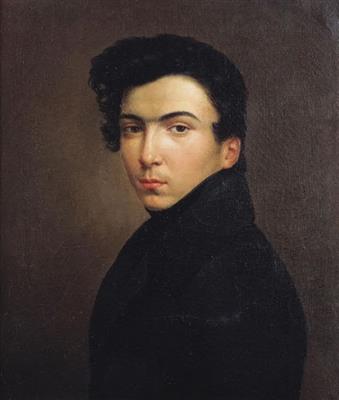
Biography
His most celebrated canvas, "Mal'aria" (1848[1]-49), now at the Musée d'Orsay, shows two young women in a boat on a stagnant pool, one feverish, one supporting her. The title names the disease, but the painting's power lies in its stillness: the damp air, the immobility of the water, the muted palette. It is academic painting used against its own tendency toward the heroic.
Hébert served twice as Director of the French Academy in Rome, in 1867[1] and again in 1885, a distinction that placed him at the institutional heart of French art for half a century. He also completed a mosaic for the apse of the Panthéon in Paris. A museum in his name opened near Grenoble and a second in the 6th arrondissement of Paris, where many of his portraits and subject paintings remain. He died on 5 December 1908[1], aged 91.
Timeline
- 1817Born in Grenoble on 3 November.
- 1839Won the Prix de Rome with his composition depicting Joseph's cup found in Benjamin's sack.
- 1848Painted "Mal'aria", which depicts two young women in a boat on a stagnant pool.
- 1849Completed "Mal'aria".
- 1867Became Director of the French Academy in Rome.
- 1885Served a second term as Director of the French Academy in Rome.
- 1908Died on 5 December, aged 91.
Notable Works
Tap to view larger.
Next stop
Browse the movements →
Every movement in the collection, from the Renaissance to Pop art.
Related Artists


Frequently Asked Questions
What is Ernest Hébert known for?
Ernest Hébert is known for his paintings of rural life around Rome, particularly his celebrated canvas, "Mal'aria". He also completed a mosaic for the apse of the Panthéon in Paris.What is Ernest Hébert's most famous work?
It is difficult to name one single work as Ernest Hébert's most famous. He was a prolific painter with a career spanning several decades. However, some of his more recognised pieces include 'La Malaria', depicting a mother and child in the Roman Campagna, and 'Les Cervarolles', showing women from Cervara, Italy. Hébert's work often focused on Italian peasant life and classical themes. He gained considerable recognition during his lifetime, holding positions such as director of the French Academy in Rome. His paintings can be found in many major museums, including the Musée d'Orsay in Paris. While it is challenging to pinpoint one definitive masterpiece, his body of work has secured his place in 19th-century French art.What should I know about Ernest Hébert's prints?
When considering Ernest Hébert's prints, it is helpful to understand some basic print terminology: a 'vintage print' was made around the time the negative was created. A 'period print' followed within ten to fifteen years. Anything printed later is termed an 'old print', 'modern print', or 'contemporary print'. An 'original print' was made by the artist or under their direct supervision. A 'facsimile' is a later re-creation using the same methods as the original where possible. Original prints are often produced by hand using techniques such as woodcut, engraving, linocut, etching, or lithography. The artist creates the artwork directly on the plate, block or screen. Each print is considered an original. Offset reproductions are made using photochemical processes; giclée prints are a later development using inkjet technology. 'Canvas transfers' involve transferring the image onto canvas to resemble a painting. The market decides what is artistic. The print market often refers to the 'unique print'. Printing can be a difficult operation, sometimes involving chemical treatments. Some photographers consider each photo unique.What style or movement did Ernest Hébert belong to?
Ernest Hébert (1817[1]-1908[1]) was a French academic painter. He is associated with the artistic style of Romanticism; later in his career, his work showed influences of Naturalism. Hébert studied at the École des Beaux-Arts in Paris, and won the Prix de Rome in 1839[1]. This prize enabled him to study at the French Academy in Rome, where he lived for many years. Italy and its people often appeared in his art. His style is characterised by its attention to detail, realistic figures, and often sentimental or nostalgic themes. Hébert's paintings often depicted Italian peasants, religious scenes, and portraits. He achieved considerable success during his lifetime, receiving many official honours. He also held positions such as director of the École des Beaux-Arts.What was Ernest Hébert known for?
Ernest Hébert (1817[1]-1908[1]) was a French academic painter. He is best known for portraits and genre scenes, often featuring Italian peasants. Hébert studied at the École des Beaux-Arts in Paris under Paul Delaroche. He won the Prix de Rome in 1839[1], which allowed him to study at the French Academy in Rome for five years. This Italian sojourn had a strong effect on his artistic style and subject matter. His paintings often present romanticised views of rural life, particularly in Italy. These works gained popularity with the French public. He also held several important positions in the French art establishment, including director of the French Academy in Rome from 1866 to 1873 and again from 1885 to 1891. Interestingly, the artist was caricatured as "M. Hébert" in a painting by Alfred Jarry, a student in Rennes from 1888 to 1891. Jarry's painting depicts Hébert as pompous and stolid, with droopy eyes and a bulbous nose.When did Ernest Hébert live and work?
Ernest Hébert (1817[1]-1908[1]) was a French academic painter. In 1839[1], a painter named A.-A.-E. Hébert won first prize; it is likely that this was Ernest Hébert. The Galerie du Luxembourg was established as a museum for living French artists in 1818. Works were kept there for only five to ten years after the artist's death; then they would enter the Louvre or a suitable provincial museum. The rule was irregularly applied, with many works remaining in the Luxembourg collection long after the death of more famous artists. The remaining pictures from the collection were dispersed in 1937. The July Revolution forced the abdication of Charles X in 1830. Louis-Philippe of Orleans was elected King. Salons were held annually from 1831.Where can I see Ernest Hébert's work?
Paintings by Ernest Hébert can be viewed in museums in France. These include the Musée d’Orsay, the Musée du Louvre, the Musée des Arts Decoratifs, the Musée National d’Art Moderne (Centre Georges Pompidou), the Musée du Petit Palais, and the Musée Gustave Moreau; all of which are located in Paris. Outside Paris, Hébert's work can be seen at the Musée des Beaux-Arts in Nantes, the Musée Fabre in Montpellier, the Musée des Beaux-Arts in Dijon, the Musée des Beaux-Arts in Rennes, the Musée des Beaux-Arts in Rouen, and the Musée de Peinture et de Sculpture in Grenoble. Other locations include the Musée Crozatier in Le Puy, the Musée des Beaux-Arts Jules Cheret in Nice, and the Musée des Augustins in Toulouse.Where was Ernest Hébert from?
Ernest Hébert was French. Étienne Aubry, a painter known for his scenes of daily life, was from Versailles. He trained in Paris under Jacques-Augustin Silvestre and Joseph-Marie Vien. Aubry was admitted to the Académie Royale de Peinture et de Sculpture as a portrait painter in 1775. Jean-Antoine Houdon, a neoclassical sculptor, was also born in Versailles. He studied at the Royal Academy in Paris and won the prix de Rome in 1761. He went to Italy in 1764 and stayed for four years to study classical art. Jean Aubert was a French architect and interior designer. He designed the stables at Chantilly for Louis-Henri de Bourbon, Prince de Condé. He also designed interiors for the Petit Château at Chantilly and the Hôtel Peyrenc de Moras in Paris, which is now the Musée Rodin. Nicolas Robert was born in Paris on 22 May 1733.Who did Ernest Hébert influence?
It is difficult to identify specific artists directly influenced by Ernest Hébert. Influence is a complex phenomenon; as the poet Charles Baudelaire wrote, "The imitator’s imitator finds his own imitators." Some theorists suggest originality is "the unique intersection of multiple influences, a combination that one and only one artist can accomplish." While direct connections are elusive, the artistic environment Hébert inhabited provides context. During the 19th century, the concept of artistic originality shifted. Independent artists challenged academic norms, with some atelier masters, such as Charles Gleyre and Thomas Couture, promoting new methods. Couture, who did not belong to the Academy, encouraged students to work rapidly and spontaneously. His most famous pupil was Édouard Manet, who absorbed Couture’s unconventional attitudes to light, shade, and handling. Therefore, while Hébert's specific influence may be undocumented, he was part of a milieu that valued individual expression, which affected many artists.Who was Ernest Hébert?
Alfred Jarry (1873[1]-1907[1]) was a French author and painter. Although he is known for his paintings, he is best known as the author of the play *Ubu Roi* (1896). The play is based on Jarry's school days in Rennes, from 1888 to 1891; it caricatures one of his teachers there, a M. Hébert. An early Jarry painting, entitled *M. Hébert, professeur de physique* (circa 1888-91), depicts M. Hébert as an epitome of pomposity. From 1891 to 1893, Jarry studied at the École Normale Supérieure in Paris. He socialised with the Symbolists and visited the literary salons of Stéphane Mallarmé. In 1894, in partnership with Remy de Gourmont, he published an art periodical with lavish illustrations, *L'Imagier*, which attracted the attention of such artists as Henri Rousseau. Jarry's works, with their blasphemous intent, influenced Guillaume Apollinaire, André Breton, and Antonin Artaud and had an impact on twentieth-century movements such as Dada and Surrealism, as well as the theatre of the absurd.What was Ernest Hébert's art style?
Ernest Hébert's painting style is academic, but with a subversive element. His painting "Mal'aria" demonstrates this, as it uses academic techniques to depict a scene of stillness and suffering, rather than heroism.
Sources
Editorial draws on the following primary and tertiary references for Ernest Hébert.
- [1] wikipedia Wikipedia: Ernest Hébert Used for: biography, birth dates, death dates, identifiers, movement attribution, nationality.
- [2] book Harding, James, Artistes pompiers : French academic art in the 19th century Used for: biography.
- [3] book Allison Lee Palmer, Historical Dictionary of Neoclassical Art and Architecture Used for: biography.
- [4] book Ross King, The Judgment of Paris Used for: stylistic analysis.
Editorial overseen by Solis Prints. Sources verified 2026-10-14. Click a source for details, or hover over [N] in the page above to preview.
Editorial standardsMethodologyCorrectionsAI disclosureAbout the editorial team