



Epsylon Point
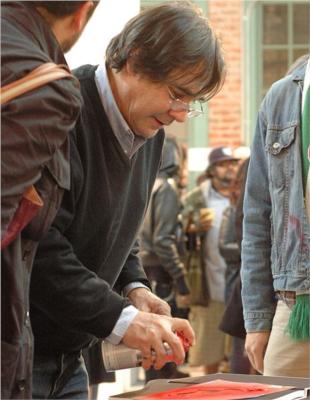
When Epsylon Point took over the Balard district of Paris's 15th arrondissement with stencils in 1983, few people outside a small community of urban artists had any sense of what the technique could become. Working alongside his friend LaSigne, he developed a method for layering colour through cut paper stencils onto walls, arriving at something technically distinct from the tag-based graffiti that dominated the scene. He is now credited as the pioneer of colour stencilling in France, a lineage that runs directly through to some of the most recognisable street art of the following decades.

Biography
Born in 1950[1], he trained at the Beaux-Arts in Dijon, graduating in 1979, and spent the first years of his career as a photographer and performer. The encounter with spray paint came through performance work rather than vandalism, and the shift to walls was almost immediate. Between 1979 and 1985 he worked across Paris, and in 1985 participated in the first organised gathering of the French[1] graffiti and urban art movement in Bondy.
In the early 1990s he moved to Turin, where he trained a new generation of street artists in stencil techniques. His influence over that period was practical as much as symbolic: he was teaching the method, not just demonstrating it. He returned to France at the end of the decade and has exhibited regularly since 2000. The stencil artist C215 has described him as a 'living legend of street art in France.'
Timeline
- 1950Born in France.
- 1979Graduated from the Beaux-Arts in Dijon, France, aged 29.
- 1979Began his career as a photographer and performer.
- 1983Started using stencils in the Balard district of Paris's 15th arrondissement.
- 1985Participated in the first organised gathering of the French graffiti and urban art movement in Bondy, France.
- 1990Moved to Turin, Italy, to train street artists in stencil techniques.
- 2000Returned to France and began exhibiting regularly.
Notable Works
Tap to view larger.
Next stop
Browse the movements →
Every movement in the collection, from the Renaissance to Pop art.
Related Artists


Frequently Asked Questions
What is Epsylon Point known for?
Epsylon Point is known for developing a method for layering colour through cut paper stencils onto walls. This was technically distinct from the tag-based graffiti that dominated the scene at the time.What should I know about Epsylon Point's prints?
Epsylon Point is a digital artist creating work that often explores themes of technology, futurism, and abstraction. Prints by Epsylon Point are produced using modern digital methods. This allows for a high level of detail and colour accuracy. Many of the artist's prints are available in limited editions. This means that only a certain number of prints are produced, potentially increasing their collectability. The artist uses archival inks and high-quality papers. These materials ensure the prints resist fading and damage over time. When purchasing an Epsylon Point print, consider the edition size, the paper type, and the ink used. These factors affect the print's value and longevity. Also, be aware of the print's dimensions to ensure it fits your desired display space. Digital art prints offer a way to engage with contemporary artistic practices. They also allow collectors to acquire pieces at various price points.What techniques or materials did Epsylon Point use?
Epsylon Point, like other printmakers, likely employed varied materials and techniques to produce different effects. These include drypoint, woodcut, and lithography. Drypoint etching uses a metal needle to create points and lines on a smooth copper plate. Colour is applied to the entire plate, then wiped off, leaving colour in the etched marks. The plate is pressed powerfully onto paper, fusing colour and paper. Woodcut involves a metal tool and a wood plate. The point is created by encircling it, like a fortress, and the colour is rolled onto the surface. The pressure of the press is light, so the point sits on, not in, the paper. Lithography uses a stone or clay plate. Colour can be applied loosely, compactly, by stippling, or by spraying, depending on its consistency. Texture possibilities are important, even in the limited field of the point. Accumulations of points can be created directly by hand or by mechanical means, such as spray techniques.What was Epsylon Point known for?
Epsylon Point is the name used by the French[1] digital artist and musician known as Mathieu W Schmidt. He is best known for his work in digital collage, often incorporating elements of science fiction, psychedelia, and surrealism. Schmidt's Epsylon Point projects frequently combine visual and aural elements. He has produced album art and promotional materials for musicians in the electronic music scene. His work often appears on record sleeves and in music videos. His style is characterised by dense layering and manipulation of images. These images are often sourced from disparate locations. Schmidt then assembles them into unified, dreamlike compositions. The finished works often evoke a sense of altered perception. They also display a strong interest in technology and its effects on the human mind. Schmidt's art has been exhibited in galleries and festivals internationally. He continues to produce work that pushes the boundaries of digital art.When did Epsylon Point live and work?
Epsylon Point is a contemporary digital artist. They are known for their work with generative algorithms. These algorithms produce abstract, geometric patterns. Their art exists primarily as non-fungible tokens (NFTs) on the blockchain. Because Epsylon Point is a digital artist working with new technologies, information about their life and career appears mainly in online spaces, such as NFT marketplaces and crypto-art publications, rather than in traditional art-historical sources. This makes a conventional biography difficult to assemble. Epsylon Point's emergence as an artist coincides with the rise of NFTs. This took place around 2021. Their work is associated with platforms such as Art Blocks. These platforms allow artists to create and sell generative art directly to collectors. Epsylon Point continues to produce and distribute art through these channels.Where can I see Epsylon Point's work?
Epsylon Point is a digital artist who publishes primarily online. As such, their work is widely accessible through various virtual platforms. The primary location to view Epsylon Point's creations is their official website, which acts as a comprehensive archive of their projects. Additionally, their work is often featured on online art communities and social media platforms, such as ArtStation, DeviantArt, Instagram, and Twitter. These platforms allow for easy discovery and engagement with their art. Occasionally, Epsylon Point's digital art has been included in new media exhibitions or festivals that explore the intersection of art and technology. These events often take place in major cultural centres and offer a physical space to experience digital artworks alongside other forms of contemporary art. To find out about these events, it is best to follow the artist's online presence, or to check the listings for major media-art galleries.Where was Epsylon Point from?
Sylvain Dubuisson, who sometimes publishes as Epsylon Point, was born in 1946 in Bordeaux, France. He studied architecture at the Saint Luke School of Architecture in Tournai, Belgium. After school, he worked in the engineering offices of Ove Arup in London for several years before turning to design. Dubuisson's work often consists of single pieces or small series with literary references. He is fascinated by lighting and creates lamps with sophisticated mechanisms that tell a story. Dubuisson also incorporates new materials into his work, such as carbon fibre, and adapts his research to industrial and manufacturing constraints. He has been commissioned by numerous companies and has designed furniture, tea sets, urban furniture, and liturgical objects. Dubuisson's work has been exhibited in museums and galleries internationally, including the Axis Gallery in Tokyo and the National Museum of Modern Art in Seoul.Who did Epsylon Point influence?
It is difficult to pinpoint specific artists who were directly influenced by Epsylon Point, as their work exists primarily in the digital realm. Their influence is more readily seen in the broader areas of digital art and design. Epsylon Point's manipulation of 3D software and digital painting techniques has certainly affected a generation of artists working with similar tools. Their work has contributed to a greater acceptance of digital methods within fine art. Many younger artists are now comfortable using software that, in the past, might have been seen as belonging only to commercial design. The use of abstract forms and unusual perspectives in Epsylon Point's pieces can be seen echoed in the work of artists who explore similar themes of technology, perception, and the human condition. While not a direct, one-to-one influence, their art has helped to shape the aesthetics of contemporary digital art. The prevalence of online art communities means that these influences are often diffused and hard to trace to a single source.Who influenced Epsylon Point?
Epsylon Point's influences are diverse, drawing from various artistic movements and individual artists. Henri Matisse influenced many artists who bypassed abstract expressionism by adopting his surface-oriented figurative style. Pupils of Matisse, such as Patrick Henry Bruce and Arthur Burdett Frost, moved towards abstraction and the use of pure colour after studying with him. At Black Mountain College, the Bauhaus artists, including Kandinsky, Klee, Schwitters, and Albers, had an impact. Later, John Cage and Merce Cunningham introduced Dada influences, primarily affecting Robert Rauschenberg's work. Despite the prevalence of abstract expressionism, with figures like Gorky, Pollock, Rothko and Newman, Noland was drawn to Paul Klee, whose colourism, Cubism, and proto-Surrealist imagery captured his imagination. Klee's approach to abstraction, reducing natural phenomena to fundamental elements, and his use of colour to convey mood resonated with Noland. Later, Jackson Pollock's active paint handling also influenced Noland's artistic development.Who was Epsylon Point?
Epsylon Point is a contemporary digital artist. They are known for creating mathematically derived artworks, often using algorithms and complex computer code. Their work explores themes of geometry, structure, and the interplay between order and chaos. Epsylon Point's artistic practice involves writing custom software to generate visual forms. These forms are frequently presented as high-resolution prints, animations, and interactive installations. The artist manipulates parameters within their code to produce a wide range of aesthetic outcomes. These outcomes range from minimalist geometric patterns to more elaborate, organic-seeming compositions. Their work has been exhibited in galleries and festivals internationally. Epsylon Point's art appeals to audiences interested in the intersection of art, science, and technology. Their pieces invite viewers to contemplate the underlying mathematical principles that govern the visual world.Why are Epsylon Point's works important today?
Epsylon Point is a contemporary digital artist whose work explores themes of technology, identity, and the human condition in the 21st century. His art is important because it provides a commentary on our increasingly digital world. His pieces often incorporate elements of glitch art and abstraction; these techniques reflect the fragmented and complex nature of modern life. Epsylon Point's art prompts viewers to consider the impact of technology on their own lives and on society as a whole. Furthermore, his work is accessible to a wide audience due to its digital nature. It can be easily shared and viewed online, allowing for a global conversation about the issues he raises. As technology continues to advance and shape our world, Epsylon Point's artistic explorations become ever more relevant. His work offers a valuable perspective on the challenges and opportunities presented by our rapidly changing technological environment.When was Epsylon Point born?
Epsylon Point was born in 1950[1].
Sources
Editorial draws on the following primary and tertiary references for Epsylon Point.
- [1] wikipedia Wikipedia: Epsylon Point Used for: biography, birth dates, death dates, identifiers, movement attribution, nationality.
- [2] book guggenheim-joanmif00solo Used for: biography.
- [3] book guggenheim-twopri00weis Used for: biography.
- [4] book Post-impressionism : cross-currents in European painting Used for: biography.
- [5] book Anfam, David A;Callen, Anthea. Techniques of the impressionists, Techniques of the great masters of art Used for: biography.
- [6] book The Editors of New York Magazine, The Encyclopedia of New York Used for: stylistic analysis.
Editorial overseen by Solis Prints. Sources verified 2026-10-16. Click a source for details, or hover over [N] in the page above to preview.
Editorial standardsMethodologyCorrectionsAI disclosureAbout the editorial team