



EMILIO MORTINI
Emilio Mortini announced himself to the international art world in 1994 at a group exhibition at the Red Grooms City gallery in New York, then aged 21. Within a year he had held his first solo show at the Judson Gallery in the same city, and between 1995 and 1997 he completed nearly 500 works: a rate of production that signalled not restlessness but a systematic exploration of what materials could do when placed in conversation with each other.
Biography
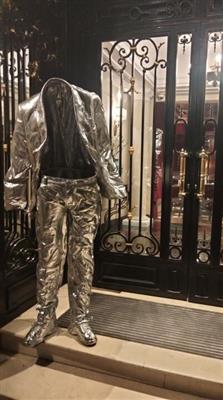
Born on 4 August 1972[1] in Neuilly-sur-Seine to a Franco-Italian family, Mortini works primarily as a sculptor, though his practice ranges across painting and mixed media. His signature approach pits the industrial against the classical: resin and aluminium alongside marble, stone, and bronze, contrasting textures and densities that carry very different cultural weights. Where one material speaks of manufacture, the other speaks of antiquity, and Mortini locates meaning in that friction.
His work found a Parisian platform at the Marwan Hoss gallery near Place Vendôme, and he has participated in the FIAC in Paris and the Monaco Art Exhibition. Unlike artists whose careers consolidate around a single signature gesture, Mortini's practice has remained deliberately heterogeneous, moving between figuration and abstraction, mass-produced finish and hand-worked surface.
Timeline
- 1972Born in Neuilly-sur-Seine, France, on 4 August, to a Franco-Italian family.
- 1994At 21, Mortini's work was shown at a group exhibition at the Red Grooms City gallery in New York.
- 1995Held his first solo show at the Judson Gallery in New York.
- 1995Between 1995 and 1997, he completed nearly 500 works.
- 1995Began working primarily as a sculptor, also working in painting and mixed media.
- 1995Developed a signature style contrasting industrial and classical materials such as resin, aluminium, marble, stone, and bronze.
- 1995His work was exhibited at the Marwan Hoss gallery near Place Vendôme, Paris.
- 1995Participated in the FIAC in Paris.
- 1995Participated in the Monaco Art Exhibition.
Notable Works
Tap to view larger.
Next stop
Browse the movements →
Every movement in the collection, from the Renaissance to Pop art.
Related Artists


Frequently Asked Questions
What is EMILIO MORTINI known for?
Emilio Mortini is known for contrasting the industrial with the classical in his art. He uses materials such as resin and aluminium alongside marble, stone, and bronze. He locates meaning in the friction between manufacture and antiquity.Who was EMILIO MORTINI?
Emilio Mortini is a sculptor, painter, and mixed media artist who was born in Neuilly-sur-Seine in 1972[1]. He announced himself to the international art world in 1994 at a group exhibition at the Red Grooms City gallery in New York. He works primarily as a sculptor, though his practice ranges across painting and mixed media.What was EMILIO MORTINI's art style?
Unlike artists whose careers consolidate around a single signature gesture, Emilio Mortini's practice has remained deliberately heterogeneous. He moves between figuration and abstraction, mass-produced finish and hand-worked surface. He explores what materials can do when placed in conversation with each other.When was EMILIO MORTINI born?
EMILIO MORTINI was born in 1972[1].
Sources
Editorial draws on the following primary and tertiary references for EMILIO MORTINI.
- [1] wikipedia Wikipedia: EMILIO MORTINI Used for: biography, birth dates, death dates, identifiers, movement attribution, nationality.
- [2] book guggenheim-peggygu00alle Used for: biography.
- [3] book Braun, Emily, 1957-; Asor Rosa, Alberto; Royal Academy of Arts (Great Britain), Italian art in the 20th century : painting and sculpture, 1900-1988 Used for: biography.
- [4] book Masterpieces of western art : a history of art in 900 individual studies from the Gothic to the present day Used for: biography.
- [5] book 1892-1968, Panofsky, Erwin,, Tomb sculpture: four lectures on its changing aspects from ancient Egypt to Bernini Used for: biography, stylistic analysis.
Editorial overseen by Solis Prints. Sources verified 2026-08-31. Click a source for details, or hover over [N] in the page above to preview.
Editorial standardsMethodologyCorrectionsAI disclosureAbout the editorial team