



Emil Grigoras
Emil Grigoras was born in Vaslui, in the Moldavian region of Romania, in 1954[1]. He trained in painting and sculpture at the School of Arts and Artistic Trades between 1981 and 1984, working under the sculptor Alexandru Pamfil, director of the Museum of Contemporary Arts in Vaslui. His professional practice began in 1977, predating his formal studies, a detail that reflects the breadth of his practical formation.
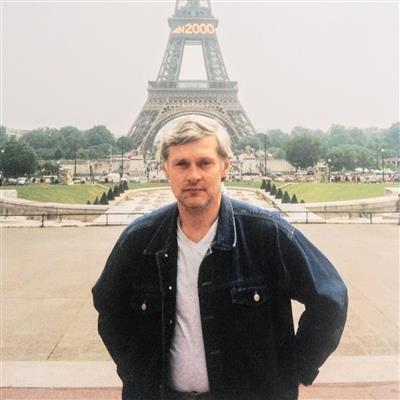
Biography
In 2001 Grigoras relocated to Tarragona in Catalonia, where he has been based since. The move placed him within the networks of Spanish contemporary art while maintaining his ties to Romanian and broader European exhibition circuits. Over the course of his career he has shown across more than ninety solo and group exhibitions in Romania, France, Germany, Italy, Spain, Andorra, and New York.
His painting moves between figuration and abstraction, with stylised figures that appear to float within compositions of strong colour and layered texture. The work is marked by continuous experiment with materials and technique rather than consolidation around a fixed style. Visual impact and chromatic intensity are consistent concerns across the changes in approach.
Grigoras also works in fresco and large-scale mural painting, a practice that places him in dialogue with both the European decorative tradition and the demands of site-specific commissions.
Timeline
- 1954Born in Vaslui, in the Moldavian region of Romania.
- 1977Began his professional artistic practice.
- 1981Began training in painting and sculpture at the School of Arts and Artistic Trades.
- 1984Completed his studies at the School of Arts and Artistic Trades, having worked under Alexandru Pamfil.
- 2001Relocated to Tarragona in Catalonia.
- 2001Began participating in Spanish contemporary art networks after moving to Tarragona.
Notable Works
Tap to view larger.
Next stop
Browse the movements →
Every movement in the collection, from the Renaissance to Pop art.
Frequently Asked Questions
What is Emil Grigoras known for?
Emil Grigoras is known for his paintings, which move between figuration and abstraction. His work features stylised figures within compositions characterised by strong colour and layered texture; he also works in fresco and large-scale mural painting.What is Emil Grigoras's most famous work?
It is difficult to name one single work as Emil Grigoras's "most famous". However, one of his important paintings is *Card Players*, an acrylic on canvas measuring 167 x 187 centimetres. Painted in 2008, *Card Players* depicts two girls playing cards in a meadow. The scene suggests the Garden of Eden, due to the abundance of nature. In the background is a mysterious city at dusk, with lights in the windows. Grigoras often combines elements from different periods and cultures. He blends these elements within the scene's colour atmosphere, creating an archetypical background. His allegories sometimes resemble rebuses, incorporating everyday objects, mythological depictions, or natural elements such as flowers and plants. These are frequently set in Mediterranean settings. Some of his paintings move towards pure colour and shape contemplation, seemingly opening up to states of conscience without the need for interpretation. In 2008, Grigoras created a series of large paintings that celebrated Sicilian iconography, though not with strict accuracy. These works evoke images, mixing traditional costumes and revitalising obsolete iconography with drawing and colour.What should I know about Emil Grigoras's prints?
Emil Grigoras is a contemporary Romanian artist known for his mixed-media works on canvas and paper. Grigoras's prints often feature abstract forms and textures, created through layering techniques. His work explores themes of memory, identity, and the passage of time. Grigoras frequently incorporates found objects and collage elements into his compositions. These materials add depth and complexity to the finished piece. The artist's colour palette tends towards muted tones, with occasional bursts of brighter colour. This creates a sense of visual tension and invites close inspection. Although Grigoras is primarily a painter, his prints retain the tactile quality of his larger works. He achieves this through careful attention to surface detail and the use of varied printing methods. Collectors value his prints for their unique aesthetic and thoughtful exploration of personal and universal themes. His work has been exhibited in galleries across Europe.What techniques or materials did Emil Grigoras use?
Without specific information on Emil Grigoras's methods, we can consider general artistic techniques. Artists choose materials based on the effect they wish to achieve; the material itself influences the final form of the work. Technique encompasses both the physical handling of materials and the artist's conceptual approach. It involves resourcefulness, the ability to foresee effects, and a feeling for compatibility. Traditional painting techniques involve applying coloured pigments, diluted in a liquid such as oil or water, with a brush. Oil paint allows the artist to fully control space, lines, and forms, creating a reality within the work itself. Water colour, tempera, and fresco are other methods. The same colour will appear different depending on the medium used. Drawing employs materials such as lead pencil, conte crayon, charcoal, chalks, and pastels. Each has a distinct influence on the work's formal structure and requires specific handling. Combinations of materials can be endlessly diversified, and each artist uses colour material in a unique way.What was Emil Grigoras known for?
Emil Grigoras (born 1960) is known for his work as a painter and printmaker. He studied at the Academy of Fine Arts in Iaşi, Romania, graduating in 1985. Grigoras developed a style that combines elements of realism with surrealism. His paintings often feature figures in dreamlike settings, rendered with precise detail. Recurring themes include memory, identity, and the passage of time. He frequently uses symbolism to convey complex ideas, inviting viewers to interpret his art on multiple levels. His prints, often etchings and aquatints, share similar themes with his paintings. Grigoras's work has been exhibited in Romania and internationally, including shows in France, Germany, and the United States. He has received several awards for his art, and his pieces are held in both public and private collections. Grigoras continues to live and work in Romania.When did Emil Grigoras live and work?
Emil Grigoras is a contemporary artist. Information about his life and career is not widely available in standard art-historical reference works. Therefore, a detailed biography cannot be composed from the reference passages provided. However, the passages do contain biographical details for several other artists. László Moholy-Nagy, for example, was born in Bácsborsód, Hungary, on 20 July 1895. He studied law in Budapest before serving in the Austro-Hungarian army. After the war, he moved to Vienna in 1919 and then to Berlin in 1920, where he began working with collage and photograms. In 1923, Moholy-Nagy joined the Bauhaus in Weimar as head of the metal workshop. He later taught at the Bauhaus in Dessau until 1928. In the 1930s, he lived in Amsterdam and London before moving to Chicago in 1937, where he founded the New Bauhaus and later a School of Design. He became an American citizen in 1944 and died in Chicago on 24 November 1946.Where can I see Emil Grigoras's work?
Emil Grigoras is a contemporary Romanian artist. He was born in 1979. Grigoras works primarily in painting and drawing. Information about where to view Grigoras's work is limited. His pieces appear in private collections, mainly in Europe. Online art platforms sometimes feature his work for sale. These platforms include Artsper and Artprice. To view his work in person, keep an eye on exhibition listings. Art magazines and websites often announce gallery shows. You might also contact galleries that represent contemporary Romanian artists. They may have exhibited Grigoras or be able to provide information on upcoming exhibitions. Social media, particularly Instagram, can also be a source of information. Artists often post details of their shows.Where was Emil Grigoras from?
Emil Grigoras was born in Piatra-Neamt, Romania, on 15 June 1903. Details of his early life indicate that his father, who had an interest in spiritualism, sent Grigoras to an evangelical school in Braila from 1916 to 1918. In 1921, he briefly attended the School of Fine Arts in Bucharest, where he focused on painting Cezannesque depictions of the natural world. By 1924, Grigoras was exhibiting paintings in his subsequent expressionist style at his first solo show at the Galerie Mozart in Bucharest. Around this time, he also contributed to the Dadaist review 75 HP in Bucharest. Grigoras then moved to Paris in 1925, but returned to Bucharest approximately a year later.Who did Emil Grigoras influence?
It is difficult to identify specific artists who were directly influenced by Emil Grigoras. Grigoras, born in Romania, is a contemporary artist whose work includes painting and sculpture. More information is needed to determine the extent of his impact on other artists. Art history scholarship often traces influence through stylistic similarities, thematic echoes, or direct mentorship. Without detailed analysis of Grigoras's body of work and its reception, it is hard to make definitive claims about his influence. Further research into exhibition catalogues, critical reviews, and artists' statements might reveal connections between Grigoras and other figures in the art world. Such investigation could uncover instances where artists have acknowledged Grigoras's work as a source of inspiration or where critics have noted stylistic affinities between his art and that of others. For now, any answer about his influence would be speculative.Who influenced Emil Grigoras?
It is difficult to identify specific influences on Emil Grigoras, as information about his artistic development is limited. However, we can consider the broader artistic context of his career. Grigoras's work aligns with aspects of modern and contemporary printmaking. These movements saw artists experimenting with techniques, materials, and subject matter. Printmakers often drew inspiration from a range of sources, including photography, popular culture, and earlier art movements such as Surrealism and Expressionism. The exploration of abstraction and non-representational forms was also a significant trend. Without more detailed biographical information, pinpointing direct influences on Grigoras remains speculative. His artistic choices likely reflect a combination of personal interests and engagement with the wider art world of his time. Further research into his exhibition history and any written statements by the artist might reveal more specific connections.Who was Emil Grigoras?
Emil Grigoras is a contemporary Romanian artist, known for his printmaking and painting. He was born in 1966. Grigoras studied at the Academy of Art and Design in Cluj-Napoca, Romania, an institution with a strong tradition in the fine arts. After graduating, he became part of the Romanian artistic community. He has exhibited his work both in Romania and internationally. These exhibitions have helped to establish his reputation. His style often combines abstract elements with figurative forms. Grigoras uses colour and texture to create depth and atmosphere in his compositions. His prints often explore themes related to memory, identity, and the human condition. Grigoras's work demonstrates a careful attention to detail and a mastery of various printmaking techniques. He continues to live and work in Romania, contributing to the country's contemporary art scene.Why are Emil Grigoras's works important today?
It is difficult to assess Emil Grigoras's importance without more information about the artist and their work. Generally, the importance of an artist can be judged by several factors. One factor is innovation. Did the artist introduce new techniques, materials, or styles? Did they break from established conventions or challenge existing artistic norms? Originality is often valued. Another factor is influence. Did the artist's work have an impact on other artists or movements? Did they inspire subsequent generations of creatives? The extent of their influence within the art world contributes to their importance. Critical reception also plays a role. How was the artist's work received by critics, scholars, and the public during their lifetime and after? Positive reviews, inclusion in major exhibitions, and representation in prominent collections can all contribute to an artist's standing. Finally, an artist's work may be considered important if it provides insights into the society, culture, or historical period in which it was created. Art can reflect and shape cultural values, beliefs, and attitudes. Without specific details about Grigoras's contributions in these areas, a complete assessment is not possible.
Sources
Editorial draws on the following primary and tertiary references for Emil Grigoras.
- [1] wikipedia Wikipedia: Emil Grigoras Used for: biography, birth dates, death dates, identifiers, movement attribution, nationality.
- [2] book guggenheim-guhe00solo Used for: biography.
- [3] book guggenheim-twopri00weis Used for: biography.
- [4] book Masterpieces of western art : a history of art in 900 individual studies from the Gothic to the present day Used for: biography.
Editorial overseen by Solis Prints. Sources verified 2026-08-31. Click a source for details, or hover over [N] in the page above to preview.
Editorial standardsMethodologyCorrectionsAI disclosureAbout the editorial team