

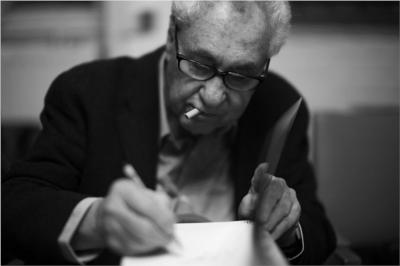
Elliott Erwitt
Elliott Erwitt was born in Paris in 1928[2] to Russian Jewish emigre parents, spent part of his childhood in Italy, and arrived in the United States as a teenager in 1939[2]. He studied photography in Los Angeles and later at the New School in New York, and joined Magnum Photos in 1953, the cooperative founded by Henri Cartier-Bresson and Robert Capa. He served as Magnum's president three times across the following three decades.
Biography
His reputation rests on a gift for comic timing that few photographers have matched. Where Cartier-Bresson spoke of the decisive moment, Erwitt was after something closer to the decisive comic one: the juxtaposition, the incongruity, the instant before or after the obvious picture. His ongoing series on dogs and their owners, collected across several books including "Son of Bitch" and "Dogs Dogs", generated images that are genuinely funny without sentimentality and that read differently depending on whether you notice the dog or the human first.
The serious work sits alongside the comic without contradiction. Erwitt was present at the American National Exhibition in Moscow in 1959[2] and photographed the moment Nikita Khrushchev jabbed his finger at Richard Nixon during the Kitchen Debate, making the defining image of that confrontation. His photographs of segregated drinking fountains in the American South are among the most economical civil rights documents of the era.
He shot regularly for Life, Look, and Holiday throughout the postwar decades and worked extensively in advertising and documentary film. He said that the most important thing a camera does is "get you out of the house", a remark that reflects his conviction that photography was fundamentally about sustained engagement with the world rather than equipment or theory.
Erwitt died in November 2023[2] at the age of 95, having made pictures on every continent.
Timeline
- 1928Born in Paris to Russian Jewish émigré parents.
- 1939Arrived in the United States as a teenager.
- 1953Joined Magnum Photos, the cooperative founded by Henri Cartier-Bresson and Robert Capa.
- 1959Photographed Nikita Khrushchev and Richard Nixon during the Kitchen Debate at the American National Exhibition in Moscow.
- 1974Published "Son of Bitch", a collection of photographs of dogs and their owners.
- 1998Published "Dogs Dogs", another collection of photographs of dogs.
- 2023Died in November at 95, having photographed on every continent.
Notable Works
Tap to view larger.
Next stop
Browse the movements →
Every movement in the collection, from the Renaissance to Pop art.
Related Artists


Frequently Asked Questions
What is Elliott Erwitt known for?
Elliott Erwitt is known for his gift for comic timing in photography. He is also known for his series on dogs and their owners, and for capturing the defining image of the Kitchen Debate between Nixon and Khrushchev.What is Elliott Erwitt's most famous work?
Elliott Erwitt was a prolific photographer known for his candid and often humorous black-and-white images. While he did not have one single, universally recognised photograph, several of his works have achieved iconic status. One example is his 1950[2] photograph of a couple kissing, reflected in a car mirror. Another is his 1957 image of a dog wearing a knitted jumper, looking up at its owner. These photographs, and others like them, capture everyday moments with wit and charm, and have become widely celebrated examples of his style. Erwitt's ability to find humour and humanity in ordinary situations is a defining aspect of his photography. He worked for Magnum Photos from 1953, and served as its president.What should I know about Elliott Erwitt's prints?
Elliott Erwitt (1928[2]-2024) was a French[2]-born American photographer known for his black and white photography, often capturing ironic and absurd situations in everyday life. He worked for Magnum Photos from 1953[2], eventually becoming its president. Erwitt's prints cover a range of subjects, including documentary photography, photojournalism, advertising and personal work. He is celebrated for his ability to find humour and humanity in ordinary moments. His images often feature dogs, children, and scenes from city life. Many of Erwitt's most famous photographs are gelatin silver prints. This traditional process gives his work a distinctive tonal range and a classic aesthetic. His work has been exhibited in museums and galleries worldwide, and his prints are highly sought after by collectors. When buying an Erwitt print, it is important to check its provenance and authenticity.What style or movement did Elliott Erwitt belong to?
Elliott Erwitt is often associated with humanist photography, a style that gained international recognition after the Second World War. This approach focuses on capturing everyday life, human emotions, and social interactions. Humanist photographers aimed to document the human condition with empathy and understanding. They sought to find beauty and meaning in ordinary moments, often focusing on the lives of everyday people. Figures such as Henri Cartier-Bresson, known for his concept of the "decisive moment", exemplify this style. Cartier-Bresson aimed to capture fleeting moments of significance with precision and clarity. However, some photographers, such as Mario Giacomelli, offered a contrasting approach. Giacomelli, while also considered a humanist photographer, presented a more personal and lyrical vision. His images often employed blur and other techniques to create a dreamlike quality, differing from Cartier-Bresson's sharp, documentary style. This divergence illustrates the range within humanist photography, encompassing both detached observation and more subjective, expressive interpretations of the human experience.What techniques or materials did Elliott Erwitt use?
Elliott Erwitt primarily worked with black and white photography, favouring Leica cameras and a candid, reportage style. He often captured humorous and ironic scenes of everyday life. Some of Erwitt's techniques included cropping and retouching prints, activities some photographers consider questionable. He also experimented with the combination of photography and painting. Some works involved airbrushed stains applied to the surface of a photograph, maintaining its photographic quality. Other pieces showed marks in opposition to photographic qualities. Erwitt also explored the impact of enlargement on photographic images. By magnifying small details from postcards, he examined how the texture of reproduction screens and the intervention of a retoucher's hand contributed to the image. He was interested in the point at which the grain of the emulsion became too large to absorb the imprint of form.Where can I see Elliott Erwitt's work?
Elliott Erwitt's photographs are held in many public collections. In the United States, you can find his work at the Metropolitan Museum of Art, the Museum of Modern Art (both in New York), the Museum of Fine Arts (Boston), the National Gallery of Art (Washington), the Los Angeles County Museum of Art, the Minneapolis Institute of Arts, the Philadelphia Museum of Art, the New Orleans Museum of Art, the Wolfsonian at Florida International University (Miami Beach), and the Charles Hosmer Morse Museum of American Art (Winter Park, Florida). In Canada, Erwitt's images are held by the National Gallery of Canada (Ottawa) and the Royal Ontario Museum (Toronto). In the United Kingdom, see his work at the National Portrait Gallery (London), the National Museum of Photography, Film & Television (Bradford), the Victoria & Albert Museum (London), the Brighton Museum & Art Gallery, the Geffrye Museum (London), the Manchester Art Gallery, and the National Museums of Scotland (Edinburgh). His work also appears in the Musée d'Orsay (Paris).Where was Elliott Erwitt from?
Elliott Erwitt was born Elio Romano Erwitt in Paris, France, in 1928[2]. His parents were Russian Jewish immigrants. Erwitt and his family left France for Italy in 1930[2], then emigrated to the United States in 1939. He spent his teenage years in Los Angeles, where he developed an interest in photography. He then moved to New York City in 1948, where he exchanged janitorial work for film classes. Erwitt began his photography career in the late 1940s. He was influenced by photographers Robert Frank and Walker Evans. Between 1952 and 1969, Erwitt worked as a photojournalist and advertising photographer. In 1964, he was awarded a Guggenheim Fellowship, which allowed him to focus on his personal work. His work was included in the 1966 exhibition Toward a Social Landscape at the George Eastman House, and in the 1967 Museum of Modern Art exhibition New Documents.Who did Elliott Erwitt influence?
It is difficult to measure the specific influence of any one photographer; however, the photographers of *Life* magazine, such as Margaret Bourke-White, Alfred Eisenstaedt, Peter Stackpole, and Carl Mydans, along with Henri Cartier-Bresson and Dorothea Lange, had a considerable impact on photojournalism and the photo essay. These photographers, along with Man Ray, Lászlo Moholy-Nagy, Edward Weston, and Ansel Adams, helped to establish photography as an art form, opening it up for future generations. Abstract Expressionism inspired Aaron Siskind and Minor White to create abstract photography. Surrealism, along with Man Ray, inspired Bill Brandt, Jerry Uelsmann, and Lucas Samaras to create special-effect or fantasy photography, using techniques such as superimposition and composite images. David Hockney and Robert Rauschenberg combined photography and painting. Postmodern photographers, such as Cindy Sherman, merge photography with text, media messages, and symbols.Who influenced Elliott Erwitt?
Elliott Erwitt's photographic style developed through exposure to various influences. In the late 1940s, Garry Winogrand encountered photography while serving in the Air Force. Between 1947[2] and 1951, he studied painting and photography at multiple institutions, including the New School for Social Research with Alexey Brodovitch. Winogrand found significant inspiration in the work of Robert Frank and Walker Evans around 1960. He admired their visual intelligence, but he did not directly imitate their styles. Frank and Evans used stylistic refinements to access subject context, whereas Winogrand accepted the compaction of facts and fiction in the physical world. Harry Callahan also had an impact. Ansel Adams gave workshops at the Detroit Camera Club in 1941, and Callahan stated, "It is Ansel that freed me".Why are Elliott Erwitt's works important today?
Elliott Erwitt's work remains significant due to his approach to photography, which aligns with artistic strategies developed in the Dada movement. Dada, emerging in the early 20th century, challenged traditional artistic values through humour and unconventional methods. One key aspect of Dada's legacy is its emphasis on repurposing and "cut-up" techniques. These strategies, initially used in photomontage and other visual arts, have permeated culture. Today, we see echoes of Dada in rapid cutting in visual media, sampling in hip-hop, and the mash-up aesthetic prevalent online. Surfing the Internet, with its fragmented information and remix culture, mirrors Dada's experimental spirit. Photomontage, a technique central to Dada, also became a basic tool in advertising. This demonstrates how Dada's innovations, even when detached from their original context, continue to shape visual communication. Erwitt’s photography, with its often humorous and unexpected juxtapositions, shares an affinity with Dada's playful subversion of expectations, making his work relevant in a world saturated with images influenced by these earlier artistic approaches.When was Elliott Erwitt born?
Elliott Erwitt was born in 1928[2].
Sources
Editorial draws on the following primary and tertiary references for Elliott Erwitt.
- [1] museum Victoria and Albert Museum Used for: museum holdings.
- [2] wikipedia Wikipedia: Elliott Erwitt Used for: biography, birth dates, death dates, identifiers, movement attribution, nationality.
- [3] book Ansel Adams; Beaumont Newhall; Nancy Newhall; Louise Dahl-Wolfe; Aaron Siskind; Richard Avedon; Harry Callahan; Lee Friedlander; Tina Modotti; W. Eugene Smith; Paul Strand; Edward Weston; Garry Winogrand; Amy Rule, Ansel Adams; Beaumont Newhall; Nancy Newhall; Louise Dahl-Wolfe; Aaron Siskind; Richard Avedon; Harry Callahan; Lee Friedlander; Tina Modotti; W. Eugene Smith; Paul Strand; Edward Weston; Garry Winogrand; Amy Rule - Original sources _ art and ar Used for: biography, stylistic analysis.
- [4] book Jed Perl, Art in America 1945-1970 Used for: biography.
- [5] book guggenheim-rroseisr00bles Used for: biography.
- [6] book guggenheim-twopri00weis Used for: biography.
- [7] book Martina Caruso, Italian Humanist Photography From Fascism to the Cold War Used for: stylistic analysis.
- [8] book Carol Strickland and John Boswell, The Annotated Mona Lisa Used for: stylistic analysis.
Editorial overseen by Solis Prints. Sources verified 2026-08-31. Click a source for details, or hover over [N] in the page above to preview.
Editorial standardsMethodologyCorrectionsAI disclosureAbout the editorial team