



Elisabeth Sonrel
A bronze medal and the Henri Lehmann prize of 3,000 francs at the 1900[1] Exposition Universelle was not an outcome many expected for a painter still in her mid-twenties, but Élisabeth Sonrel had been heading somewhere particular since she walked into the studios of Jules Lefebvre at the École des Beaux-Arts in Paris.
Biography
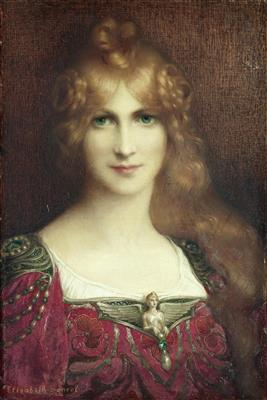
Born in Tours in 1874[1], she received her first instruction from her father before gaining formal admission to the Paris school, where Lefebvre's academic rigour provided a foundation she would deliberately push against. After visiting Florence and Rome, she adopted a Pre-Raphaelite approach to figure painting, drawn to the spiritual and the symbolic over the contemporary social scenes favoured by many of her contemporaries. Her 1892[1] diploma piece, "Pax et Labor", entered the collection of the Musée des Beaux-Arts de Tours and remains there.
The years around 1900[1] were her most productive. Her painting "Le Sommeil de la Vierge" secured the Exposition prize, and she was exhibiting regularly at the Salon des Artistes Français, a relationship she maintained from 1893 to 1941. In parallel, she produced posters, postcards, and book illustrations drawing on Arthurian legend, Dante's "Divine Comedy", and medieval Christian imagery, all filtered through the decorative language of Art Nouveau[1].
After 1900[1], her career shifted toward portraiture and landscape. She made regular trips to Brittany, eventually building a villa at La Baule, and the coastal light of the Atlantic seems to have loosened her palette considerably. She continued working into old age and died in Sceaux in 1953[1] at seventy-nine.
Timeline
- 1874Born in Tours. She received early art instruction from her father.
- 1892Her diploma piece, "Pax et Labor", was acquired by the Musée des Beaux-Arts de Tours.
- 1893Began exhibiting regularly at the Salon des Artistes Français; she continued until 1941.
- 1900Awarded a bronze medal and the Henri Lehmann prize at the Exposition Universelle for her painting "Le Sommeil de la Vierge".
- 1900Around this time, she produced posters, postcards, and book illustrations inspired by Arthurian legend and Dante's "Divine Comedy".
- 1900Visited Florence and Rome, adopting a Pre-Raphaelite approach to figure painting.
- 1953Died in Sceaux at 79. She had continued working into old age.
Notable Works
Tap to view larger.
Next stop
Art Nouveau →
Explore the artists and ideas of Art Nouveau.
Related Artists


Frequently Asked Questions
What is Elisabeth Sonrel known for?
Élisabeth Sonrel is known for her paintings, posters, postcards, and book illustrations. Her work often drew on Arthurian legend, Dante's "Divine Comedy", and medieval Christian imagery, rendered in the Art Nouveau[1] style.What should I know about Elisabeth Sonrel's prints?
Elisabeth Sonrel (1874[1]-1953[1]) was a French[1] Art Nouveau[1] painter and draughtswoman, working in watercolour, pastel, and oil. She is known for symbolist compositions, often featuring female figures in allegorical or mythological scenes. Although Sonrel is primarily known as a painter, examples of her work were produced as prints. Printmaking includes a range of techniques, such as etching and engraving, for creating multiple original images. These techniques involve the artist creating an image on a matrix (like a plate or block), which is then inked and used to produce impressions on paper. Each impression is considered an original, and the artist typically signs and numbers the prints in a limited edition. It is important to distinguish between an original print, made by the artist or under their direct supervision, and a reproduction, which is a copy of an artwork in another medium. The art market has specific definitions for these terms, and legislation in some regions mandates disclosure of information about prints, including the artist's name, date, medium, and edition size.What techniques or materials did Elisabeth Sonrel use?
Elisabeth Sonrel was a French[1] artist known for her watercolour and gouache paintings. She also produced works in oil. Her style often incorporated elements of symbolism and Pre-Raphaelitism. Sonrel's watercolours are characterised by their luminous quality and attention to detail. She employed thin washes of colour to build up layers of translucent tones. This technique allowed her to create a sense of depth and atmosphere in her compositions. She often combined watercolour with gouache, an opaque watercolour paint, to add highlights and texture to her work. Her oil paintings display a similar concern for detail and colour. She used smooth brushwork and subtle gradations of tone to create a polished finish. Sonrel's choice of materials and techniques contributed to the dreamlike quality of her images. Her paintings often depict ethereal figures in idyllic settings, reflecting her interest in mythology and spiritual themes.What was Elisabeth Sonrel known for?
Elisabeth Sonrel was a French[1] artist associated with the Art Nouveau[1] movement. She worked during a time when graphic art was developing as a career. The late 19th century saw a growing market for artist prints, and new techniques made printmaking more accessible. Etching allowed artists to transfer their hand directly onto a metal plate, emphasising subtleties of line. Lithography allowed a greater emphasis on tone and colour. By the 1890s, public interest in prints led to dedicated exhibitions and press coverage, blurring the lines between artistic and commercial illustration. Art Nouveau journals were also important in spreading Art Nouveau ideas. Sonrel's work fits into this context of increased interest in graphic arts and the rise of Art Nouveau aesthetics.When did Elisabeth Sonrel live and work?
Elisabeth Sonrel (1874[1]-1953[1]) was a French[1] artist and designer. She is best known for symbolist and Art Nouveau[1] paintings, often featuring female figures and literary themes. Born in Tours, France, Sonrel received artistic training from her father, painter Nicolas Stéphane Sonrel, and later at the École des Beaux-Arts in Paris, where she studied with Jules Lefebvre. She exhibited at the Salon des Artistes Français from 1893[1] onwards. Her submissions included portraits, allegorical subjects, and scenes inspired by Brittany and her travels. Sonrel's style incorporates elements of Pre-Raphaelitism and medievalism, seen in her use of line, flattened perspective, and symbolic details. Her paintings often depict ethereal women in garden settings or dreamlike states. She also produced religious works, such as panels for the Basilica of Sainte-Thérèse in Lisieux. Later in her career, Sonrel travelled extensively, particularly in Italy. She produced many watercolours of Italian people and architecture. She died in Sceaux, near Paris.Where can I see Elisabeth Sonrel's work?
Elisabeth Sonrel's works can be viewed in several museums. In France, these include the Musée des Beaux-Arts in Nantes, the Musée d’Orsay, the Musée du Louvre, the Musée du Petit Palais, and the Musée des Arts Decoratifs, all in Paris. Other French[1] museums that hold her work are the Musée des Beaux-Arts in Dijon, the Musée des Beaux-Arts in Lille, the Musée Crozatier in Le Puy, the Musée des Beaux-Arts in Nancy, the Musée des Beaux-Arts Jules Cheret and the Musée Matisse, both in Nice, the Musée des Beaux-Arts in Orleans, the Musée des Beaux-Arts in Quimper, the Musée Saint-Denis in Reims, the Musée des Beaux-Arts in Rennes, the Musée des Beaux-Arts in Rouen, the Musée d’Art et d'lndustrie in Saint Etienne, the Musée du Prieure in Saint Germain-en-Laye, the Musée de l’Annonciade in Saint Tropez, the Musée du Haubergier in Senlis, the Musée d’Art Moderne in Strasbourg, and the Musée des Augustins in Toulouse.Where was Elisabeth Sonrel from?
Elisabeth Sonrel was French[1]. She was born in Tours, Indre-et-Loire, on 13 May 1874[1]. Her father, Nicolas Stéphane Sonrel, was also an artist. He painted genre scenes and portraits. Sonrel became a student of the painter Jules Lefebvre. Lefebvre taught at the Académie Julian in Paris. Sonrel began exhibiting her work at the Salon des Artistes Français from 1893[1]. She received an honourable mention at the Salon in 1894. In 1900, she won a bronze medal at the Exposition Universelle. Sonrel travelled extensively throughout her life. She drew inspiration from places such as Italy and Bohemia. She is particularly associated with Brittany, where she painted many scenes. She died in Sceaux, Hauts-de-Seine, on 30 January 1953[1].Who did Elisabeth Sonrel influence?
Elisabeth Sonrel's direct artistic influence is difficult to trace with certainty. However, consideration of the artistic milieu of her time offers some context. Sonrel worked within the Symbolist movement, which itself was partly a reaction against academic art. Symbolism valued subjective expression and mystical themes. Artists such as Gustave Moreau and Puvis de Chavannes are considered important figures. The rise of Art Nouveau[1] also coincided with Sonrel's career. Art Nouveau emphasised decorative design, and its influence can be seen in Sonrel's stylised figures and use of flowing lines. Artists like Alphonse Mucha were central to this style. While it is difficult to pinpoint specific artists who directly emulated Sonrel's style, her work contributed to the broader currents of Symbolism and Art Nouveau. These movements, in turn, affected many artists working in Europe at the turn of the 20th century.Who was Elisabeth Sonrel?
Elisabeth Sonrel (1874[1]-1953[1]) was a French[1] painter and draughtswoman of the late nineteenth and early twentieth centuries. She was born in Tours, France, and received artistic training from her father, Nicolas Stéphane Sonrel, and later at the École Nationale Supérieure des Beaux-Arts in Paris, where she studied with Jules Lefebvre. Sonrel is best known for allegorical subjects, often with female figures in classical or medieval settings. She worked in watercolour, pastel, and oil. Her style shows the influence of Symbolism and the aesthetic movement. She exhibited at the Salon des Artistes Français, receiving an honourable mention in 1893[1] and a bronze medal in 1900. Later in her career, she painted religious subjects, as well as scenes from Brittany and landscapes from Italy.Why are Elisabeth Sonrel's works important today?
Elisabeth Sonrel (1874[1]-1953[1]) was a French[1] Art Nouveau[1] and Symbolist painter. She is remembered today for her allegorical works, her portraits, and her depictions of religious and mythological subjects. Sonrel studied at the École des Beaux-Arts in Paris, under Jules Lefebvre. She exhibited at the Salon des Artistes Français, receiving an honourable mention in 1893[1], and a bronze medal at the Exposition Universelle in 1900. Her style is characterised by its dreamlike quality, often featuring ethereal figures in natural settings. Sonrel's colour palette is typically soft and muted, contributing to the overall atmosphere of serenity in her paintings. She drew inspiration from mediaeval art, Pre-Raphaelite painting, and the Symbolist movement. Sonrel's paintings offer insight into the artistic tastes of the early 20th century. Her work provides a window into the cultural and spiritual interests of the period, particularly the fascination with mysticism and the idealisation of women. Today, her paintings are appreciated for their aesthetic beauty and their historical value.What was Elisabeth Sonrel's art style?
After visiting Florence and Rome, Élisabeth Sonrel adopted a Pre-Raphaelite approach to figure painting. She was drawn to the spiritual and the symbolic, rather than contemporary social scenes.
Sources
Editorial draws on the following primary and tertiary references for Elisabeth Sonrel.
- [1] wikipedia Wikipedia: Elisabeth Sonrel Used for: biography, birth dates, death dates, identifiers, movement attribution, nationality.
- [2] book Masterpieces of western art : a history of art in 900 individual studies from the Gothic to the present day Used for: biography.
- [3] book 1892-1968, Panofsky, Erwin,, Tomb sculpture: four lectures on its changing aspects from ancient Egypt to Bernini Used for: biography, stylistic analysis.
- [4] book Bernard Denvir, World of Art_ Post-Impressionism Used for: biography.
- [5] book Bernard Denvir, World of Art_ Post-Impressionism Used for: biography.
Editorial overseen by Solis Prints. Sources verified 2026-09-30. Click a source for details, or hover over [N] in the page above to preview.
Editorial standardsMethodologyCorrectionsAI disclosureAbout the editorial team