

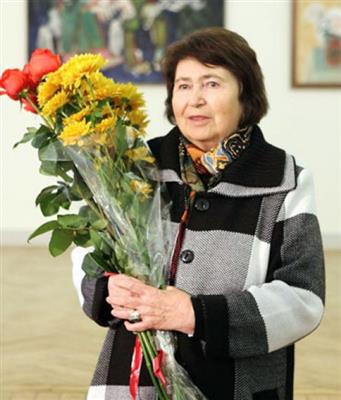
Elena Bontea
Elena Bontea emerged in the 1960s as one of the most individual voices in Moldovan painting, finding her subject matter not in grand historical tableaux but in the quiet world of the domestic still life: earthenware pots, old fabrics, fruit, flowers, and the worn surfaces of everyday vessels.
Biography
She studied at the I. Repin College of Plastic Arts in Chișinău from 1952 to 1957, then pursued postgraduate work at the Institute of History and Theory of Art in Saint Petersburg between 1960 and 1966. Before completing that programme, she had already begun working as a scientific collaborator at the National Museum of Plastic Arts of the Republic of Moldova[1], a post she held from 1957 to 1967. She joined the Union of Plastic Artists of Moldova in 1965.
Her painting draws on the Expressionist tradition, but its energy is directed inward, towards texture and the particularities of light on glazed ceramics or folded cloth. There is nothing generic in her still lifes: objects are chosen for their histories, for the way time has marked them.
The recognition she received over her career reflects the seriousness with which Moldovan cultural institutions regard her contribution. She was awarded the Youth Prize of Moldova[1] in 1987, the Civic Merit Medal and the National Prize of the Republic of Moldova in 1996, and the title of Master of Art in 2001. The Union of Plastic Artists granted her its Excellence Prize in 2001, 2002, and 2005. She was also decorated with the Order of Labour.
Timeline
- 1936Born in Moldova.
- 1952Began studies at the I. Repin College of Plastic Arts in Chișinău.
- 1957Graduated from the I. Repin College of Plastic Arts in Chișinău.
- 1957Began working as a scientific collaborator at the National Museum of Plastic Arts of the Republic of Moldova.
- 1960Began postgraduate work at the Institute of History and Theory of Art in Saint Petersburg.
- 1965Joined the Union of Plastic Artists of Moldova.
- 1967Left her post at the National Museum of Plastic Arts of the Republic of Moldova.
- 1987Awarded the Youth Prize of Moldova.
- 1996Awarded the Civic Merit Medal and the National Prize of the Republic of Moldova.
- 2001Awarded the title of Master of Art and the Excellence Prize from the Union of Plastic Artists.
- 2002Awarded the Excellence Prize from the Union of Plastic Artists.
- 2005Awarded the Excellence Prize from the Union of Plastic Artists.
Next stop
Browse the movements →
Every movement in the collection, from the Renaissance to Pop art.
Related Artists

Frequently Asked Questions
What is Elena Bontea known for?
Elena Bontea is known for her still life paintings. Her subject matter includes earthenware pots, old fabrics, fruit, flowers, and worn vessels.What is Elena Bontea's most famous work?
It is difficult to identify one single work as Elena Bontea's "most famous". Her artistic practice includes varied subjects and styles, making a definitive selection challenging. Bontea's work often explores themes of nature and human emotion. She uses colour and form to express inner states and observations of the world around her. Her paintings range from figurative compositions to more abstract explorations of texture and light. While Bontea has exhibited in various galleries and art spaces, her popularity is perhaps most visible through online platforms and social media. This wider reach allows her art to connect with a broad audience, making it difficult to gauge reception based on traditional metrics of artistic success. Without specific sales figures, major museum acquisitions, or inclusion in standard art historical surveys, determining a single "most famous" piece remains speculative.What should I know about Elena Bontea's prints?
Elena Bontea is a contemporary artist known for her mixed-media works on paper. Her prints often incorporate techniques of collage, drawing, and painting. Bontea's art explores themes of memory, identity, and the passage of time. She frequently uses found objects, photographs, and text fragments in her compositions; these elements create layers of meaning and invite viewers to construct their own narratives. Bontea's process involves manipulating and recontextualising existing materials. This approach allows her to examine the relationship between personal experience and collective history. Her colour palettes are often muted, with subtle variations in tone and texture. These choices contribute to the overall sense of atmosphere and introspection in her work. Bontea's prints are characterised by their delicate balance between abstraction and representation. This quality makes them both visually appealing and conceptually engaging. Her work has been exhibited in galleries and museums throughout Europe.What style or movement did Elena Bontea belong to?
It is difficult to assign Elena Bontea to one specific style or movement. Italian fashion during the mid-20th century, particularly in Florence, was known for a few qualities. These included an expressive use of colour, natural elegance of line, harmony between shape and function, and an inventive relationship with materials. Italian designers aimed to position their work as a modern aesthetic, distinct from French influence, while also appealing to the American market. Some designers created boutique collections that allowed for freer experimentation. These collections sometimes incorporated humour, Italian folklore, and diverse fabrics. During this time, some haute-couture designers also produced more affordable boutique lines. This duality reflected a shift towards mass production, as haute-couture costs increased. Some designers successfully integrated the haute-couture image into ready-to-wear lines.What was Elena Bontea known for?
Elena Bontea is known for a range of works that include painting and abstraction. Her pieces often incorporate figures, portraits, and elements suggestive of interior spaces. Bontea's art explores themes of identity and the human condition. Recurring motifs in her work include seated figures, nudes, and symbolic objects, which create a sense of narrative. She uses colour to evoke mood and atmosphere, often employing contrasting tones to create visual tension. Her compositions frequently feature a juxtaposition of recognisable forms and abstract elements. This blending of representation and non-representation invites viewers to engage with the artwork on multiple levels. Bontea's art is characterised by its enigmatic quality, prompting contemplation on the relationship between the conscious and unconscious.Who influenced Elena Bontea?
Elena Bontea's artistic style shows an engagement with several modern masters, although specific influences are difficult to determine. Her use of colour and form suggests an awareness of early 20th-century movements. The bold application of paint and simplified forms in some of her works recall aspects of Fauvism. Artists like Henri Matisse, with his emphasis on decorative patterns and non-naturalistic colour, may have provided a point of reference for Bontea's explorations. The Fauvist movement valued individual expression through colour. Additionally, the reduction of figures to geometric shapes in some of Bontea's compositions hints at the influence of Cubism. Cubist painters such as Pablo Picasso and Georges Braque analysed objects from multiple viewpoints, reassembling them in abstract arrangements. Bontea's approach to form shares some similarities with this analytical method. Her work is not a direct imitation of either movement, but rather an individual synthesis of various modernist ideas.Who was Elena Bontea?
There appear to be two artists named Elena Bontea. One was active in the early 20th century, and the other in the mid-20th century. One Elena Bontea participated in the Kazan Railroad Station project in 1915-1916[1], producing sketches for paintings in four lunettes: *Turkey*, *Japan*, *India*, and *Siam*. In 1924, she relocated to Paris after receiving a commission for a decorative painting. She did not return to Russia. Bontea travelled to England, Germany, Belgium, Morocco, Italy, Switzerland, Brittany, and the south of France. She painted portraits, including those of Sergei Prokofiev, Konstantin Somov, and Sergei Lifar, as well as still lifes. She died on 19 September 1967. Another Elena Bontea turned to textile and fashion design for the Atelier of Fashions in Moscow in 1923. She was a member of the design team for the Izvestiia Pavilion at the All-Union Agricultural Exhibition in Moscow. She started work on the costumes for Yakov Protazanov's film *Aelita*. In 1924, she emigrated to Paris. She contributed to the Venice Biennale and taught at Fernand Leger's Academie Moderne. She died on 17 March 1949, in Paris.Why are Elena Bontea's works important today?
Elena Bontea is a contemporary artist whose work engages with themes of memory, identity, and displacement. Her art is important because it offers a fresh perspective on the human condition in an increasingly globalised world. Bontea's pieces often incorporate mixed media, combining painting, drawing, and collage techniques to create layered, textured surfaces. This approach allows her to explore the complexities of personal and collective histories. Bontea's art resonates with viewers who are grappling with questions of belonging and cultural heritage. Her work provides a space for reflection on the challenges and opportunities that arise from migration and cultural exchange. By addressing these issues in a sensitive and thought-provoking manner, Bontea contributes to an ongoing dialogue about the nature of identity in the 21st century. Her art is a valuable contribution to contemporary art and visual culture.When was Elena Bontea born?
Elena Bontea was born in 1936[1].
Sources
Editorial draws on the following primary and tertiary references for Elena Bontea.
- [1] wikipedia Wikipedia: Elena Bontea Used for: biography, birth dates, death dates, identifiers, movement attribution, nationality.
- [2] book guggenheim-guhe00solo Used for: biography.
- [3] book guggenheim-masterp00solo Used for: biography.
- [4] book guggenheim-twopri00weis Used for: biography.
Editorial overseen by Solis Prints. Sources verified 2026-10-14. Click a source for details, or hover over [N] in the page above to preview.
Editorial standardsMethodologyCorrectionsAI disclosureAbout the editorial team