



Edward E. Simmons
The vaulted corridors of the Library of Congress contain one of Edward Simmons's most enduring contributions to American[1] public art: the mural 'Melpomene', installed in 1896[1] as part of the building's ambitious decorative programme. It stands alongside commissions at the Minnesota State Capitol and the Waldorf Astoria as evidence of the remarkable scope Simmons achieved as a muralist in the American Renaissance.
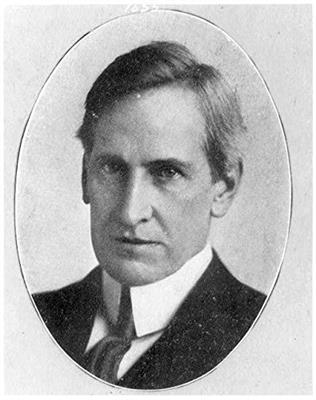
Biography
Born in Concord, Massachusetts, in 1852[1] to a family connected to the transcendentalist milieu (his uncle was Ralph Waldo Emerson's brother), Simmons graduated from Harvard in 1874[1] before travelling to Paris to study under Jules Joseph Lefebvre and Gustave Boulanger. He won a gold medal there, and his early paintings from France and Brittany established him as a capable figure in the Impressionist idiom.
Returning to the United States, he became one of the founding members of the Ten American[1] Painters, the influential exhibiting society that broke from the Society of American Artists in 1897[1]. His panel paintings, easel works, and murals earned him consistent institutional recognition. In 1922 he published his autobiography, 'From Seven to Seventy'. His canvas 'The Carpenter's Son' had a stranger afterlife: cut from its frame by thieves in 1996, it was recovered a decade later and restored. Simmons died in Baltimore in November 1931[1].
Timeline
- 1852Born in Concord, Massachusetts. His uncle was Ralph Waldo Emerson's brother.
- 1874Graduated from Harvard at 22.
- 1874Moved to Paris to study under Jules Joseph Lefebvre and Gustave Boulanger.
- 1896Installed the mural 'Melpomene' in the Library of Congress.
- 1897Became one of the founding members of the Ten American Painters after breaking from the Society of American Artists.
- 1922Published his autobiography, 'From Seven to Seventy'.
- 1931Died in Baltimore at 79.
Notable Works
Tap to view larger.
Next stop
Impressionism →
Explore the artists and ideas of Impressionism.
Related Artists


Frequently Asked Questions
What is Edward E. Simmons known for?
Edward Simmons is known for his mural work in the American[1] Renaissance style. He completed commissions at the Minnesota State Capitol and the Waldorf Astoria, in addition to his work in the Library of Congress.What is Edward E. Simmons's most famous work?
Edward Simmons (1852[1]-1931[1]) was an American[1] Impressionist painter known for his murals, portraits, and decorative works. He received training at the Académie Julian in Paris. Later, he became a member of the Ten American Painters, a group of artists who seceded from the Society of American Artists in 1897[1]. Simmons received several large-scale mural commissions, including work for the Minnesota State Capitol, the Library of Congress, and the Massachusetts State House. At the Massachusetts State House, he created a series of murals that depict the themes of justice, peace, and liberty. He also completed a series of panels representing the nine muses for the Library of Congress. These commissions cemented his position as a prominent muralist during the American Renaissance.What style or movement did Edward E. Simmons belong to?
Edward E. Simmons is associated with Impressionism[1], an art movement that emerged in France around the 1870s. Impressionist artists, including Claude Monet, Pierre-Auguste Renoir, and Edgar Degas, aimed to capture fleeting moments and the transient effects of light and climate. The Impressionists often depicted scenes from modern urban life, such as bars, dance halls, and railway stations. They employed loose brushwork and pure colours to convey the illusion of spontaneously recorded natural light. Departing from traditional artistic conventions, they sometimes adopted formal devices from photography and Japanese prints, including radical foreshortening and unusual perspectives. While Impressionism took root in France, it also influenced American[1] artists. Some major American artists influenced by French Impressionism include James Abbott McNeill Whistler, John Singer Sargent, and Henry Ossawa Tanner.What techniques or materials did Edward E. Simmons use?
Edward Emerson Simmons (1852[1]-1931[1]) was an American[1] Impressionist painter, muralist, and stained glass artist. Simmons studied at the Académie Julian in Paris, where he became familiar with academic figure painting and the emerging Impressionist aesthetic. Simmons worked in a variety of media. He is known for oil paintings, often depicting figures in domestic settings or plein air scenes. His style is characterised by broken brushwork and an interest in capturing the effects of light and atmosphere. Simmons also received several large-scale mural commissions. One prominent example is his work for the Minnesota State Capitol (1903[1]-1905[1]), where he created murals depicting historical and allegorical subjects. He employed techniques appropriate for large interior spaces, including simplified forms and clear, bright colours that would read well from a distance. These murals were executed in oil paint on canvas, which was then adhered to the walls. In addition to painting, Simmons designed stained glass windows. This reflects his versatility as an artist and his interest in different modes of visual expression. His stained glass work often featured figurative designs and incorporated a range of colours and textures.What was Edward E. Simmons known for?
Edward E. Simmons (1852[1]-1931[1]) was an American[1] Impressionist painter, remembered for his work as a muralist. Simmons was one of a group of American artists influenced by French Impressionism[1], along with John Singer Sargent and James Abbott McNeill Whistler. Impressionism began in France in the 1860s and continued into the 1880s. Impressionist painters chose to paint outside, observing the play of natural light and shadow. They used distinct brushstrokes to evoke sun, shadow, and the fleeting effects of changing light. They experimented with colour combinations, pairing complementary colours, such as blue/orange, red/green, and violet/yellow, to intensify them. Their radical vision, once scorned, created some of the best-loved paintings today. Later in his career, John Singer Sargent also adopted a similar style, turning toward watercolour. The willingness of Impressionist artists to try different ways of painting, even when others laughed, inspired others to try new things.Where can I see Edward E. Simmons's work?
Edward E. Simmons's work can be viewed in several locations. In New York, you can find pieces at the Metropolitan Museum of Art, the Museum of Modern Art, the American[1] Numismatic Society, and the Cooper-Hewitt, National Design Museum, Smithsonian Institution. Other US museums include the Los Angeles County Museum of Art (LACMA), the Minneapolis Institute of Arts, the Charles Hosmer Morse Museum of American Art in Winter Park, Florida, the Virginia Museum of Fine Arts in Richmond, the Wolfsonian at Florida International University in Miami Beach, the Yale University Art Gallery in New Haven, the Hispanic Society of America Museum, the Whitney Museum of American Art, the George Eastman House in Rochester, the Pennsylvania Academy of the Fine Arts, the Philadelphia Museum of Art, the Carnegie Museum of Art in Pittsburgh, the Corcoran Gallery of Art, the Hirshhorn Museum and Sculpture Garden, the Library of Congress, the National Gallery of Art, and the National Museum of American Art, and the Phillips Collection, all in Washington DC, and the J. Paul Getty Museum in Los Angeles. Outside the United States, Simmons's art can be seen at the Royal Ontario Museum in Toronto. In the UK, visit the Bakelite Museum, the Brighton Museum & Art Gallery, the Geffrye Museum, the Manchester Art Gallery, the National Museums of Scotland, and the Victoria & Albert Museum.Where was Edward E. Simmons from?
Edward Emerson Simmons was an American[1] Impressionist painter. He was born in Concord, Massachusetts, on 27 October 1852[1]. His parents were Samuel Simmons and Mary Emerson Ripley Simmons. Simmons came from a notable New England family. His ancestor William Simmons arrived in Plymouth, Massachusetts, around 1621. Ralph Waldo Emerson was his cousin; Frederic Tudor, the "Ice King", was his uncle. He was educated at Harvard University, graduating in 1874[1]. Shortly after, he moved to Paris for artistic training at the Académie Julian. He studied with William-Adolphe Bouguereau and Jules Lefebvre. Simmons returned to the United States in the 1890s and became associated with the Ten American Painters, a group of artists who seceded from the Society of American Artists in 1897. He died in Baltimore, Maryland, on 17 November 1931[1].Who was Edward E. Simmons?
Edward E. Simmons was an American[1] artist born in Chicago, Illinois, in 1866[1]. When he was five years old, his family relocated to San Francisco. Simmons began painting at the age of twelve. He studied at the Mark Hopkins Institute of Art in San Francisco. His instructors included Virgil Williams, Arthur Mathews, and Amadee Joullin. Simmons travelled and trained in France, Germany, and Italy. Later, he returned to the Mark Hopkins Institute as a teacher. The 1906 San Francisco earthquake and fire resulted in the destruction of his studio and many of his artworks. In 1938, Simmons moved to San Bruno, California, where he resided and continued to paint until his death in 1958. His students nicknamed him "The Old Master". He is known for his still life paintings.Why are Edward E. Simmons's works important today?
Edward E. Simmons (1852[1]-1931[1]) was an American[1] Impressionist painter, but the available passages do not discuss his work or its importance. Instead, they describe the work of several later 20th-century artists who confronted social and political issues. Lorna Simpson explores racism and sexism, while Melvin Edwards addresses civil rights themes. Jaune Quick-to-See Smith engages with Native American heritage. David Wojnarowicz recorded the impact of AIDS on the gay community, and Krzysztof Wodiczko documented the plight of the homeless. These artists use various media, such as photography, sculpture, and video installations, to challenge stereotypes and encourage introspection on cultural heritage and historical references. Their art prompts viewers to re-examine values and cultural emblems, reflecting a broader movement towards social commentary in art.What was Edward E. Simmons's art style?
His early paintings from France and Brittany established Edward Simmons as a capable figure in the Impressionist idiom. Later, he became known for his panel paintings, easel works, and murals.How did Edward E. Simmons die?
Edward E. Simmons died in 1931[1] at the age of 79.
Sources
Editorial draws on the following primary and tertiary references for Edward E. Simmons.
- [1] wikipedia Wikipedia: Edward E. Simmons Used for: biography, birth dates, death dates, identifiers, movement attribution, nationality.
- [2] book Dorling Kindersley, Artists: Inspiring Stories of the World's Most Creative Minds Used for: biography.
- [3] book Fred S. Kleiner, Gardner's Art through the Ages Used for: stylistic analysis.
- [4] book Gwendolyn DuBois Shaw;, The Art of Remembering Used for: stylistic analysis.
- [5] book Landauer, Susan, The not-so-still life : a century of California painting and sculpture Used for: biography.
- [6] book 1892-1968, Panofsky, Erwin,, Tomb sculpture: four lectures on its changing aspects from ancient Egypt to Bernini Used for: biography.
Editorial overseen by Solis Prints. Sources verified 2026-09-30. Click a source for details, or hover over [N] in the page above to preview.
Editorial standardsMethodologyCorrectionsAI disclosureAbout the editorial team