



Doug Ohlson
Doug Ohlson spent most of his adult life working within a short radius of Manhattan's art world, but his sensibility came from the flat, atmospheric expanses of rural Iowa. Born in Cherokee in 1936[1], he studied studio art at the University of Minnesota before moving to New York, where sculptor Tony Smith became a formative influence at Hunter College. Ohlson would go on to teach there for 35 years.
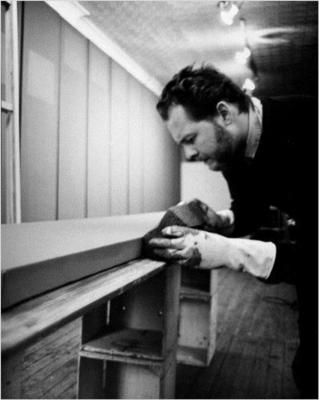
Biography
His paintings from the 1960s featured sharply defined, repeated geometric shapes with vivid colour progressions, precise enough to earn him a place in MoMA's landmark 1968[1] survey "The Art of the Real: 1948-1968[1]", curated by E.C. Goossen. That same year he received a Guggenheim Fellowship. Goossen credited Ohlson's handling of atmospheric colour partly to his Iowa upbringing, where light changes slowly across wide open skies.
Over subsequent decades he held seven solo exhibitions at the Fischbach Gallery and continued showing at the Andre Zarre Gallery. His work entered the permanent collections of the Brooklyn Museum, the Metropolitan Museum of Art, and the Whitney Museum of American[1] Art. Later paintings moved toward characteristically rougher backgrounds, loosening the geometric precision of earlier years without abandoning the underlying structure.
He died in Manhattan in June 2010[1], aged 73, following a fall.
Timeline
- 1936Born in Cherokee, Iowa.
- 1968His work was included in "The Art of the Real: 1948-1968" at MoMA, New York, curated by E.C. Goossen.
- 1968Received a Guggenheim Fellowship.
- 2010Died in Manhattan, New York, at 73, following a fall.
Notable Works
Tap to view larger.
Next stop
Browse the movements →
Every movement in the collection, from the Renaissance to Pop art.
Related Artists


Frequently Asked Questions
What is Doug Ohlson's most famous work?
It is difficult to name one single work as Doug Ohlson's "most famous". He is best known for his large abstract paintings that explore colour and form. Ohlson's mature style, developed in the 1960s, involved hard-edged geometric shapes, often circles or dots, arranged on a monochrome field. These works investigate spatial relationships and the optical effects of colour. His paintings from this period, such as those included in the exhibition *Color and Field: Houston Collects*, are well regarded. Later in his career, Ohlson's work became more gestural, with softer edges and blended colours. Although his style shifted, his focus remained on colour and its capacity to evoke emotion and create space. While he produced a consistent body of work over several decades, no single painting has achieved the level of popular recognition that would qualify it as his "most famous".What should I know about Doug Ohlson's prints?
Doug Ohlson (1936[1]-2010[1]) was an American[1] abstract painter and printmaker. He is best known for his geometric compositions and colour field paintings. Ohlson studied at the University of Minnesota, Minneapolis, and at the Central School of Art, London. He was associated with the Post-Painterly Abstraction movement, a development from Abstract Expressionism. This style emphasises openness of design, with large areas of unmodulated colour. His prints often feature simple shapes, such as circles and squares, arranged in carefully balanced compositions. Colour is a defining element in Ohlson's work. He explored the interaction of hues and their effect on the viewer. Ohlson frequently employed a limited palette, creating subtle variations in tone and value. Ohlson taught at various institutions, including the Maryland Institute College of Art and Hunter College, New York. His work can be found in the collections of the Metropolitan Museum of Art, the Museum of Modern Art, and the Whitney Museum of American Art, all in New York.What style or movement did Doug Ohlson belong to?
Doug Ohlson was active during a period when multiple styles co-existed, often incorporating social commentary. The New York School, which gained prominence after World War II and continued through the 1960s, saw the Western art world shift, both physically and conceptually, to New York City. A 1965[1] Los Angeles County Museum of Art exhibition, titled ‘The New York School: The First Generation Painting of the 1940s and 19508,’ included artists such as Willem de Kooning, Philip Guston, Robert Motherwell, Jackson Pollock, and Mark Rothko. Paintings by the first generation of New York School artists were large and abstract. They emphasised bold brushstrokes. Critic Harold Rosenberg coined the phrase ‘action painting’ to describe these works. Subjective and highly gestural, they addressed the theme of human impulse and desires, commenting on society's need to impose order on such expression and to define and control taboos through myth.What techniques or materials did Doug Ohlson use?
Doug Ohlson (1936[1]-2010[1]) was an American[1] abstract painter associated with colour field painting and geometric abstraction. He is known for large-scale canvases featuring simple geometric forms. Ohlson's mature works typically involved carefully balanced compositions of circles, rectangles and triangles. These shapes often appear as soft-edged blocks of colour. He achieved this effect through a meticulous process of layering diluted acrylic paint on unprimed canvas. The use of thin washes allowed the weave of the canvas to remain visible, contributing to the luminosity of the finished painting. Ohlson sometimes employed masking techniques to create clean edges, juxtaposing them with the blurred boundaries achieved through his layering process. Although primarily a painter, Ohlson also experimented with printmaking, creating screenprints that echo the geometric forms and colour relationships found in his paintings. These prints allowed him to explore variations on his established themes.What was Doug Ohlson known for?
Doug Ohlson, an American[1] artist, is known for his abstract paintings. In 1957[1], Ohlson moved to New York and became involved with performance art. He met artists such as George Brecht, Allan Kaprow, George Segal, and Robert Whitman. He became a figure in Happenings during the late 1950s and early 1960s. Ohlson's early works included enigmatic images, monstrous human figures, and everyday objects. These pieces used drawings, collages, and papier-mâché. In 1961, he opened The Store, which displayed familiar objects made of plaster. This reflected American society's celebration of consumption. By 1962, critics recognised him as an important Pop artist. His first outdoor public monument was realised in 1967. It was a Conceptual performance/action behind the Metropolitan Museum of Art in New York. As a protest against the Vietnam War, he had a crew dig a rectangular hole, the size of a grave, and then refill it. From the mid-1960s, he proposed colossal art projects for cities. In 1969, his first iconic work, Lipstick (Ascending) on Caterpillar Tracks, was installed at Yale University.When did Doug Ohlson live and work?
Doug Ohlson was an American[1] abstract painter, born in Cherokee, Iowa, on 26 September 1936[1]. He is associated with the Color Field movement. Ohlson studied at the University of Minnesota Duluth, and at the University of Iowa, where he earned his BA in 1958[1] and his MFA in 1960. He moved to New York City in the early 1960s, becoming part of a community of artists exploring colour and form. He exhibited at the Fischbach Gallery, Tibor de Nagy Gallery, and Susan Caldwell Gallery in New York. Ohlson taught at various institutions, including the School of Visual Arts in New York, and the University of Maryland. He died in New York City on 1 May 1999.Where can I see Doug Ohlson's work?
Doug Ohlson's artworks have been included in group exhibitions at various museums. These include the Contemporary Arts Museum in Houston; the University Art Museum, California State University, Long Beach; the Baltimore Museum of Art; the Montgomery Museum of Fine Arts; the Frederick R. Weisman Art Museum, University of Minnesota, Minneapolis; the McNay Art Museum, San Antonio; the Wichita Art Museum; the Muskegon Museum of Art; the Joslyn Art Museum, Omaha; the Lowe Art Museum, University of Miami, Coral Gables; and the Toledo Museum of Art. Ohlson's pieces have also been displayed at the Musée d'Art Moderne et d'Art Contemporain, Nice; the Contemporary Arts Center, New Orleans; the Galena de Arte IBEU Copacabana, Rio de Janeiro; the Seanle Art Museum; the Hara Museum of Contemporary Art, Tokyo; and the Kalamazoo Institute of Arts. His work was part of the Solomon R. Guggenheim Museum's 'Rendezvous: Masterpieces from the Centre Georges Pompidou'. Other venues include the Colorado University Art Galleries, Boulder; the Spencer Museum of Art, University of Kansas, Lawrence; the Centre Cultural de la Fundacio 'la Caixa', Barcelona; the Schim Kunsthalle, Frankfurt am Main; the Museum of Modern Art, New York; and the Seattle Art Museum.Where was Doug Ohlson from?
Doug Ohlson was born in Storm Lake, Iowa, in 1936[1]. He is associated with colour field painting and geometric abstraction. Ohlson studied at the University of Minnesota, Minneapolis, from 1954[1] to 1958. He then attended Cornell University in Ithaca, New York, from 1958 to 1961. He taught at various institutions, including the University of Southern California, Bennington College, and Hunter College. His work is characterised by large-scale canvases with fields of colour and geometric shapes. These paintings often explore spatial relationships and the interplay of hues. Ohlson's art can be seen as part of a broader movement towards abstraction in American[1] painting during the mid-20th century. He had solo exhibitions at the Graham Gallery and André Emmerich Gallery, both in New York.Who did Doug Ohlson influence?
It is difficult to identify specific artists who were directly influenced by Doug Ohlson. However, one can consider the broader artistic movements and contexts that may have intersected with his work. Ohlson's abstract style, with its emphasis on colour and form, places him within a tradition of abstract expressionism. This movement saw a resurgence in the 1980s, with younger artists reconsidering the national artistic heritage of America. The support structure for emerging artists was strong in New York, where Ohlson lived and worked. While Neo-Expressionism waned, other forms of expression, such as abstraction, gained attention. Ohlson's work, with its focus on colour and geometric shapes, aligns with this broader trend of artists exploring abstraction.Who influenced Doug Ohlson?
Doug Ohlson's artistic development involved exposure to several influences. In the late 1950s and early 1960s, he was intrigued by the work of Louis and Noland, specifically Louis's Veils and Unfurleds and Noland's targets and chevrons. Ohlson noted that their approach, which aimed to introduce colour without relying on gesture or subject matter, represented a departure from, yet also a development of, his own work. Earlier, while studying at Black Mountain College (1946[1]-1948[1]), Noland became familiar with Albers' colour theories and Bauhaus principles. However, Noland found them too rigid. He credited Ilya Bolotowsky as his most important teacher there. Bolotowsky guided students through Impressionism, Cubism, neo-plastic art, and Surrealism. Noland described Bolotowsky as someone who, emerging from Mondrian's influence, "painted in colour". Mondrian's theories about colour relations, arising from spatial division, were conveyed by Bolotowsky.Who was Doug Ohlson?
Claes Oldenburg was born in Stockholm, Sweden, on 28 January 1929. His father was a diplomat, and the family lived in the United States and Norway before settling in Chicago in 1936[1]. From 1946[1] to 1950, Oldenburg studied literature and art history at Yale University in New Haven. Subsequently, he studied art under Paul Weighardt at the Art Institute of Chicago from 1950 to 1954. During his first two years of art school, he also worked as an apprentice reporter at the City News Bureau of Chicago. Afterwards, he opened a studio, where he made magazine illustrations and easel paintings. Oldenburg became an American[1] citizen in December 1953. In 1957, he moved to New York and met several artists who were doing early performance work, including George Brecht, Allan Kaprow, George Segal, and Robert Whitman. Oldenburg became a prominent figure in Happenings and performance art during the late 1950s and early 1960s. In 1977 Oldenburg married Coosje van Bruggen. Together, they collaborated on performances and large-scale projects.
Sources
Editorial draws on the following primary and tertiary references for Doug Ohlson.
- [1] wikipedia Wikipedia: Doug Ohlson Used for: biography, birth dates, death dates, identifiers, movement attribution, nationality.
- [2] book guggenheim-19artistsemergen00solo Used for: biography.
- [3] book guggenheim-claesold00olde Used for: biography, stylistic analysis.
- [4] book guggenheim-invested00blis Used for: biography.
- [5] book guggenheim-popicons00gugg Used for: biography, stylistic analysis.
- [6] book Masterpieces of western art : a history of art in 900 individual studies from the Gothic to the present day Used for: biography.
Editorial overseen by Solis Prints. Sources verified 2026-08-31. Click a source for details, or hover over [N] in the page above to preview.
Editorial standardsMethodologyCorrectionsAI disclosureAbout the editorial team