

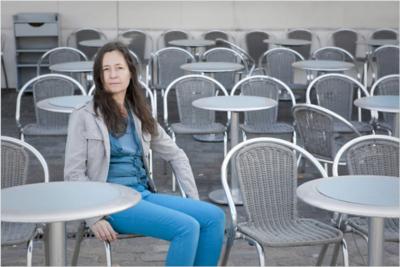
Dominique Gonzalez-Foerster
Dominique Gonzalez-Foerster was born in Strasbourg in 1965[1] and trained at the École des Beaux-Arts in Grenoble, then at L'École du Magasin in Dijon and the Institut des Hautes Études en Arts Plastiques in Paris, with a brief period at the Düsseldorf Kunstakademie. Her first solo exhibition, Mouchoirs Abstraits, was held in 1986 at the Bibliothèque de l'École des Beaux-Arts in Grenoble when she was twenty-one.
Biography
She works primarily with space as medium, creating what she describes as architectural mise-en-scènes: colour-coded environments that viewers navigate like detectives entering someone else's biography. Her references are literary and cinematic rather than art-historical. The 1993 installation A Rebours, shown at Kunstverein Hamburg, took its title and logic from Huysmans's 1884 novel, building three rooms (yellow bedroom, red hall, blue office) that invited audiences into a character's interior world. Fritz Lang's 1948 film Secret Beyond the Door, about an architect who collects rooms where murders were committed, gave her a theoretical grounding for the claim that "rooms produce scenarios."
Her contribution to Documenta in Kassel in 2002, Park: A Plan for Escape, assembled displaced park objects from across the world in the Karlsaue gardens: volcanic lava from Mexico, a Copacabana telephone booth, a rose bush from Chandigarh. A pavilion showed a film montage drawing on Antonioni, Rossellini, and Tsai Ming-Liang. The work folded cinema, geography, and displacement into a single outdoor installation that was less a garden than a theory of one.
Gonzalez-Foerster has exhibited at the Venice Biennale (Aperto '93), the Stedelijk Museum in Amsterdam, Manifesta II in Luxembourg, and Documenta. She has described her installations as functioning like biographies of real and fictional people, citing Lou Andreas-Salomé and Marie Curie as early inspirations alongside fictional characters and film protagonists.
Timeline
- 1965Born in Strasbourg.
- 1986Held her first solo exhibition, "Mouchoirs Abstraits", at the Bibliothèque de l'École des Beaux-Arts in Grenoble at 21.
- 1993Exhibited at the Venice Biennale (Aperto '93).
- 1993Her installation "A Rebours" was shown at Kunstverein Hamburg, drawing inspiration from Huysmans's 1884 novel.
- 2002Contributed "Park: A Plan for Escape" to Documenta in Kassel, assembling displaced park objects in the Karlsaue gardens.
Next stop
Browse the movements →
Every movement in the collection, from the Renaissance to Pop art.
Related Artists


Frequently Asked Questions
What is Dominique Gonzalez-Foerster known for?
Dominique Gonzalez-Foerster is known for working primarily with space as a medium, creating architectural mise-en-scènes. These colour-coded environments invite viewers to navigate them like detectives entering someone else's biography, drawing on literary and cinematic references.Who was Dominique Gonzalez-Foerster?
Dominique Gonzalez-Foerster, born in Strasbourg in 1965[1], trained at the École des Beaux-Arts in Grenoble, L'École du Magasin in Dijon, and the Institut des Hautes Études en Arts Plastiques in Paris, with a brief period at the Düsseldorf Kunstakademie. Her first solo exhibition, Mouchoirs Abstraits, was held in 1986 at the Bibliothèque de l'École des Beaux-Arts in Grenoble.What was Dominique Gonzalez-Foerster's art style?
Since the end of the 1980s, Dominique Gonzalez-Foerster has been charting the topography of imaginary interiors and the memories that permeate their walls. Her medium is space itself, eschewing more predictable modes of representation like painting, sculpture, photography, or literary description.When was Dominique Gonzalez-Foerster born?
Dominique Gonzalez-Foerster was born in 1965[1].
Sources
Editorial draws on the following primary and tertiary references for Dominique Gonzalez-Foerster.
- [1] wikipedia Wikipedia: Dominique Gonzalez-Foerster Used for: biography, birth dates, death dates, identifiers, movement attribution, nationality.
- [2] book Rugg, Judith, Exploring Site-specific Art Used for: biography, stylistic analysis.
- [3] book guggenheim-anglesofvisionfr00denn Used for: biography.
- [4] book guggenheim-invested00blis Used for: biography, stylistic analysis.
- [5] book guggenheim-mediascape00klot Used for: biography.
- [6] book Mercer, Kobena, Travel & See_ Black Diaspora Art Practices since the 1980s Used for: stylistic analysis.
Editorial overseen by Solis Prints. Sources verified 2026-08-31. Click a source for details, or hover over [N] in the page above to preview.
Editorial standardsMethodologyCorrectionsAI disclosureAbout the editorial team