



David Hare
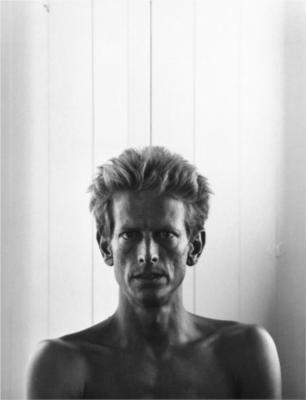
David Hare arrived at sculpture sideways: he trained as a photographer, ran a colour photography laboratory in New York, and only turned to three-dimensional work after his wartime immersion in European Surrealism changed his sense of what art could do. Born in New York City in 1917[1] and educated in Colorado and Arizona, he was drawn into the circle of exiled avant-garde artists who had fled the German occupation of France, and between 1942[1] and 1944 he co-edited the Surrealist review VVV alongside André Breton, Marcel Duchamp, and Max Ernst. That collaboration placed him at the centre of an extraordinary transfer of ideas from the Old World to the new.
Biography
His first solo exhibition came in 1944[1] at Art of This Century, Peggy Guggenheim's New York gallery that in the same years championed Pollock, Rothko, and de Kooning. Hare's early welded metal sculptures shared the period's fascination with myth, the unconscious, and biomorphic form, figures that seem to grow from root systems, creatures poised between animal and mineral states. Moon Cage (1955), a spare welded piece now associated with his transitional phase, marks his movement away from pure Surrealist imagery towards something more structural and abstract.
By the late 1950s Hare was exhibiting internationally: the São Paulo Bienal in 1957[1], the Whitney Museum's Nature in Abstraction the following year, and successive Pittsburgh Internationals. Fruit Tree (1956, steel and bronze, five feet nine inches) and Seated Figure with Wings (1958) demonstrate his sustained interest in metamorphic, half-human forms. His work resists clean categorisation: too indebted to Surrealism to be fully Abstract Expressionist, too American in its directness to sit comfortably alongside the European group he helped introduce. He died in 1992[1], leaving a body of work that serves as a rare document of the transatlantic moment when New York became the centre of modern art.
Timeline
- 1917Born in New York City.
- 1942Co-edited the Surrealist review VVV with André Breton, Marcel Duchamp, and Max Ernst; he continued in this role until 1944.
- 1944Had his first solo exhibition at Art of This Century, Peggy Guggenheim's New York gallery.
- 1955Created "Moon Cage", a welded piece marking his transition away from Surrealist imagery.
- 1956Created "Fruit Tree", a steel and bronze sculpture.
- 1957Exhibited at the São Paulo Bienal.
- 1958Exhibited at the Whitney Museum's Nature in Abstraction exhibition; also created "Seated Figure with Wings".
- 1992Died at 75, leaving behind a body of work documenting the transatlantic shift of modern art to New York.
Notable Works
Tap to view larger.
Next stop
Browse the movements →
Every movement in the collection, from the Renaissance to Pop art.
Frequently Asked Questions
What is David Hare known for?
David Hare is known for his welded metal sculptures, particularly his biomorphic forms that suggest a transition between animal and mineral states. His work resists easy categorisation, as it blends Surrealist influences with a distinctly American directness.What is David Hare's most famous work?
It is difficult to name David Hare's single most famous work, as his output spanned painting, sculpture, and photography. He is perhaps best known for his contributions to Surrealism and Abstract Expressionism. Hare co-edited the Surrealist journal *VVV* in New York during the 1940s. His work from this period often explored themes of mythology and the subconscious. Later, he moved away from pure Surrealism, developing a more personal style. Some of Hare's notable sculptures include his series of "Janus" figures, which feature biomorphic forms and allude to the Roman god of beginnings and endings. His paintings, such as *Figure in a Landscape*, often incorporate bold colours and gestural brushstrokes. Hare's work is held in the collections of major museums, including the Museum of Modern Art in New York and the Tate Gallery in London.What should I know about David Hare's prints?
David Hare's prints are considered original works if they were conceived as prints and executed solely as prints. Typically, these are produced in limited, numbered editions, with each print signed by the artist. Each impression is considered an original, created from a plate, stone, block, or screen made for that purpose. The artist individually inks and pulls each print. Prints are often marked with edition numbers, such as 12/25, indicating the specific print number out of the total edition size. The title is usually written in the centre of the bottom margin, with the artist's signature on the right. Pencil is the preferred medium for these markings. Besides numbered editions, artists may also create artist's proofs (A/P), trial proofs (T/P), variant editions (V2, V3), or variable editions (V/E). Prints marked "Hors de Commerce" are identical to the edition but not for sale. The Professional Art Dealers Association of Canada (PADAC) and other organisations have established definitions to distinguish original prints from reproductions, the latter being copies of artworks originally created in another medium, such as painting. The intent of the artist is important: an original print intends to be a work of art in its own right, not a copy.What style or movement did David Hare belong to?
David Hare (1917[1]-1992[1]) was an American sculptor, photographer, painter, and art collector associated with Surrealism and Abstract Expressionism. Born in New York City, Hare initially worked as a photographer before turning to sculpture in the early 1940s. His early sculptures often incorporated found objects, reflecting the Surrealist interest in the subconscious and the irrational. In the mid-1940s, Hare became closely associated with the New York School, a group of artists who developed Abstract Expressionism. He participated in group exhibitions and contributed to the development of an American avant-garde. Hare's work from this period often explored themes of mythology, psychology, and existentialism, executed with a distinctive personal style that combined elements of Surrealism and abstraction. He was part of the short-lived but important Subjects of the Artist school in New York.What techniques or materials did David Hare use?
David Hare was a versatile artist who worked across media. He is known for his sculpture, painting, and photography. Initially, Hare was a photographer. He opened his own studio in New York in 1941[1], and he explored colour photography techniques. He also made experimental photographs, such as photograms. During the 1940s, Hare became involved with Surrealism. He began making sculpture, often using plaster, wire, and found objects. These sculptures often have a rough, unfinished quality. His work of this period includes titles such as *Figure in a Landscape* (1944) and *Moon Cage* (1955). Later in his career, Hare returned to painting. His paintings often feature bold colours and abstract forms. He also incorporated collage elements into some of his paintings. Throughout his career, Hare explored themes of mythology, nature, and the human condition.What was David Hare known for?
David Hare (1917[1]-1992[1]) was an American sculptor, painter, and photographer associated with Surrealism and Abstract Expressionism. He is best known for his enigmatic sculptures and mixed-media works. Initially, Hare pursued photography in the 1930s. He opened his own commercial studio in New York in 1941[1]. However, he soon became involved with the Surrealist artists who had taken refuge in New York during the Second World War. In the early 1940s, he edited the Surrealist journal *VVV* with André Breton, Max Ernst, and Marcel Duchamp. Hare's early sculptures often incorporated found objects and unconventional materials. His work explored themes of mythology, identity, and the subconscious. He was interested in automatism and chance, allowing the materials to guide his creative process. After the Second World War, Hare became associated with the Abstract Expressionist movement. He exhibited at the Betty Parsons Gallery, alongside Jackson Pollock, Mark Rothko, and Barnett Newman. During this period, his work became more abstract and gestural. He continued to explore psychological themes in his sculpture and painting. Hare taught at various institutions, including the Philadelphia College of Art.Where can I see David Hare's work?
Many major museums hold works by David Hare. In the United States, these include the Metropolitan Museum of Art, the Museum of Modern Art (both in New York), the Los Angeles County Museum of Art (LACMA), the Minneapolis Institute of Arts, the Virginia Museum of Fine Arts, the Charles Hosmer Morse Museum of American Art, and the Wolfsonian at Florida International University. In Canada, Hare's work can be seen at the Royal Ontario Museum. In the United Kingdom, museums holding his work include the Victoria & Albert Museum, the National Museums of Scotland (Royal Museum), the Manchester Art Gallery, the Geffrye Museum, the Brighton Museum & Art Gallery, and the Bakelite Museum.Where was David Hare from?
David Hare was an American artist, born in New York City in 1917[1]. His parents, natives of Ireland, had immigrated to the United States. Hare's early life was spent in New York, where he was exposed to the burgeoning art scene. Hare did not receive formal artistic training. He initially pursued photography, opening a commercial studio in 1941[1]. His interest shifted towards Surrealism and sculpture during the 1940s. He became associated with artists such as Marcel Duchamp, André Breton, and Max Ernst. These connections solidified his place within the New York avant-garde. Hare co-edited the Surrealist journal *VVV* from 1942 to 1944. He experimented with various media, including painting and assemblage, throughout his career. His work often explored themes related to mythology and the subconscious. Hare continued to live and work in the United States until his death in 1992[1], maintaining his connection to the artistic community of his birthplace.Who did David Hare influence?
David Hare's influence can be seen in the work of other artists with whom he maintained close relationships. Hans Hofmann felt a sense of competition with Hare's work for a time. Hofmann then produced paintings with a turpentine effect, seemingly as a friendly challenge. Hare also had a close friendship with David Smith; they supported each other as colleagues. They were interested in each other's work and, to some extent, used it in their own practices. Thupelo workshops, and other regional workshops that followed its model, also show Hare's influence. These workshops began in 1988[1] in various African countries. Members of the Thupelo group were often guests at these workshops, acting as experienced facilitators. These locations included Zimbabwe, Botswana, Mozambique, Zambia, Senegal, England, and Jamaica. The workshops created a network of artists and facilitated cross-influences and interpersonal relationships between them.Who influenced David Hare?
David Hare's artistic development involved a range of influences, from Cubism to the New York School. Early on, teachers exposed Hare to Analytic Cubism, and he exhaustively analysed the structure of paintings by Braque and Picasso. He also studied early Kandinsky and Miró, along with Matisse and Mondrian. By 1950[1]-51, Hare considered Pollock, de Kooning and Rothko mentors. Arshile Gorky's 1951 exhibition at the Whitney, which included *Agony* (1947) and *The Liver Is the Cock's Comb* (1944), made a considerable impression. Hare saw many of Pollock's works from the 1940s, including his enamel paintings. Hare also felt the impact of Barnett Newman, Clyfford Still and Mark Rothko. Later, in the early 1960s, Hare was moved by the work of Morris Louis and Kenneth Noland. He felt that Louis and Noland wanted to invent a new way of putting colour down without gesture or subject matter.Who was David Hare?
David Hare (1917[1]-1992[1]) was an American sculptor, painter, and photographer associated with Surrealism and Abstract Expressionism. Born in New York City, Hare initially worked as a photographer, opening his own studio in 1941[1]. He created camouflage devices for the US military during the Second World War. Hare's artistic career shifted towards sculpture in the 1940s. He experimented with various materials, including plaster, metal, and found objects. In 1948, he co-founded Subjects of the Artist School in New York with Mark Rothko, William Baziotes, and Robert Motherwell. This short-lived school promoted avant-garde artistic ideas. His work often explored themes of mythology, nature, and the human condition. Hare's sculptures frequently incorporate symbolic imagery and biomorphic forms. Although he is perhaps less well known than some of his Abstract Expressionist contemporaries, Hare's contributions to American art are significant, particularly his innovative approach to sculpture. He exhibited widely throughout his career, and his works are held in numerous public collections.Why are David Hare's works important today?
The importance of any artist's work is often re-evaluated as time passes and cultural contexts shift. The reception and interpretation of art are highly dependent on the specific moment in which one encounters it. Factors such as prevailing artistic trends, political ideologies, and social values all shape our understanding of an artist's contribution. For example, the rise of Abstract Expressionism in the United States altered perceptions of earlier modern artists like Picasso. The dominance of abstract art led some to view Picasso's representational style as outdated. Similarly, changing attitudes towards Marxism and Soviet socialism influenced how socialist realist art was perceived. Examining past artistic interpretations provides insight into the values and beliefs of previous generations. This historical perspective allows us to understand how cultural and political forces influence artistic tastes and critical assessments. The continuing study of artists, such as David Hare, allows us to analyse how these forces shape our understanding of art history.
Sources
Editorial draws on the following primary and tertiary references for David Hare.
- [1] wikipedia Wikipedia: David Hare Used for: biography, birth dates, death dates, identifiers, movement attribution, nationality.
- [2] book guggenheim-guhe00solo Used for: biography.
- [3] book guggenheim-modernsculpturef00hirs Used for: biography.
- [4] book guggenheim-peggygu00alle Used for: biography.
Editorial overseen by Solis Prints. Sources verified 2026-10-07. Click a source for details, or hover over [N] in the page above to preview.
Editorial standardsMethodologyCorrectionsAI disclosureAbout the editorial team