



Daniël Dupré
In a watercolour of the Grotto of the Nymph Egeria in Rome, Daniël Dupré placed himself at the centre of the composition: a small figure, sketchbook in hand, dwarfed by the vegetation and ancient stonework around him. It is an unusually candid self-portrait for the period, and it captures something essential about his practice, which was always about recording place rather than imposing himself upon it.
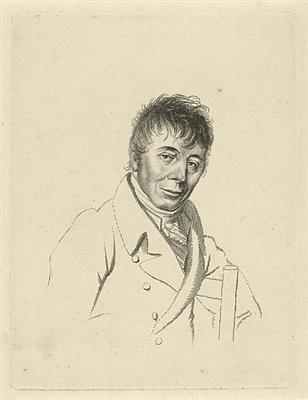
Biography
Born in Amsterdam on 20 December 1751[1], Dupré trained first under the landscapist Johannes van Dregt, then at the Stadstekenacademie under Jurriaan Andriessen. He made early study tours along the Rhine and through Switzerland and Germany before the Amsterdam authorities awarded him a grant in 1786[1] to travel to Italy and refine his skills as a landscape draughtsman. He spent four years on the peninsula, working in Rome, Naples, Tivoli, Sorrento, Capri and Civita Castellana before returning home in 1790.
The Italian years gave him his subject matter. His output was dominated by architectural views and atmospheric landscapes in watercolour, a medium he handled with considerable delicacy. Works like his View of Civita Castellana and Arcadian Landscape with Setting Sun, both now in the Rijksmuseum in Amsterdam, show his ability to build mood through carefully graduated washes, capturing the quality of light in the Roman Campagna and the melancholy grandeur of antique ruins.
Dupré spent the remainder of his life in Amsterdam, where he died on 4 June 1817[1]. His work belongs to a generation of Dutch[1] artists who looked south for their education and brought back a taste for Italian light and classical topography that would persist in Northern European painting well into the nineteenth century.
Timeline
- 1751Born in Amsterdam on 20 December.
- 1786Awarded a grant by Amsterdam authorities to travel to Italy to refine his skills as a landscape draughtsman.
- 1790Returned to Amsterdam after spending four years in Italy, working in Rome, Naples, Tivoli, Sorrento, Capri and Civita Castellana.
- 1790Created "View of Civita Castellana".
- 1790Created "Arcadian Landscape with Setting Sun".
- 1817Died in Amsterdam on 4 June.
Notable Works
Tap to view larger.
Next stop
Browse the movements →
Every movement in the collection, from the Renaissance to Pop art.
Related Artists


Frequently Asked Questions
What is Daniël Dupré known for?
Daniël Dupré is known for his architectural views and atmospheric landscapes in watercolour. His works, such as View of Civita Castellana and Arcadian Landscape with Setting Sun, demonstrate his skill in capturing the light of the Roman Campagna and the grandeur of antique ruins.What should I know about Daniël Dupré's prints?
Daniël Dupré was part of a larger art market in Amsterdam during the 17th century. At the time, Amsterdam was a centre for art collecting and dealing; artists like Rembrandt frequented print shops, auctions, and private sales to acquire works. Collectors often aimed to acquire paper art, including prints and drawings, by masters such as Dürer and Lucas van Leyden. Collections of prints and drawings were dispersed after the owner's death. Joachim von Sandrart, a collector in Amsterdam, sold his collection at auction in 1645, which included a substantial amount of paper art. Rembrandt also bought and sold art, reflecting his interests and dealing activities. His collection included prints by various artists, and he acquired multiple impressions of Dürer's works, likely for resale. These prints were organised into art books, with folios dedicated to Italian and German artists.What style or movement did Daniël Dupré belong to?
Daniël Dupré was a Dutch[1] Golden Age painter. The concept of physical movement was of great interest to artists during this period. They explored how to depict it and relate figures within a plane. Some followed the Italian model, concentrating on devices governing movement and line. Others explored the human body's potential for movement, not for its own sake, but for its capacity to express interior states of feeling in physical terms. Group portraiture in Holland during this period had its own conventions. Artists would depict physical movement, and relate figures in a plane. Some artists followed the Italian model, concentrating on devices governing movement and line. Others, however, were also interested in exploring the human body's potential for movement, not for its own sake but for its capacity to express interior states of feeling in physical terms. In Amsterdam, Pieter Isaacsz. was the main representative of the first group, and Aert Pietersz. of the second.What techniques or materials did Daniël Dupré use?
Daniël Dupré's techniques involved a layered approach to painting. He began with a crimson underpainting, which sometimes shows through the final layers. For the background, Dupré created a dense black effect by layering oil paint with ashes, sand, and coal dust. He employed a thick cream paint mixture, applying it with a broad spatula over the surface. After this, thinned black paint and turpentine were applied with a fine brush into the troughs created by the spatula. Touches of pure crimson red were then added to the blackened lines. Dupré used a palette knife extensively, not only for 'drawing' but also to expose the light colour of the primed canvas in certain areas. This method is similar to Dubuffet's use of *haute pâte*, which involves a thick mixture of oil paint, turpentine, colour washes, and granular materials.Where can I see Daniël Dupré's work?
Daniël Dupré's works can be viewed in numerous museums and galleries. These include the Musée du Louvre in Paris, which has both a painting and graphic arts department. Other locations in France include the Musée des Beaux-Arts in Nancy and the Musée d’Art et d’Industrie in Roubaix. Belgium also holds some of Dupré's pieces; for example, the Brangwyn Museum in Bruges and the Musées Royaux des Beaux-Arts de Belgique in Brussels. Outside of Europe, museums such as the Art Gallery of New South Wales in Sydney, Australia, also hold collections that may include Dupré. In the United Kingdom, Towneley Hall Art Gallery in Burnley and the National Gallery of Scotland in Edinburgh are potential locations. This list is not exhaustive; collections can change, so checking museum websites or catalogues directly is advisable.Where was Daniël Dupré from?
Daniël Dupré was Dutch[1]. Aelbert Cuyp, a painter from Dordrecht (a city in the province of South Holland), was born in 1620. Like his father, Jacob Gerritsz. Cuyp, Aelbert was born and worked in Dordrecht. Aelbert's pictures show a breadth of vision that was quite original. Aert de Gelder, another painter, came from Dordrecht as well. Frans Hals, who reflected the vitality of the country, transferred as a young man to Haarlem. He studied with Karel van Mander and spent the remainder of his life there. Hals trained some of the foremost younger Dutch painters. Jan van Goyen spent the first half of his working life in his native city of Leyden, and the second in The Hague. He studied with several masters, including Esaias van de Velde, and travelled extensively in the Netherlands and abroad.Who influenced Daniël Dupré?
Daniël Dupré's artistic development involved several influences. Early on, his father, Jacob Gerritsz, instructed him. He was also a pupil of Abraham Bloemaert. However, the most significant influence came from studying the works of Jan van Goyen, particularly van Goyen's harmonious, golden-yellow coloration, which became a defining element in Dupré's art. Later in his career, after 1660, the Italianate style of painting became more noticeable in Dupré's work. This included the classical pastoral style popularised by Jan Both. This Italian influence led to an extended colour range and the introduction of antique ruins, mountains, rocks, and idyllic shepherds into his pictures. Because of Dupré's handling of light, he was called the "Dutch[1] Claude Lorrain."Why are Daniël Dupré's works important today?
Daniël Dupré was part of a nineteenth-century trend of renewed interest in Dutch[1] history and national identity. This period saw increased study of Dutch history and a desire to celebrate national heroes and artists. The construction of monuments to important figures, such as Rembrandt and Joost van den Vondel, reflects this sentiment. Vondel was even proclaimed the national poet. This interest extended to funerary monuments; the tombs of figures such as admirals Michel de Ruyter and Maerten Tromp were venerated. Dupré's work connects to this broader movement. The Dutch Republic's revolt against absolutism, its triumph of Protestantism, and its national uprising against foreign oppression remained inspiring. Although the Dutch Republic's time as a major power had faded by the nineteenth century, certain aspects of its history continued to resonate. The cultural achievements of the Golden Age began to overshadow the economic and political ones.What was Daniël Dupré's art style?
Daniël Dupré handled watercolour with considerable delicacy. He built mood through carefully graduated washes, capturing the quality of light.How did Daniël Dupré die?
Daniël Dupré died in 1817[1] at the age of 66.
Sources
Editorial draws on the following primary and tertiary references for Daniël Dupré.
- [1] wikipedia Wikipedia: Daniël Dupré Used for: biography, birth dates, death dates, identifiers, movement attribution, nationality.
- [2] book Allison Lee Palmer, Historical Dictionary of Neoclassical Art and Architecture Used for: biography.
- [3] book Palmer, Allison Lee, Historical Dictionary of Neoclassical Art and Architecture Used for: stylistic analysis.
- [4] book Masterpieces of western art : a history of art in 900 individual studies from the Gothic to the present day Used for: biography.
- [5] book Metropolitan Museum Of Art, Metropolitan Museum Of Art - Dutch Painting, the Golden Age_ an Exhibition of Dutch Pictures of the Seventeenth Century, under the High Patronage of Her Majesty the Queen of the Netherlands - Metropolitan Museum of Art, Toledo Museum of Art, Art Used for: biography.
- [6] book Hochstrasser, Julie, Still life and trade in the Dutch golden age Used for: biography, stylistic analysis.
Editorial overseen by Solis Prints. Sources verified 2026-10-18. Click a source for details, or hover over [N] in the page above to preview.
Editorial standardsMethodologyCorrectionsAI disclosureAbout the editorial team