

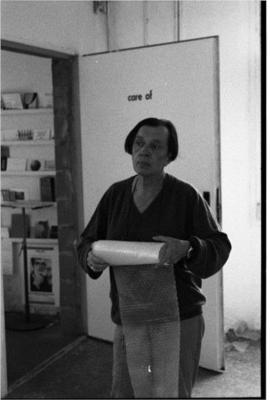
Dadamaino
Dadamaino trained as a doctor before abandoning medicine for paint. Born Eduarda Emilia Maino in Milan on 2 October 1930[1], she taught herself to paint in the late 1950s, held her first solo show at Galleria dei Bossi in 1958[1], and never looked back. The nickname came from childhood; the art that followed was entirely her own.
Biography
Her early Volumi series cut large oval holes into monochrome canvases, letting the wall itself become part of the composition. This brought her into Milan's Azimuth circle, founded by Piero Manzoni, and into the orbit of the international Zero movement, whose members were dismantling painting's conventions from Frankfurt to Tokyo. Throughout the 1960s she shifted from perforation to optical investigation, producing the Ricerca del Colore series (1967[1]) that graded spectral colours from light to dark, exploiting the way adjacent hues alter one another at their edges.
Later decades brought increasingly systematic work: alphabetic and sign-based sequences, and drawings built from tiny repeated marks that accumulate across large sheets of paper. The scale is modest; the effect is quietly hypnotic. She had solo presentations at two Venice Biennales, in 1980[1] and 1990, and a retrospective in Bochum in 2000.
Dadamaino died in Milan on 13 April 2004[1]. Works are held at Tate Modern, the Centre Pompidou, the Guggenheim Venice, and the Philadelphia Museum of Art. A 2021 retrospective at the Centre Pompidou, Women in Abstraction, introduced her to a new generation.
Timeline
- 1930Born Eduarda Emilia Maino in Milan on 2 October.
- 1958Held her first solo exhibition at Galleria dei Bossi.
- 1960Began her Volumi series, which featured oval holes cut into monochrome canvases.
- 1967Produced the Ricerca del Colore series, which graded spectral colours from light to dark.
- 1980Had a solo presentation at the Venice Biennale.
- 1990Had a solo presentation at the Venice Biennale.
- 2000A retrospective of her work was held in Bochum.
- 2004Died in Milan on 13 April.
Notable Works
Tap to view larger.
Next stop
Browse the movements →
Every movement in the collection, from the Renaissance to Pop art.
Related Artists





Frequently Asked Questions
What is Dadamaino's most famous work?
Dadamaino is best known for her series of works called *Volumi* (Volumes). These began in 1958[1] and occupied her for much of her career. The *Volumi* are typically constructed from transparent PVC sheets. These are often punctured with irregular holes. Dadamaino's *Volumi* explore themes of transparency, light, and space. They invite the viewer to consider the relationship between the artwork and its surrounding environment. The perforations create a play of light and shadow. This alters the appearance of the work depending on the viewing angle and light conditions. Although *Volumi* is her best-known series, Dadamaino also produced other significant bodies of work. These include the *Alfabeto della mente* (Alphabet of the Mind) and *Il fatto mentale* (The Mental Fact). These works often incorporate text and explore similar themes of perception and cognition. Her practice also extended to painting and printmaking. These different media allowed her to explore her conceptual interests through varied means.What should I know about Dadamaino's prints?
Dadamaino, born Eduarda Maino (1930[1]-2004[1]), was an Italian[1] visual artist associated with the Milanese avant-garde. She is best known for her contributions to kinetic and programmed art. Although Dadamaino explored various media throughout her career, her prints offer insight into her systematic approach. From the late 1950s, she produced works that investigated seriality and repetition. Her earliest prints often featured simple geometric forms, such as circles and squares, arranged in grid-like structures. These compositions reflect her interest in mathematical principles and the potential for generating complex patterns from basic elements. Later, Dadamaino expanded her printmaking practice to incorporate alphabetical characters. The "Alfabeto della mente" (Alphabet of the Mind) series, begun in the late 1960s, is a prime example. In these works, letters are isolated, fragmented, and recombined to challenge conventional modes of communication. These prints relate to her wider practice, which included installations and sculptural objects using similar motifs. Dadamaino's prints provide a more accessible entry point into her conceptual project. They demonstrate her engagement with the dematerialisation of the art object and the exploration of perception.What style or movement did Dadamaino belong to?
Dadamaino, born Eduarda Emilia Maino (1930[1]-2004[1]), was an Italian[1] visual artist whose practice resists easy categorisation. Although associated with the international Zero movement, she maintained a distinct artistic identity. The Zero group, active from the late 1950s, rejected traditional artistic conventions. They aimed to reduce art to its essential elements, often using monochrome colours and industrial materials. Dadamaino engaged with these ideas, particularly in her early work. She is known for her experimentation with surfaces, light, and space. Her work often incorporated transparent materials and serial repetition. Dadamaino's work moved beyond the strictures of the Zero group. She explored themes of language, perception, and social interaction. Her "Alfabeto della mente" (Alphabet of the Mind) series, begun in the 1960s, featured abstract letterforms. These works demonstrate her interest in communication and the structures of thought. While her work shares some affinities with Minimalism and Conceptual Art, Dadamaino developed a unique approach. She combined formal experimentation with a concern for human experience.What techniques or materials did Dadamaino use?
Dadamaino, born Eduarda Maino (1930[1]-2004[1]), worked with a variety of materials throughout her career. She is best known for her work with transparent or translucent plastic sheeting. In the late 1950s, Dadamaino began creating works by piercing holes in these surfaces. These early works, such as those in the series *Volumi*, explored the interaction of light and space. She often layered the perforated plastic, creating complex visual effects. Later, Dadamaino incorporated alphabetic characters and letterforms into her art. Her *Alfabeto della mente* (Alphabet of the Mind) series, begun in the late 1960s, featured silkscreened letters applied to plastic or canvas. These works investigated language, communication, and the relationship between the visual and the textual. She also experimented with other media, including painting and collage. Her practice was characterised by a spirit of experimentation and a desire to push the boundaries of traditional art forms. Dadamaino's innovative use of materials helped to define her unique artistic vision.What was Dadamaino known for?
Dadamaino (Eduarda Maino) was an Italian[1] visual artist associated with the European avant-garde movements of the 1960s. She is known for her contributions to kinetic art and her exploration of visual perception through geometric abstraction. Her early work involved the creation of dynamic structures using transparent materials; these explored light and movement. Later, Dadamaino became associated with the Zero Group, an international artistic movement that rejected subjective expression in favour of objective, often monochrome, constructions. She experimented with modular systems and serial repetition, creating works that invited viewer participation and challenged traditional notions of artistic authorship. Her work often incorporated industrial materials such as plastic and metal, reflecting the technological advancements of the time. Dadamaino's art investigated the relationship between order and chaos, presence and absence, and the interplay between the artwork and its surrounding space.When did Dadamaino live and work?
Dadamaino was born in Milan on 2 October 1930[1] and died there on 13 April 2004[1]. She was a key figure in the Italian[1] art scene from the late 1950s onwards. Her early work engaged with Dada and Surrealism, but she soon developed her own distinctive style, characterised by the use of repetition, transparency, and industrial materials. During the 1960s, she became associated with the Zero movement, an international network of artists who rejected traditional notions of art and sought to create new forms of expression. Her work from this period often incorporated perforated surfaces and modular elements, reflecting an interest in seriality and the dematerialisation of the art object. Dadamaino's career continued to evolve in the later decades of the twentieth century, as she experimented with different media and explored new themes. She remained active in the Italian and international art worlds until her death in 2004[1].Where can I see Dadamaino's work?
Dadamaino's work can be found in numerous public collections. These include museums in Italy, such as the Galleria Nazionale d'Arte Moderna e Contemporanea in Rome and the Museo del Novecento in Milan. Beyond Italy, her art is held in collections throughout Europe. Examples include the Centre Pompidou in Paris; the Stedelijk Museum in Amsterdam; and the Kunstsammlung Nordrhein-Westfalen in Düsseldorf. In the United States, Dadamaino's pieces are in the collection of the Museum of Modern Art (MoMA) in New York. These institutions offer opportunities to view examples of her diverse output. This includes her early abstract paintings, works from the *Volumi* series, and later explorations with alphabetical and textual elements. Checking the museums' websites for current exhibitions is advisable, as not all works are continuously on display. Major retrospectives dedicated to Dadamaino have also occurred at various points, which gather her work from multiple sources.Where was Dadamaino from?
Dadamaino was born in Milan, Italy, in 1930[1]. Her birth name was Eduarda Emilia Maino. She adopted Dadamaino as her artistic name in the late 1950s; the name combines "dada" with her surname. She remained based in Milan throughout her career. The city was a centre for Italian[1] art movements after the Second World War. She was associated with the Zero group, an artistic movement that rejected traditional painting and sculpture. Instead, they explored new materials and techniques. Dadamaino's early work included paintings and prints. She began creating her signature Volumi series in 1958[1]; these were three-dimensional works made from perforated plastic or metal. She also experimented with kinetic art, creating pieces that moved or changed shape. Her work often explored themes of perception, space, and the relationship between art and the viewer. Dadamaino died in Milan in 2004[1].Who did Dadamaino influence?
Dada's irreverence, ingenuity, and indifference to cultural estimations had an impact on subsequent artwork. The 'anti-art' orientation influenced another generation during the Cold War. Movements such as Art Brut, Cobra, Brutalism, Gutai, Kineticism, Lettrism, the Situationist International, Nouveau Réalisme, Semina and the Rat Bastard Protective Association, Fluxus, Viennese Actionism, and Arte Povera all bear the imprint of Dada. Figures such as John Cage, Merce Cunningham, and Paul Taylor were influenced by Dada, collage, and performance. Artists like Daniel Spoerri and Allan Kaprow, pioneer of happenings, were labelled Neo-Dada artists, though they considered the term derogatory. Robert Rauschenberg was enabled to get out from under Abstract Expressionism. The embrace of raw materiality was a godsend to Josef Beuys. Richard Hamilton and James Rosenquist found a cornucopia of primary materials ready to hand for Pop art. Jean-Michel Basquiat was influenced by George Grosz. Kounellis has been affected by Dada precedents, exploiting chance and improvisation.Who influenced Dadamaino?
Dadamaino's work, like that of many artists of her generation, shows the influence of Dada. The Dada movement, which began in the 1910s, questioned established artistic, social, and political orders. Dada artists employed absurdity, chance, and unconventional materials to challenge traditional values. The "anti-art" orientation of Dada had a comparable impact on a later generation of artists during the Cold War. Dada's recognition of the artistic potential of everyday objects and its indifference to cultural estimations of high and low art also had an impact. The Italian[1] artist Kounellis, for example, was affected by Dada precedents. His tableaux, like Dadamaino's work, exploited chance and improvisation. The writings of Tristan Tzara, a Dadaist who worked in Paris and Zurich, were influential among artists exploring apolitical Dada.Who was Dadamaino?
Dadamaino (Edoarda Emilia Maino, 1930[1]-2004[1]) was an Italian[1] visual artist associated with the Milanese avant-garde. She is best known for her contributions to kinetic art and her exploration of minimalist aesthetics. Dadamaino began her artistic career in the late 1950s, initially influenced by informal art. By the early 1960s, she had developed her distinctive style, characterised by the use of perforated surfaces and the interplay of light and shadow. Her work often incorporated industrial materials, reflecting a concern with the integration of art and technology. She participated in various exhibitions, gaining recognition for her innovative approach to form and space. Dadamaino's practice also touched on conceptual art, particularly in her later works. She explored themes of perception, language, and the relationship between the artwork and the viewer.Why are Dadamaino's works important today?
Dadamaino's practice is significant because of her engagement with the legacy of Dada, and its continued influence on art. Dada's core principles included irreverence, ingenuity, and a disregard for traditional hierarchies. Dada artists embraced chance, championed the role of the dilettante, and defied obsequious professionalism. Dada's influence extended beyond its immediate circle, shaping various artistic movements and individual practices. The iconoclastic nature of Dada made it a source of inspiration for artists across different mediums. The movement’s emphasis on assemblage, collecting, and recycling anticipated the disjuncture between art institutions and environmental concerns. Dada's recognition of artistic potential in rubbish and chaos has had a lasting impact. Dada's influence can be seen in the work of artists such as Jackson Pollock, Christoph Schlingensief, and Richard Layzell. These artists demonstrate Dada's continuing relevance to artistic practices in the late twentieth and early twenty-first centuries. Dada’s influence manifests in diverse ways, including action painting, politically charged activities, and the subversion of audience expectations.
Sources
Editorial draws on the following primary and tertiary references for Dadamaino.
- [1] wikipedia Wikipedia: Dadamaino Used for: biography, birth dates, death dates, identifiers, movement attribution, nationality.
- [2] book guggenheim-handboo00pegg Used for: biography.
- [3] book guggenheim-transfsi00wald Used for: biography.
- [4] book Braun, Emily, 1957-; Asor Rosa, Alberto; Royal Academy of Arts (Great Britain), Italian art in the 20th century : painting and sculpture, 1900-1988 Used for: biography.
Editorial overseen by Solis Prints. Sources verified 2026-08-31. Click a source for details, or hover over [N] in the page above to preview.
Editorial standardsMethodologyCorrectionsAI disclosureAbout the editorial team