

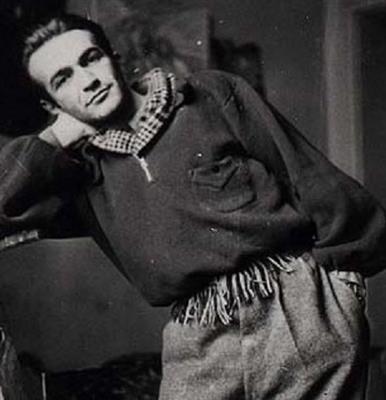
Corrado Cagli
Corrado Cagli's biography reads like a catalogue of 20th-century ruptures. Born in Ancona in 1910[1], he made his public debut at seventeen with a mural on Rome's Via Sistina, and held his first solo exhibition in 1932[1]. In the mid-1930s he co-founded the Scuola Romana alongside Giuseppe Capogrossi and Emanuele Cavalli, a group that sought a synthesis of Mediterranean tradition and contemporary sensibility.
Biography
Mussolini's racial laws of 1938[1] ended that phase abruptly. Cagli, who was Jewish, fled Italy for Paris and then New York, where he obtained American citizenship. He enlisted in the U.S. Army, participated in the Normandy landings in June 1944, fought through Belgium and Germany, and was among the soldiers who entered Buchenwald on its liberation. He drew what he saw there. The resulting images are among the most direct documentary artworks produced by any participant in the liberation.
After the war, a Guggenheim Fellowship in 1946[1] supported his move into abstract and neo-cubist territory. He returned to Rome in 1948 and continued working across figurative and non-figurative modes for the rest of his life, winning the Marzotto Prize in 1954 and creating a banner for Siena's Palio in 1972. He died in Rome in 1976[1].
Timeline
- 1910Born in Ancona.
- 1927Made his public debut with a mural on Rome's Via Sistina at 17.
- 1932Held his first solo exhibition.
- 1935Co-founded the Scuola Romana with Giuseppe Capogrossi and Emanuele Cavalli.
- 1938Fled Italy for Paris, then New York, due to Mussolini's racial laws.
- 1944Participated in the Normandy landings as a member of the U.S. Army in June.
- 1945Entered Buchenwald as part of its liberation and created documentary artworks of what he witnessed.
- 1946Received a Guggenheim Fellowship, supporting his move into abstract and neo-cubist styles.
- 1948Returned to Rome.
- 1954Won the Marzotto Prize.
- 1972Created a banner for Siena's Palio.
- 1976Died in Rome.
Next stop
Browse the movements →
Every movement in the collection, from the Renaissance to Pop art.
Related Artists


Frequently Asked Questions
What is Corrado Cagli known for?
Corrado Cagli is known for his participation in the Normandy landings in June 1944[1] and for being among the soldiers who entered Buchenwald. He created direct documentary artworks based on what he witnessed there.What is Corrado Cagli's most famous work?
Corrado Cagli's artistic output spanned several media and styles, making it difficult to identify a single, definitive "most famous work". He is perhaps best known for his association with the Roman School (Scuola Romana), a movement that rejected the prevailing Novecento Italiano style in favour of a more expressionistic and colourful approach. During the 1930s, Cagli developed a unique style he termed "Magic Realism", characterised by dreamlike imagery and symbolic content. Examples from this period include his murals and paintings with classical themes. After immigrating to the United States in 1939[1], Cagli's work took on new dimensions. He experimented with abstract expressionism and incorporated elements of his wartime experiences. His designs for the ballet "The Seasons" (1947), with music by John Cage, brought him recognition in New York's artistic circles. Later in life, Cagli returned to Italy, and his later works often explored themes of memory and identity. Given the diversity of his career, Cagli's notability rests on several bodies of work rather than one specific piece.What should I know about Corrado Cagli's prints?
When considering Corrado Cagli's prints, it is useful to understand some basic printmaking terminology and practices. An "original print" is conceived as a print, executed solely as a print, and usually produced in a numbered edition signed by the artist. Each print in the edition is an original, printed from a plate, stone, screen, block or other matrix created for that purpose. There is no single original print from which copies are made. Prints are often produced in limited editions, where the artist sets a specific number of prints. These are numbered (for example, 35/100, meaning it is the 35th print of 100). Some artists also create artist's proofs, marked "AP". The edition number is a claim by the artist, and adds value to the work. Prints can be woodcuts, engravings, linocuts, mezzotints, etchings, lithographs or serigraphs. Offset reproductions, also known as posters, are reproduced by photochemical means. Giclée prints are inkjet fine art prints. Canvas transfers involve transferring the image onto canvas to give the look of a painting.What style or movement did Corrado Cagli belong to?
Corrado Cagli's artistic affiliations are complex. He engaged with multiple styles, resisting easy categorisation. In the late 1930s, Cagli connected with the Corrente group in Milan. This association placed him among artists rejecting Fascist cultural policies. They sought a renewed connection with European art, moving away from nationalistic classicism. The group favoured a generic Expressionism. After the Second World War, Cagli was associated with the Fronte Nuovo delle Arti in 1947[1]. This group aimed to synthesise contrasting tendencies, prioritising a dialectic of forms over a fixed aesthetic. However, the Fronte was short-lived, and Cagli's subsequent direction is less clearly defined. Later in his career, Cagli's work moved towards abstraction. Some critics link him to movements like Arte Informel, characterised by a rejection of traditional form and an emphasis on the artist's gesture and materials. However, Cagli's position within these later movements requires further investigation.What techniques or materials did Corrado Cagli use?
Corrado Cagli experimented with a range of materials and methods. Like many artists, he understood that the physical properties of a medium influence the final artwork. Cagli is known for developing a "new type of glass picture". These were not transparent window pieces, but opaque glass works intended to be hung on a wall or mounted as part of a building, either indoors or outdoors. The technique he used was sandblasting. He employed flashed glass, which typically features a milk-glass body covered with a thin coating of coloured glass, often black or red. Sandblasting involved covering the glass with a stencil, cutting out the design, and then using high-pressure sand to grind a relief into the exposed areas. Shorter sandblasting times could create a dull finish instead of a relief. Cagli also used glass painters' colours, which were made permanent by firing in a kiln.What was Corrado Cagli known for?
Corrado Cagli (1910[1]-1981) was an Italian[1] painter and sculptor, also noted for his work in set design and costume. In the 1930s, Cagli was part of the Roman School, which moved away from the prevailing Novecento Italiano style. This group favoured a more expressionistic approach. During this period, Cagli developed a personal style incorporating elements of cubism and futurism. He is known for his murals and involvement in the antifascist resistance during World War II, after which he emigrated to the United States. After the war, his style shifted towards abstraction. Cagli experimented with different media, including graphics and stage design, and he developed an interest in colour theory. He returned to Italy in the 1960s, where he continued to work until his death.When did Corrado Cagli live and work?
Corrado Cagli was born in Ancona, Italy, in 1910[1]. He died in Rome in 1976[1]. In 1937[1], Cagli created a mural for the Italian[1] Pavilion at the Paris International Exposition. He was involved in the anti-fascist resistance during World War II. After the war, he spent time in the United States, painting a mural for the Department of Geology in Kansas City, Missouri. He returned to Italy a year later. Cagli participated in the 1948 International Exhibition of Abstract and Concrete Art in Milan. He also exhibited in the 1951 Abstract and Concrete Art in Italy show in Rome. In 1952, Cagli participated in the Omaggio a Leonardo exhibition at the Fondazione Origine, Rome.Where can I see Corrado Cagli's work?
You can find Corrado Cagli's work in numerous public collections. These include the Los Angeles County Museum of Art (LACMA); the Metropolitan Museum of Art, in New York; the Minneapolis Institute of Arts; and the Museum of Modern Art, also in New York. Other locations include the Royal Ontario Museum in Toronto; the Virginia Museum of Fine Arts in Richmond; and the Wolfsonian at Florida International University, in Miami Beach. In the United Kingdom, Cagli's art can be viewed at the Brighton Museum & Art Gallery; the Geffrye Museum, in London; the Manchester Art Gallery; the National Museums of Scotland, in Edinburgh; and the Victoria & Albert Museum, in London. Additionally, various university collections hold pieces, such as the Ackland Art Museum, the Allen Memorial Art Museum, the Princeton University Art Museum, the Fogg Art Museum, the University Art Museum (Santa Barbara), the University of Michigan Museum of Art, and the Yale University Art Gallery.Who did Corrado Cagli influence?
It is difficult to identify specific artists directly influenced by Corrado Cagli. However, some general observations can be made about his artistic milieu and potential influences. After World War II, Italian[1] art saw a tension between embracing international modernism and forging an independent identity. Some artists adopted "picassism," a post-Cubist style. Others, like Giuseppe Marchiori, sought to reconnect with the originality of Futurism and Metaphysical art. During this period, abstract art gained traction in Rome with the Forma group, including Giulio Turcato, Pietro Consagra, and Achille Perilli. Turcato combined post-Cubism with Balla's abstractions, evoking emotive space with colour. Dorazio, another member, analysed form, drawing inspiration from Balla's iridescent grids. The critic Germano Celant noted a cultural shift in Milan around 1956[1]-1958[1], marked by exhibitions and discussions that pushed artistic boundaries. Figures like Lucio Fontana and Piero Manzoni explored new visual languages, impacting Conceptual and Performance art.Who influenced Corrado Cagli?
Corrado Cagli's artistic development occurred in a milieu influenced by diverse figures and movements. Futurism was a significant presence in Italian[1] art during Cagli's formative years. Some scholars have described Giulio Evola, who had close ties to Futurism, as practically a student of Giacomo Balla. Evola regularly visited Balla's studio alongside artists such as Enrico Prampolini, and the Corradini brothers. Evola's early Theosophical abstraction was heavily influenced by Balla. Cagli would have been exposed to the broader context of Futurism, which drew inspiration from various sources. Filippo Marinetti, a central figure in Futurism, promoted the movement's ideas. Umberto Boccioni, Carlo Carrà, and Gino Severini, all key Futurists, contributed to the development of its theories and practices. Futurism itself was influenced by artists like Picasso, Michelangelo, and Henri Matisse.Who was Corrado Cagli?
Corrado Cagli (1910[1]-1976[1]) was an Italian[1] artist with a varied career, encompassing painting, sculpture, and stage design. Born in Ancona, he moved to Rome, where he became part of the Roman School. Cagli's early work showed an interest in social themes, but he later developed a more abstract style. During the Fascist era, his art was considered degenerate, and he left Italy for Paris and then the United States. He served in the US Army during World War II. After the war, Cagli returned to Italy and became involved with the Art Club in Rome. His style continued to evolve, incorporating elements of abstraction and expressionism. He also explored set design for theatre and ballet. His work is characterised by its experimentation with form and materials, and his career reflects the artistic and political changes of the 20th century.Why are Corrado Cagli's works important today?
Corrado Cagli (1910[1]-1981) was an Italian[1]-American artist whose career spanned several movements; his work acts as a cultural bridge between Europe and the United States. Cagli's early work was associated with the Roman School. He developed a personal style, and his work was included in the Venice Biennale in 1942[1]. During the Second World War, Cagli served in the US Army and, after the war, he became a US citizen. In the post-war period, Cagli played a part in introducing Italian art to the American public. He had a solo exhibition at the Catherine Viviano Gallery in New York in 1950. This gallery was important for promoting modern Italian art in the US. Cagli's role as a cultural ambassador is important, as he helped to create a dialogue between Italian and American artists during the Cold War. His work provides insight into the artistic exchanges that occurred during this period.
Sources
Editorial draws on the following primary and tertiary references for Corrado Cagli.
- [1] wikipedia Wikipedia: Corrado Cagli Used for: biography, birth dates, death dates, identifiers, movement attribution, nationality.
- [2] book guggenheim-handboo00pegg Used for: biography, stylistic analysis.
- [3] book guggenheim-metph00cela Used for: biography, stylistic analysis.
- [4] book guggenheim-youngereuropeanp00swee Used for: biography.
- [5] book Braun, Emily, 1957-; Asor Rosa, Alberto; Royal Academy of Arts (Great Britain), Italian art in the 20th century : painting and sculpture, 1900-1988 Used for: biography.
- [6] book Metropolitan Museum of Art (New York, N.Y.), The Age of Caravaggio Used for: biography.
Editorial overseen by Solis Prints. Sources verified 2026-08-29. Click a source for details, or hover over [N] in the page above to preview.
Editorial standardsMethodologyCorrectionsAI disclosureAbout the editorial team