

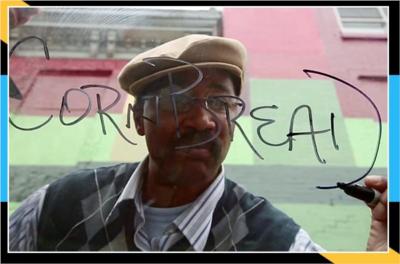
Cornbread
In 1967, a fifteen-year-old from Brewerytown, Philadelphia decided the best way to impress a girl named Cynthia Custuss was to write his name across the entire north side of the city. Darryl McCray, who went by the tag Cornbread, covered walls, buses, and shop fronts with "Cornbread Loves Cynthia" in a campaign so systematic and persistent that it is now widely recognised as one of the earliest examples of modern graffiti tagging.
Biography
The nickname came from the Youth Development Center, where he had started complaining to the cook about the white bread served at meals. After a Philadelphia newspaper falsely reported he had been killed in a gang fight, he tagged an elephant named Konna at the Philadelphia Zoo in 1971 to prove the rumour wrong. "Cornbread Lives" appeared on the animal's flank. The story ran nationally.
Four decades after writing his first tag, McCray ended up working for the city that had spent years trying to stop him. Philadelphia Mayor Wilson Goode recruited him in 1984 to join the Anti-Graffiti Network, a programme that eventually evolved into the Mural Arts Program, now the largest public mural programme in the United States. McCray became a public speaker and youth advocate. He married Consuela Sanchez in 2021; Cynthia Custuss, the girl who first inspired his writing, remained part of his life. He was inducted into the East Harlem Graffiti Hall of Fame in 2013.
Timeline
- 1953Born Darryl McCray in Philadelphia; later known as Cornbread.
- 1967Began tagging "Cornbread Loves Cynthia" across Philadelphia at 15 to impress a girl.
- 1971Tagged an elephant named Konna at the Philadelphia Zoo with "Cornbread Lives" to disprove rumours of his death.
- 1984Recruited by Philadelphia Mayor Wilson Goode to join the Anti-Graffiti Network.
- 2013Inducted into the East Harlem Graffiti Hall of Fame.
- 2021Married Consuela Sanchez.
Notable Works
Tap to view larger.
Next stop
Browse the movements →
Every movement in the collection, from the Renaissance to Pop art.
Frequently Asked Questions
What is Cornbread known for?
Cornbread is known as one of the earliest examples of modern graffiti tagging. He systematically covered walls, buses, and shop fronts with his name.What is Cornbread's most famous work?
It is difficult to identify Cornbread's single most famous work, as the passages provided do not reference this artist. However, the passages do discuss several famous works by other artists. For example, Caravaggio's early works from Rome include "Boy Peeling Fruit" (Fanciullo che monda un pomo), which was identified as his first known work in 1996. Other paintings from this period are "Sick Self Portrait" (Bacchino malato) and "Boy with Fruit" (Fanciullo con canestro di frutta); all three date from around 1593. These paintings are well-recorded in photographs and listed in significant catalogues of Caravaggio's work. Three of Caravaggio's paintings were destroyed in Berlin in 1945, and another was stolen in Palermo in 1969. Other works mentioned in the passages include Andrea del Castagno's "The Last Supper", Michelangelo's Laurentian Library, and several works by Giuseppe Arcimboldo, such as "The Lawyer" and "The Librarian".What should I know about Cornbread's prints?
When considering Cornbread's prints, bear in mind some basic principles. An original print is conceived as a print, and executed solely as a print. Each print in the edition is an original, made from a plate, stone, screen, or block created for that purpose. The artist inks and pulls each print individually; this makes it a multi-original medium. The artist decides the number of prints in the edition. Sequential numbering provides an accounting for the number of prints in the edition. Each print has a specific number; for example, 12/25 means it is print number 12 from an edition of 25. The artist usually signs the print. A reproduction is a copy of a work of art initially conceived in another medium, such as painting or watercolour. Usually, reproductions are made by photomechanical means. Numbering and signing a reproduction does not change its essence; it is still a reproduction, not an original print. Edition descriptions are always signed in pencil. The edition claim is written as a pair of numbers on the left bottom margin of the print: the print number and the edition number. The title of the print is written in the middle of the bottom margin, and the signature is on the right.What style or movement did Cornbread belong to?
Cornbread's artistic style can be related to the traditions of Hieronymus Bosch and Pieter Bruegel the Elder. These earlier artists depicted scenes of everyday life and popular culture, often with a focus on the contrast between Carnival and Lent. This theme, popular as early as the thirteenth century, appeared in paintings and festive confrontations. Bruegel's painting *Battle between Carnival and Lent* shows a staged battle in a town centre, involving the citizenry. He designed prints, and Frans Hogenberg engraved them. Hogenberg also created his own version of *Carnival and Lent* in 1558. These works suspend official symbolism, and allow the body to be boss for a brief period. Like Bosch and Bruegel, Cornbread engages with vernacular symbolism and the comedy of everyday life.What techniques or materials did Cornbread use?
Cornbread, a graffiti artist from Philadelphia, is known for tagging walls with his name. He began this practice in the late 1960s. According to some accounts, Cornbread's initial motivation was to attract the attention of a girl. Cornbread's medium was primarily spray paint. He used it to write his name repeatedly on surfaces throughout the city. This included walls, vehicles, and even an elephant at the Philadelphia Zoo. These actions predate the widespread graffiti art scene that emerged in New York City in the 1970s. While specific details about the brands or types of spray paint Cornbread employed are scarce, it is understood that he favoured readily available commercial spray paints. These paints allowed for quick and visible markings. His focus was on quantity and visibility, rather than complex artistic techniques. The simplicity and directness of his tagging became his signature.When did Cornbread live and work?
Michelangelo Merisi da Caravaggio was born in 1571, probably in Milan. His parents, Fermo di Bernardino Merisi and Lucia Aratori, were from the town of Caravaggio. Fermo was possibly a mason, or perhaps majordomo and architect to Francesco I Sforza, Marckese di Caravaggio. In 1576, the family moved from Milan to Caravaggio, likely to avoid the plague. Caravaggio's father died the following year. In 1584, Caravaggio was apprenticed to the painter Simone Peterzano in Milan for four years. By 1589, he was documented back in Caravaggio, where his mother died in 1590. By 1592, Caravaggio was living in Caravaggio with his brother, dividing their inheritance. Around the age of twenty, he moved to Rome. He worked for Monsignor Pandolfo Pucci, painting copies of devotional pictures. Later, he joined the workshop of the Cavaliere d'Arpino for eight months, painting flowers and fruit. Caravaggio died in Porto Ercole in 1610.Where can I see Cornbread's work?
Cornbread (Darryl McCray) began tagging walls in Philadelphia in the late 1960s. His early work was concentrated in his neighbourhood. He tagged walls to get the attention of a girl. Cornbread's work is public, and much of it is unsanctioned. It can be viewed on walls and trains in Philadelphia. Some examples are at Philadelphia's City Hall, and the Philadelphia Zoo (where he tagged a giraffe). Collectors have purchased some of Cornbread's painted canvases. These can be found in private collections. His work has been exhibited in galleries, too. In 2019, his work was part of the "Beyond the Streets" exhibition in Brooklyn, New York. This show included a tribute to graffiti art. It featured works by artists such as Fab 5 Freddy, Lady Pink, and Takashi Murakami.Where was Cornbread from?
Cornbread, whose real name is Darryl McCray, was born in Philadelphia, Pennsylvania, in the United States. He grew up in the Strawberry Mansion neighbourhood of North Philadelphia during the 1960s. McCray began writing "Cornbread" as a tag in 1967 as a way to gain attention from a girl he liked. He initially wrote on walls in his neighbourhood. He soon expanded his tagging to other parts of the city. His early tags were simple and direct. They usually just read "Cornbread". McCray's tagging predates the New York City graffiti boom of the 1970s. Some consider him the first modern graffiti artist. He gained local celebrity for his prolific tagging. He even tagged a private jet owned by The Jackson Five. McCray's work evolved over time. He developed a more stylised signature. He also started using spray paint in addition to markers. He has remained active in the Philadelphia art scene. He now works on commissioned murals and other projects.Who did Cornbread influence?
Cornbread's influence is visible in the work of Jean-Michel Basquiat, who repeatedly referenced jazz musicians, particularly Charlie Parker. Basquiat's paintings often include the word "ornithology", a reference to Parker's nickname "Bird" and one of his compositions. Basquiat seems to connect Parker to the idea of the artist as martyr, and his references to royalty connect to unscrupulous practices of record producers who withheld royalties. Basquiat's work also shows the influence of jazz's negotiation between African and American influences. His painting Zydeco addresses creolised music from Louisiana, combining French Creole, Cajun, and African American styles such as gospel, R&B, and jazz. Basquiat built upon the processes and innovations of bebop to develop a practice that was expressive and conceptual.Who influenced Cornbread?
It is difficult to say exactly who influenced Cornbread, as the name appears in several contexts. One is as a graffiti artist in Philadelphia, active from the late 1960s. Another is as a possible nickname for the American artist David Smith (1906-1965[1]). If referring to David Smith, his influences included John Graham, Jan Matulka, John Sloan, and Katherine Lahey. Smith also drew inspiration from nature, such as the movement of swallows, the shapes of rocks, and the growth patterns of trees. Encounters with friends, music, and memories of his workshop at 1 Atlantic Avenue also played a role in his artistic development. Smith's influences extended to the materials and tools he used, such as forging tongs, buffalo horn, and pearl shell. Another possible Cornbread was associated with the State University of New York, College at Cortland, in the late 1970s and early 1980s. This Cornbread was part of a group called the Theoretical Community, which included scholars and activists from various departments. This group engaged with a wide range of theoretical perspectives, from the Frankfurt School to French poststructuralism.Who was Cornbread?
The graffiti artist Cornbread was active in New York City during a period when hip-hop culture gained prominence. During this time, graffiti artists like Fab Five Freddy (Frederick Brathwaite) and Futura 2000 (Lenny McGurr) were invited to curate exhibitions, such as Beyond Words, which became a significant cultural event. Cornbread was part of a community of artists, musicians, and cultural figures who frequented clubs and art spaces in the city. This environment facilitated interactions and collaborations among diverse creative individuals. Cornbread's work, along with that of contemporaries, contributed to the broader artistic movements emerging from New York's urban scene. These artists often drew inspiration from their surroundings, addressing social issues and personal experiences in their art.Why are Cornbread's works important today?
Cornbread, whose given name is Darryl McCray, is considered the first modern graffiti artist. In 1967, McCray began writing "Cornbread" on walls around his Philadelphia neighbourhood to attract the attention of a girl. His simple tag predates the New York graffiti boom of the 1970s and 1980s. McCray's early work is important because it establishes several features of later graffiti. These include the use of a personal tag name, repetition of the tag in many locations, and the use of public space as a canvas. Later, McCray gained local fame when he wrote "Cornbread" on a plane owned by the Jackson 5. He was asked to tag walls at a local zoo. By the early 1970s, McCray had stopped writing graffiti. He became an anti-graffiti activist in Philadelphia. He lectured about the negative effects of tagging. Cornbread's early example set the stage for later artists. His story is often cited in documentaries and histories of graffiti. He is seen as a pioneer of a now global art form.
Sources
Editorial draws on the following primary and tertiary references for Cornbread.
- [1] wikipedia Wikipedia: Cornbread Used for: biography, birth dates, death dates, identifiers, movement attribution, nationality.
- [2] book Factory work : Warhol, Wyeth, Basquiat Used for: biography.
- [3] book Dempster, Alec, 1971- author, Lotería Huasteca : woodblock prints Used for: stylistic analysis.
- [4] book Jordana Moore Saggese, Reading Basquiat: Exploring Ambivalence in American Art Used for: biography.
- [5] book The Editors of New York Magazine, The Encyclopedia of New York Used for: stylistic analysis.
- [6] book Landauer, Susan, The not-so-still life : a century of California painting and sculpture Used for: biography.
Editorial overseen by Solis Prints. Sources verified 2026-08-31. Click a source for details, or hover over [N] in the page above to preview.
Editorial standardsMethodologyCorrectionsAI disclosureAbout the editorial team