



Constant Permeke
Constant Permeke is the painter most associated with the brooding, earth-saturated face of Flemish Expressionism[8]. Born in Antwerp in 1886[8], he studied at the academies in Bruges and Ghent before joining the colony of artists around Laethem-Saint-Martin, the village south of Ghent where Flemish art's break with academicism effectively began. He was one of the so-called Second Laethem Group, whose members pushed the rural Flemish subject towards psychological weight and formal distortion rather than gentle symbolism.
Biography
The First World War cut across his career with unusual force. Permeke was severely wounded in 1914[8] and spent much of the war in England, where the coastal fishing towns of Devon left a deep mark on his imagination. Fishermen, peasants, and the sea became his subjects for the rest of his life: figures rendered with thick impasto and compressed, monumental forms, their faces simplified almost to masks, their bodies fused with earth and water. The colours are restricted to ochres, blacks, and dark greens, giving even his largest canvases a quality of weight and silence.
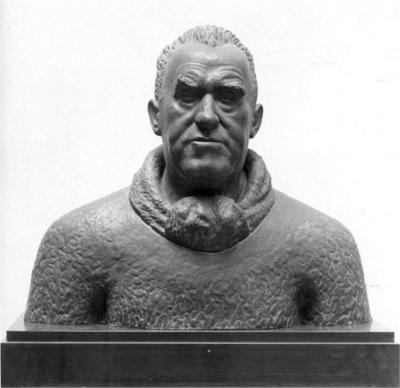
His reputation in Belgium solidified during the 1920s and 1930s. The merchant Paul-Gustave Van Hecke promoted Belgian[8] Expressionism[8] internationally, and Permeke was consistently named alongside Gustaaf Van de Woestijne and Gust de Smet as the movement's central figures. He also turned to sculpture from the 1930s, producing monumental figures in the same spirit as his paintings.
In 1929[8] Permeke built a house and studio in Jabbeke, west of Bruges, where he lived until his death in 1952[8]. The building is now the Permeke Museum, housing a permanent collection of his paintings and sculptures alongside the working spaces where much of his late work was made.
Timeline
- 1886Born in Antwerp.
- 1914Severely wounded during the First World War.
- 1914Spent much of the First World War in England, where he was influenced by the coastal fishing towns of Devon.
- 1920His reputation in Belgium solidified during this decade.
- 1929Built a house and studio in Jabbeke, west of Bruges.
- 1930Turned to sculpture, producing monumental figures.
- 1952Died in Jabbeke, west of Bruges.
Notable Works
Tap to view larger.
Where to See Constant Permeke
7 museums worldwide.
-
 31 works
Royal Museum of Fine Arts Antwerp
Antwerp, Belgium
Tue–Fri 10:00–17:00, Sat–Sun 10:00–18:00; closed Mon · €22 adults, €2 under-26
-
 11 works
Museum of Fine Arts Ghent (MSK)
Ghent, Belgium
Tue–Fri 09:30–17:30, Sat–Sun 10:00–18:00, closed Mondays
-
 4 works
Museum Boijmans Van Beuningen
Rotterdam, Netherlands
Main building closed for renovation until 2029; Depot open Tue–Sun 11:00–17:00 · Depot €20 adults
-
3 works
Van Abbemuseum
Eindhoven, Netherlands
Tue–Sun 11:00–17:00, closed Mondays · €16 adults
-
1 works
Aberdeen Archives, Gallery and Museums collections
Aberdeen, United Kingdom
-
1 works
Kröller-Müller Museum
Otterlo, Netherlands
Tue–Sun and holidays 10:00–17:00, closed Mondays (except summer period)


Next stop
Expressionism →
Explore the artists and ideas of Expressionism.
Constant Permeke prints
Hand-finished archival prints from Constant Permeke's body of work.


Related Artists


Take Constant Permeke home.
See all Constant Permeke prints →Frequently Asked Questions
What is Constant Permeke's most famous work?
It is difficult to single out one definitive piece as Constant Permeke's most famous. His body of work includes paintings, drawings, and sculptures, and he gained recognition for his distinctive style and subject matter. Permeke is particularly known for his portrayals of rural life and the working class in Belgium. He often depicted farmers, fishermen, and their families, capturing their connection to the land and sea. These works often show a sympathy for his subjects, and a concern with the realities of manual labour. Some of his well-known paintings include *The Harvester*, *The Ostend Fisherman*, and *The Couple*. These pieces are typical of his style, with their simplified forms, heavy contours, and earthy colour palettes. Permeke's sculptures, often in bronze or wood, also reflect his interest in the human figure and his ability to convey emotion through form.What should I know about Constant Permeke's prints?
Constant Permeke (1886[8]-1952[8]) was a Belgian[8] painter and sculptor, and one of the leading figures in Flemish Expressionism[8]. While he is best known for his paintings, Permeke also produced a number of prints, mainly woodcuts and lithographs. Permeke's prints share many stylistic elements with his paintings. They often feature heavy, simplified forms and a strong emphasis on the human figure, particularly peasants and working-class people. His prints often depict scenes of rural life, reflecting his interest in the daily lives and struggles of ordinary people. His woodcuts are characterised by bold lines and a rough, textured surface, achieved by carving directly into the woodblock. His lithographs display a similar directness and simplicity, with a focus on capturing the essential forms and emotions of his subjects. Permeke's prints are an important part of his overall artistic output, offering a more accessible and affordable way to experience his distinctive artistic vision.What style or movement did Constant Permeke belong to?
Constant Permeke is associated with Expressionism[8], an early 20th-century artistic movement, although his work also shows the influence of other styles. Expressionism prioritised the communication of emotional experience, often at the expense of formal compositional qualities. Permeke's art shares characteristics with German Expressionism, which valued the emotional impact of colour over its realistic qualities. German Expressionists aimed to capture the essence of things, using dynamic brushwork and emphasising the materiality of paint. Expressionism encompassed a broad attitude to life, reflecting artists' emotions and their relationship to the world. Permeke is sometimes linked to Flemish Expressionism, a regional variation. His simplified forms and focus on rural subjects align with some aspects of this style. However, it is important to note that Expressionism was not a rigidly defined style; the artists associated with it displayed a range of individual approaches.What techniques or materials did Constant Permeke use?
Constant Permeke's practice included painting and sculpture. Permeke's paintings often feature thick layers of impasto, a technique where paint is applied thickly to a surface. This creates texture and dimension. In painting, Permeke used oil paint. Oil paint allowed him to build up layers and create depth. He also worked with watercolour. Permeke's colour choices tended toward earth tones, reflecting the somber themes he explored. These included the hardships of peasant life and the power of nature. Permeke also produced sculptures, often using materials such as plaster, wood, and bronze. His sculptures share similar themes to his paintings, with a focus on the human figure and its relationship to the earth.What was Constant Permeke known for?
Constant Permeke (1886[8]-1952[8]) was a Belgian[8] painter and sculptor, working within the Expressionist style. Expressionism[8] sought to depict emotional experience rather than physical reality. Permeke's art often featured simplified forms and heavy contours. Permeke's paintings frequently depicted rural life and labourers. His subjects included fishermen, farmers, and families. These figures are often portrayed with a sense of monumentality, reflecting the hardships and dignity of their existence. His colour palette tended towards earth tones, further emphasising the connection to the land. During the early 20th century, Expressionist artists valued directness and simplicity. They were interested in bold colours, and some were influenced by the style of 15th-century woodcuts. Expressionism valued surface and image qualities over compositional concerns.When did Constant Permeke live and work?
Constant Permeke was a Flemish artist. His work was featured in several exhibitions during his lifetime. These exhibitions provide a timeline of his active career and reception. Notably, Permeke's art was included in "Belgian[8] Art" at the Musée du Jeu de Paume, Paris, in 1923[8]. Later, in 1926, his work was part of the "Retrospective Exhibition of Flemish Painting" at the Musées Royaux des Beaux-Arts, Brussels, and "Belgian Art, Ancient and Modern" at the Kunstmuseum, Bern. In 1927, his art was shown at Burlington House, London, in an exhibition of Flemish and Belgian art. His work was displayed at the "International Exhibition, Early Flemish Art" in Antwerp in 1930. Later exhibitions featuring his work include the 1935 World's Fair in Brussels, which presented "Five Centuries of Art". In 1936, Permeke's art was part of the exhibition "Rubens and his Times" at the Musée de l'Orangerie, Paris. These exhibitions suggest that Permeke was active from the early 1920s through the mid-1930s.Where can I see Constant Permeke's work?
Constant Permeke's work can be seen in several museums. In Belgium, the Koninklijk Museum voor Schone Kunsten in Antwerp holds examples. The Musées Royaux des Beaux-Arts de Belgique in Brussels also has works. Other options are the Brangwyn Museum in Brugge and the Clockarium Museum in Brussels. Elsewhere in Europe, the Musée des Beaux-Arts in Nancy, France, may have pieces. Paris has several museums that could include Permeke; these are the Musée des Arts Décoratifs, Musée d’Art Moderne, Musée de l’Orangerie, and Musée d’Orsay. Outside Europe, the Los Angeles County Museum of Art (LACMA), the Metropolitan Museum of Art in New York, and the Minneapolis Institute of Arts are possible locations. The Royal Ontario Museum in Toronto also holds relevant works.Where was Constant Permeke from?
Constant Permeke was a Belgian[8] artist. More specifically, Permeke was Flemish; Belgium is divided between French-speaking Wallonia and Flemish-speaking Flanders. The language of Belgium's government, courts, military, commerce, and fine arts was French, which was in part a reaction against the Dutch government from which Belgium gained independence in 1830. In the 1880s, the linguistic divide was increasingly seen as a demarcation of power, class, and even race. The Flemish Movement, fostered by intellectuals and the labouring classes, put enough pressure on the government to legislate the use of Flemish in court cases involving Flemings, and in bilingual street signs and other official inscriptions. The Catholic Church was particularly strong in rural Flanders and encouraged the use of Flemish in schools and within the Church, but it came into conflict with the more radical Flemish Movement.Who influenced Constant Permeke?
Constant Permeke's early work shows the influence of James Ensor, a Belgian[8] painter, and the artistic environment of Laethem-Saint-Martin. Later, Permeke encountered the work of Henri Matisse and other Fauvist painters. Permeke's exposure to French modernism occurred during his time in Paris before the First World War. He developed an appreciation for artists such as Paul Cézanne, whose emphasis on structure had an impact. Permeke's style moved away from pure representation towards a more expressive form. During the First World War, Permeke was injured and evacuated to England. There, he encountered Expressionism[8]; this encounter affected his artistic direction. His later work displays a concern with the human figure and the realities of peasant life. Permeke's style became increasingly simplified, with heavy forms and sombre colours.Who was Constant Permeke?
Constant Permeke (1886[8]-1952[8]) was a Belgian[8] painter and sculptor. He was born in Antwerp, and he died in Jabbeke. Permeke is associated with Flemish Expressionism[8]. His art often depicted rural life and labourers. Permeke's style is characterised by its simplified forms and heavy, earthy colours. His early work showed an interest in Impressionism, but he soon developed his own Expressionist style. This involved a move away from surface realism. He focused on conveying emotion and the essence of his subjects. Permeke's paintings often feature fishermen, farmers, and working-class figures. These subjects reflect his interest in the lives of ordinary people and their connection to the land. He also produced sculptures, often in wood or bronze, that share similar themes and stylistic features with his paintings.Why are Constant Permeke's works important today?
Constant Permeke (1886[8]-1952[8]) was a Belgian[8] painter and sculptor regarded as a leading figure in Flemish Expressionism[8]. His art remains significant due to his distinctive approach to form, colour, and subject matter. Permeke's works often depict rural life, with a focus on farmers and fishermen. These figures are rendered with a heavy, monumental quality, reflecting the artist's interest in the physical and emotional weight of their existence. His use of simplified forms and earthy tones further emphasises the connection between people and the land. Although Permeke was working during the rise of Cubism and other modernist movements, he maintained a unique style. He was less interested in theoretical abstraction; instead, he focused on direct emotional expression through his art. This emphasis on feeling, combined with his powerful imagery, continues to resonate with viewers today. His art offers a counterpoint to more intellectual forms of modernism, reminding us of the enduring importance of human experience.What was Constant Permeke's art style?
Permeke's style involved figures rendered with thick impasto and compressed, monumental forms, their faces simplified almost to masks, their bodies fused with earth and water. His colours are restricted to ochres, blacks, and dark greens, giving even his largest canvases a quality of weight and silence.
Sources
Editorial draws on the following primary and tertiary references for Constant Permeke.
- [1] museum Royal Museum of Fine Arts Antwerp Used for: museum holdings.
- [2] museum Van Abbemuseum Used for: museum holdings.
- [3] museum Middelheim Museum Used for: museum holdings.
- [4] museum Museum Boijmans Van Beuningen Used for: museum holdings.
- [5] museum Museum of Fine Arts Ghent (MSK) Used for: museum holdings.
- [6] museum Aberdeen Archives, Gallery and Museums collections Used for: museum holdings.
- [7] wikidata Wikidata: Q381911 Used for: identifiers.
- [8] wikipedia Wikipedia: Constant Permeke Used for: biography, birth dates, death dates, identifiers, movement attribution, nationality.
- [9] book Alhadeff, Robert(TR), Belgian Francophone Library, Volume 21 : Ãmile Verhaeren, Essays on Northern Renaissance Painting : Rembrandt, Rubens, Grunewald and Others Used for: biography.
- [10] book Aubert, Nathalie; Fraiture, Pierre-Philippe; McGuiness, Patrick, From Art Nouveau to Surrealism Used for: biography.
- [11] book guggenheim-guggenhe02solo Used for: biography.
- [12] book guggenheim-paintingsfromare00solo Used for: biography.
- [13] book Masterpieces of western art : a history of art in 900 individual studies from the Gothic to the present day Used for: biography.
Editorial overseen by Solis Prints. Sources verified 2026-09-30. Click a source for details, or hover over [N] in the page above to preview.
Editorial standardsMethodologyCorrectionsAI disclosureAbout the editorial team