



Chul Hyun Ahn
- light art
Born in Busan, South Korea in 1971[2], Chul Hyun Ahn moved to the United States in 1997 and completed his MFA at the Maryland Institute College of Art in Baltimore in 2002. He has lived and worked in the city ever since, represented by C. Grimaldis Gallery.
Biography
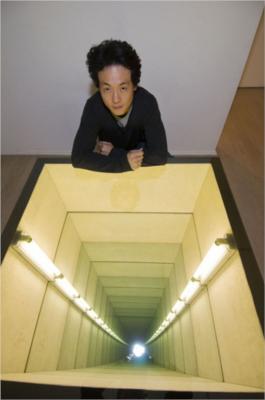
Ahn constructs light installations using one-way mirrors, LED strips, and geometric frames to produce the illusion of infinite receding space inside a shallow box. Stand in front of one of his works and the surface appears to open into a corridor or tunnel of glowing light extending far beyond the physical object. The effect is precise and quietly destabilising. Where other artists working with light favour theatrical scale, Ahn tends toward restraint: objects that resemble paintings until they resemble apertures.
The work draws on Zen ideas about the void and the infinite, setting it apart from the perceptual experiments of James Turrell or the decorative fluorescence of Dan Flavin. Ahn has cited the Korean concept of "mu" (nothingness) as a recurring point of reference. His peers include Olafur Eliasson, Ivan Navarro, and Leo Villareal, though his work is more contemplative in register than any of theirs.
His installations have been exhibited widely across the United States. A 2020 touring exhibition titled "New Light" appeared at the Vero Beach Museum of Art and other institutions in the North American Reciprocal Museum network.
Timeline
- 1971Born in Busan, South Korea.
- 1997Moved to the United States at 26.
- 2002Completed his MFA at the Maryland Institute College of Art in Baltimore at 31.
- 2002Began living and working in Baltimore.
- 2020His touring exhibition, "New Light", appeared at the Vero Beach Museum of Art.
- 2020His exhibition, "New Light", appeared at institutions in the North American Reciprocal Museum network.
Notable Works
Tap to view larger.
Next stop
Browse the movements →
Every movement in the collection, from the Renaissance to Pop art.
Related Artists

Frequently Asked Questions
What is Chul Hyun Ahn known for?
Chul Hyun Ahn is known for constructing light installations that use one-way mirrors, LED strips, and geometric frames. These produce the illusion of infinite, receding space inside a shallow box.What is Chul Hyun Ahn's most famous work?
Chul Hyun Ahn is best known for his light sculptures that create illusions of infinite space. These works often take the form of enclosed boxes or tunnels. He uses fluorescent lights and mirrors to generate the perception of depth, inviting viewers to visually enter seemingly boundless areas. One of his most recognisable series is "Void". These sculptures use simple geometric shapes, typically squares or rectangles, combined with light to produce the sensation of a bottomless void. The effect is achieved by carefully arranging internal lighting and reflective surfaces. This arrangement gives the impression of limitless space within a compact structure. Ahn's work explores themes of perception and the manipulation of space. His sculptures challenge our understanding of depth and dimension. By using light and reflection, he constructs immersive experiences that prompt contemplation on the nature of reality and illusion. His pieces have been exhibited internationally, contributing to his recognition as a significant figure in contemporary installation art.What should I know about Chul Hyun Ahn's prints?
When considering Chul Hyun Ahn's prints, it is useful to understand some basic printmaking terminology. An original print is conceived as a print, and executed solely as a print. Each impression in the edition is an original, made from a plate, stone, screen or block created for that purpose. There is no single original from which copies are made. The artist decides the number of prints in the edition. Reproductions are copies of artworks made in another medium, such as paintings or watercolours. These are usually made using photomechanical means. Numbering and signing a reproduction does not make it an original print. Limited edition prints are often numbered; for example, 12/25 indicates that the print is number 12 of an edition of 25. The artist often signs each print in pencil. Some artists also create artist's proofs, which are marked AP. The edition claim is usually written on the bottom left margin of the print, the title in the centre, and the signature on the right. The print market is unregulated, so it is important to buy from reputable dealers and to examine prints carefully.What style or movement did Chul Hyun Ahn belong to?
Chul Hyun Ahn (born in Busan, South Korea, in 1971[2]) is associated with minimalist and Op art tendencies. His work explores perception and illusion through light and space. Ahn's pieces often feature geometric shapes and light sources. These elements create the illusion of infinite spaces or voids. His use of simple forms and industrial materials aligns him with minimalist aesthetics. The manipulation of light to create optical illusions also connects him to Op art. While his work shares characteristics with both movements, Ahn's art is not easily categorised. He combines elements of minimalism and Op art to create his own unique style. Many critics consider Ahn's work to be a contemporary exploration of perception. He builds on earlier artistic movements, while also forging his own path.What techniques or materials did Chul Hyun Ahn use?
Chul Hyun Ahn is known for light sculptures that create illusions of infinite space. He often employs simple materials to achieve complex visual effects. Ahn frequently uses fluorescent light, LED lights, and mirrors in his constructions. These elements are combined to generate the perception of depth and seemingly endless corridors within confined spaces. His artwork often involves enclosed boxes or structures. Light is strategically placed and reflected to trick the eye. This creates the impression of vast, open areas beyond the physical boundaries of the sculpture. The artist's work explores themes of perception and the manipulation of space. By using light and reflective surfaces, Ahn challenges viewers' understanding of reality. He invites contemplation on the nature of space and how it is perceived. His art offers a sensory experience that plays with the viewer's sense of depth and dimension.What was Chul Hyun Ahn known for?
Chul Hyun Ahn, a South Korean artist, is known for light installations that create illusions of infinite space. These works often employ simple materials such as fluorescent lights, mirrors, and wood to generate perceptual experiences. Ahn's pieces frequently take the form of enclosed boxes or tunnels. Through careful arrangement of internal lighting and reflective surfaces, he produces the impression of limitless depth, challenging the viewer's sense of spatial awareness. His work can be understood in relation to Conceptual Art, where the idea or concept takes precedence over the tangible object. Ahn's installations invite introspection; they offer a sensory experience rooted in reality. His art explores the possibilities of new media, specifically light, to redefine spatial boundaries.When did Chul Hyun Ahn live and work?
Chul Hyun Ahn was born in 1971[2] in Seoul, South Korea. He is a contemporary artist whose work explores perception and illusion using light and space. Ahn's installations often employ LED lights and mirrors to create seemingly infinite, immersive environments. These environments challenge viewers' understanding of depth and dimension. He studied at the University of Wisconsin-Milwaukee, receiving a Master of Fine Arts degree. Ahn has exhibited extensively in the United States and internationally. His work has been featured in numerous solo and group exhibitions, establishing him as a significant figure in contemporary installation art. Ahn continues to live and work, producing new pieces that develop his exploration of light and perception.Where can I see Chul Hyun Ahn's work?
Chul Hyun Ahn's light sculptures have been exhibited in various locations internationally. These include solo and group exhibitions in the United States, Europe, and Asia. Major museums that have presented Ahn's art include the Smithsonian American Art Museum (Washington, DC), the Mattress Factory museum (Pittsburgh, Pennsylvania), and the Museum für Konkrete Kunst (Ingolstadt, Germany). His work has also been shown at the Kunsthalle Osnabrück in Germany. Commercial galleries that represent or have exhibited Ahn include the C. Grimaldis Gallery in Baltimore, Maryland; and the Bryce Wolkowitz Gallery in New York City. These galleries often participate in international art fairs, providing additional opportunities to view his pieces. Checking the artist's website or contacting the galleries directly will provide the most up-to-date information on current and upcoming exhibitions. Museum websites are also useful resources for planning visits to see specific pieces within their collections.Who did Chul Hyun Ahn influence?
It is difficult to say exactly who Chul Hyun Ahn influenced. However, some connections can be drawn between his work and that of other artists. Ahn's use of light and space shares some common ground with that of Bruce Nauman, who also worked with neon lighting. Nauman, born in 1941, explored similar themes using a range of media, including holography, video, and audio effects. Both artists create environments that engage the viewer's perception and create a sense of illusion. Bill Viola, born in 1951, is another artist whose video installations bear some comparison to Ahn's light sculptures. Viola explores similar themes using projected video sequences. Both artists create immersive environments that explore the relationship between the physical and the spiritual. Nam June Paik, a Korean-born artist, also explored the use of technology in art. Paik created video sculptures consisting of television monitors arranged in shapes and projecting images.Who was Chul Hyun Ahn?
Chul Hyun Ahn was a contemporary artist known for his light installations. These works often create the illusion of infinite space using simple materials. Ahn's pieces frequently employ light, mirrors, and sometimes sculptural forms to trick the eye. His installations can appear as deep, endless voids or tunnels, despite being relatively shallow constructions. This manipulation of perception is a central element of his artistic practice. His work engages with themes of space, perception, and the illusory nature of reality. By creating these seemingly infinite spaces, Ahn prompts viewers to question their understanding of depth and dimension. The simplicity of his materials contrasts with the complexity of the visual experience, inviting contemplation on the nature of perception itself.Why are Chul Hyun Ahn's works important today?
Chul Hyun Ahn, a Korean artist working in Baltimore, is known for light sculptures that create illusions of infinite space. Born in 1971[2], Ahn's work gained attention in the early 2000s and continues to be exhibited internationally. Ahn constructs box-like or tunnel-like forms, often using fluorescent lights and mirrors to generate the perception of limitless depth. His sculptures play with the viewer's perception, questioning the boundaries between the physical object and the suggested space beyond. This manipulation of depth and light creates a meditative experience for the observer. His work is part of several public collections, including the Albright-Knox Art Gallery in Buffalo, New York; the Baltimore Museum of Art; and the Smithsonian Institution's Hirshhorn Museum and Sculpture Garden in Washington, DC. These placements, along with ongoing gallery representation, confirm his position in contemporary art. Ahn's sculptures offer a continued exploration of light and space, contributing to ongoing dialogues within installation art and Op Art.What was Chul Hyun Ahn's art style?
Ahn's art style involves light installations that create the illusion of infinite space. His work draws on Zen ideas about the void and the infinite, setting it apart from other artists working with light.
Sources
Editorial draws on the following primary and tertiary references for Chul Hyun Ahn.
- [1] museum Victoria and Albert Museum Used for: museum holdings.
- [2] wikipedia Wikipedia: Chul Hyun Ahn Used for: biography, birth dates, death dates, identifiers, movement attribution, nationality.
- [3] book 20211101americanartcollector Used for: biography.
- [4] book Dorling Kindersley, Artists: Inspiring Stories of the World's Most Creative Minds Used for: biography.
- [5] book Art, the ape of nature : studies in honor of H. W. Janson Used for: biography.
- [6] book Doss, Erika, 1956-, Benton, Pollock, and the politics of modernism : from regionalism to abstract expressionism Used for: biography, stylistic analysis.
- [7] book Metropolitan Museum Of Art, Metropolitan Museum Of Art - Dutch Painting, the Golden Age_ an Exhibition of Dutch Pictures of the Seventeenth Century, under the High Patronage of Her Majesty the Queen of the Netherlands - Metropolitan Museum of Art, Toledo Museum of Art, Art Used for: biography.
Editorial overseen by Solis Prints. Sources verified 2026-10-14. Click a source for details, or hover over [N] in the page above to preview.
Editorial standardsMethodologyCorrectionsAI disclosureAbout the editorial team