



Charles-Amable Lenoir
- academic art
Charles-Amable Lenoir won the Prix de Rome on his second attempt, taking second prize in 1889[1] before claiming first prize the following year. It was a trajectory typical of the French[1] academic system in which he was so thoroughly trained: methodical, competitive, and ultimately rewarding for those who mastered its conventions.
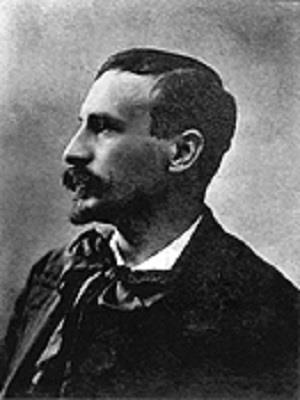
Biography
Born in 1860[1] in Châtelaillon on the Atlantic coast, Lenoir came from modest origins: his father was a customs officer and his mother a seamstress. He worked as a lycée supervisor in Rochefort before enrolling at the École des Beaux-Arts in 1883[1], where he studied under William-Adolphe Bouguereau and Tony Robert-Fleury at the Académie Julian. The Bouguereau influence is legible throughout his work: smooth, idealised surfaces, careful draughtsmanship, and a preference for female figures rendered in soft, even light.
His Salon career was steady if not spectacular. He debuted in 1887[1] and exhibited regularly until his death, receiving a bronze medal at the 1900 Paris Exposition Universelle and being named Chevalier de la Légion d'honneur in 1903. His subjects ranged across religious commissions ("Le Reniement de Saint Pierre", 1890), mythological scenes ("La Mort de Sappho", 1896), and quieter domestic images, among them "Le Calme" (1900), for which his wife sat as model.
Lenoir's practice occupied a comfortable place within the academic mainstream: technically accomplished, emotionally measured, and entirely at home in the Salon exhibition system that defined French[1] cultural life before the First World War. He died in Paris on 1 August 1926[1]. A commemorative monument was erected in Fouras, near his birthplace, in 1937.
Timeline
- 1860Born in Châtelaillon, France. His father was a customs officer, and his mother was a seamstress.
- 1883Enrolled at the École des Beaux-Arts, studying under William-Adolphe Bouguereau and Tony Robert-Fleury at the Académie Julian.
- 1887Debuted at the Salon in Paris.
- 1889Won second prize in the Prix de Rome competition.
- 1890Won first prize in the Prix de Rome competition; also painted "Le Reniement de Saint Pierre".
- 1896Painted the mythological scene "La Mort de Sappho".
- 1900Received a bronze medal at the Paris Exposition Universelle; his wife modelled for "Le Calme".
- 1903Named Chevalier de la Légion d'honneur.
- 1926Died in Paris on 1 August.
Notable Works
Tap to view larger.
Next stop
Browse the movements →
Every movement in the collection, from the Renaissance to Pop art.
Related Artists


Frequently Asked Questions
What is Charles-Amable Lenoir known for?
Charles-Amable Lenoir is known for his paintings, which include religious commissions, mythological scenes, and domestic images. He exhibited regularly at the Salon and received a bronze medal at the 1900[1] Paris Exposition Universelle.What is Charles-Amable Lenoir's most famous work?
Charles-Amable Lenoir was a French[1] academic painter, best known for his portraits and genre scenes. He studied under William Bouguereau and Gabriel Ferrier, exhibiting at the Salon in Paris from 1887[1]. While it is difficult to identify one single "most famous" work, several paintings are particularly well known. "Le Calvaire" (1889) is an early example of his academic style. Later paintings, such as "Portrait de Mademoiselle Caruelle d'Aligny" (1907), show his skill as a portraitist. He frequently depicted young women in idyllic settings, as seen in works such as "Jeune fille au bord de l'eau". These paintings capture a sense of youthful beauty and innocence, aligning with popular tastes of the period. Lenoir's paintings achieved considerable success during his lifetime. He received several awards at the Salon, including a gold medal in 1903. His work can be found in museum collections, and continues to be popular among collectors of academic art[1].What should I know about Charles-Amable Lenoir's prints?
Information regarding Charles-Amable Lenoir's prints is currently limited. Art historical texts and databases offer few details about his printmaking activities. Lenoir (1860[1]-1926[1]) was a French[1] academic painter, best known for portraits and genre scenes, in the style of the beaux-arts.. Research indicates that some artists' drawings were reproduced as prints to catalogue their work. For example, two volumes of Watteau's drawings were published in 1726 and 1728, and are a source of information about his drawings. The prints are reproductions in a catalogue raisonné of Watteau’s drawings. Similarly, prints of Charles Natoire's collection of gems were produced in 1778, after his death, as a catalogue. It is possible that prints of Lenoir's drawings or paintings were produced for similar purposes, but more research is needed to confirm this.What style or movement did Charles-Amable Lenoir belong to?
Charles-Amable Lenoir (1860[1]-1926[1]) was a French[1] academic painter. He is best known for his portraits and genre scenes. His style aligns with late academicism; this movement valued technical skill, historical or mythological subjects, and idealised beauty. Lenoir studied at the Académie Julian, a Parisian art school that offered an alternative to the more conservative École des Beaux-Arts. At the Académie Julian, artists could find instruction from various established painters. This exposure allowed Lenoir to develop his skills and refine his artistic approach. Lenoir's paintings often feature carefully posed figures, soft lighting, and smooth brushwork. These elements are characteristic of academic art[1]. Although he lived and worked during a period of significant artistic change, including the rise of Impressionism and other avant-garde movements, Lenoir remained committed to the academic tradition. He achieved success within this framework, exhibiting regularly at the Salon and receiving awards for his work. His paintings appealed to a bourgeois audience that appreciated his refined technique and conventional subject matter.What techniques or materials did Charles-Amable Lenoir use?
Information regarding the specific techniques and materials that Charles-Amable Lenoir employed is scarce. However, the period in which he worked saw significant interest in the materials and methods of painting, and a growth in the availability of information. The 18th and 19th centuries witnessed a fascination with rediscovering the techniques of ancient painters, and with developing more permanent methods. Experiments with encaustic (coloured wax) were popular. Publications such as Diderot's "Encyclopédie" (1751-1772[1]) aimed to disseminate knowledge of arts and crafts. Technical treatises and dictionaries also became more common, offering instruction on drawing, oil, tempera, miniature painting, fresco, mosaic painting, enamel painting, painting on glass, pigments and tools. These publications often detailed the preparation of canvases, the mixing of pigments, and methods to prevent paint layers from sinking. Painters of the time used a three-step method: "ebaucher, empater, retoucher" (sketching, applying paint thickly, and retouching). The increased economic interaction between France and England also led to a greater exchange of information about painting techniques and materials.What was Charles-Amable Lenoir known for?
Charles-Amable Lenoir was known for his adherence to Academic art principles. During the 19th century, European art academies held considerable power. Most artists needed acceptance into their nation's primary academy to achieve success. These institutions grew increasingly conservative and resistant to innovation. In 1816, the Parisian Académie Royale de Peinture et de Sculpture (founded in 1648) merged with the Académie de Musique and the Académie d’Architecture, creating the Académie des Beaux-Arts. This unified academy became the standard for others and advocated a blend of Neoclassicism and Romanticism. Artists were instructed to employ precise lines, realistic depictions, concealed brushwork, and subtly mixed tones and colours. The hierarchy of subjects gave precedence to historical, biblical, or mythological themes, as well as portraiture.Who did Charles-Amable Lenoir influence?
Charles-Amable Lenoir (1860[1]-1926[1]) was a French[1] academic painter, principally known for portraiture and genre scenes. While it is difficult to identify specific artists who were directly influenced by Lenoir, his impact can be understood through his role as an instructor and his contribution to the academic art[1] world of his time. Lenoir taught at the Académie Julian in Paris. This was a popular private art school that attracted students from around the world. As an instructor, he imparted his knowledge and techniques to a large number of aspiring artists. The Académie Julian alumni include figures such as Édouard Vuillard, Maurice Denis, and Pierre Bonnard. It is important to note that these artists moved towards Post-Impressionism and Les Nabis, differing from Lenoir's more traditional style. His influence is more clearly seen in the general continuation of academic traditions in early twentieth-century French art. Lenoir's work, with its emphasis on technical skill and classical subjects, helped to maintain the standards of academic painting. This provided a foundation for later generations of artists, even those who ultimately pursued different artistic paths.Who influenced Charles-Amable Lenoir?
Charles-Amable Lenoir (1860[1]-1926[1]) was a French[1] academic painter who specialised in portraits and genre scenes. He entered the École des Beaux-Arts in 1883[1]. There, he studied with William Bouguereau and Tony Robert-Fleury. Bouguereau's influence is apparent in Lenoir's smooth, idealised style and his preference for figurative subjects. Bouguereau was a champion of academic painting, which emphasised technical skill, classical themes, and a polished finish. Lenoir adopted these principles in his own work. Robert-Fleury, who was known for his history paintings and his teaching abilities, likely encouraged Lenoir's attention to detail and his narrative approach to painting. Robert-Fleury's emphasis on historical accuracy and dramatic composition may have informed Lenoir's genre scenes, which often depict everyday life with a sense of theatricality. Lenoir's style also reflects the broader influence of the French academic tradition. This tradition valued technical mastery, historical knowledge, and the pursuit of ideal beauty. While Lenoir's work is not particularly innovative, it demonstrates a high level of skill and a deep understanding of academic conventions.Who was Charles-Amable Lenoir?
Information on Charles-Amable Lenoir is difficult to locate. However, other artists active in France during his era can provide context. Pierre Auguste Renoir was born in Limoges on 25 February 1841. In 1844, the Renoirs relocated to Paris. In 1848 Auguste began attending a school. Renoir excelled in musical theory and was soon accepted into the choir at the Église Saint-Eustache, under the direction of Charles Gounod. In 1854, the boy’s parents apprenticed him to a porcelain painter. Pierre Cécile Puvis de Chavannes (born in Lyon, 1824; died in Paris, 1898[1]) began painting at thirty-five. He studied with Eugène Delacroix and Thomas Couture. Paul Legrand (born at Vitry-sur-Seine, 1860[1]) trained in Paris under Gerome and Saint-Pierre. He debuted at the Salon of 1888, received an honourable mention at the 1893 Salon, and a 3rd-class medal at the Exposition Universelle of 1900. His reputation was established with his paintings of contemporary genre scenes.Why are Charles-Amable Lenoir's works important today?
Charles-Amable Lenoir (1860[1]-1926[1]) was a French[1] academic painter, known for his portraits and genre scenes. He studied under William Bouguereau and Tony Robert-Fleury, exhibiting at the Salon from 1883[1]. He won a third-class medal in 1889, a second-class medal in 1893, and a gold medal at the Exposition Universelle in 1900. Lenoir's paintings offer insights into the aesthetic preferences of the late 19th and early 20th centuries. His work reflects the academic tradition, with its emphasis on technical skill and idealised beauty. Paintings such as "Le Calme" (1896) and "Portrait de Mademoiselle Caruelle" (1902) demonstrate his ability to capture likeness and convey a sense of serenity. Today, Lenoir's paintings are appreciated for their craftsmanship and historical value. They provide a window into the art world of his time, revealing the values and ideals that shaped artistic production. His portraits offer a glimpse into the lives of his subjects, while his genre scenes depict everyday life in a romanticised manner. Although he is not among the most famous painters of his era, his work is still collected and exhibited, contributing to a broader understanding of French academic art[1].What was Charles-Amable Lenoir's art style?
Charles-Amable Lenoir's art style was influenced by William-Adolphe Bouguereau. This influence is evident in his smooth, idealised surfaces, careful draughtsmanship, and preference for female figures rendered in soft, even light.
Sources
Editorial draws on the following primary and tertiary references for Charles-Amable Lenoir.
- [1] wikipedia Wikipedia: Charles-Amable Lenoir Used for: biography, birth dates, death dates, identifiers, movement attribution, nationality.
- [2] book Helen Glanville, A History of the Restoration and Conservation of Works of Art Used for: biography, stylistic analysis.
- [3] book Brodskaya Nathalia, Brodskaya Nathalia - Symbolism Used for: biography.
- [4] book Lilian H. Zirpolo, Historical Dictionary of Baroque Art and Architecture Used for: biography, stylistic analysis.
- [5] book Milam, Jennifer Dawn, Historical Dictionary of Rococo Art Used for: biography, stylistic analysis.
- [6] book Nathalia Brodskaya, Impressionism Used for: biography.
Editorial overseen by Solis Prints. Sources verified 2026-10-14. Click a source for details, or hover over [N] in the page above to preview.
Editorial standardsMethodologyCorrectionsAI disclosureAbout the editorial team