



Chaim Goldberg
When the Metropolitan Museum of Art acquired Chaim Goldberg's work in 1971[1], it was recognising something rare: a painter who had survived the obliteration of the world he painted. Born in Kazimierz Dolny, Poland in 1917[1], Goldberg grew up in a Jewish shtetl where the rhythms of religious life, market days, and communal celebration formed the subjects he would spend a lifetime depicting.
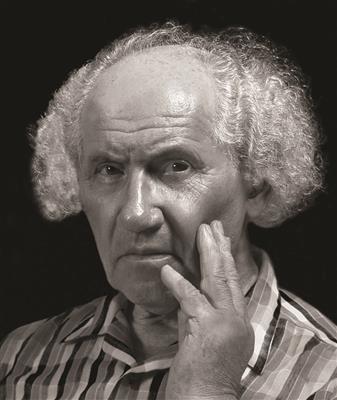
Biography
He trained at the Jozef Mehoffer School of Fine Arts in Kraków, graduating in 1934[1], then at the Academy of Fine Arts in Warsaw under Tadeusz Pruszkowski. When the Second World War engulfed Poland, Goldberg fled east, eventually reaching Palestine. He spent a decade in Israel before emigrating to the United States in 1967, becoming a citizen in 1973.
The Holocaust cast a long shadow over his practice. He produced more than 150 memorial paintings documenting Jewish life before and during the Nazi annihilation: works that balance grief with the warmth of a culture he had personally witnessed. His canvases of Jewish dance, inspired by collaboration with choreographer Felix Fibich, show figures caught in ecstatic motion, the energy defying loss.
By the 1970s his reputation was international. A retrospective at the Smithsonian Institution's Hall of Graphic Arts in 1973[1] drew wide attention, and his work entered 34 major collections worldwide. A posthumous retrospective in Kazimierz Dolny in 2013-14, displaying more than 160 works, confirmed his standing as the most significant visual chronicler of Polish[1] Jewish shtetl life. He died in Boca Raton, Florida, on 26 June 2004[1].
Timeline
- 1917Born in Kazimierz Dolny, Poland. He grew up in a Jewish shtetl.
- 1934Graduated from the Jozef Mehoffer School of Fine Arts in Kraków.
- 1934Began studies at the Academy of Fine Arts in Warsaw under Tadeusz Pruszkowski.
- 1967Emigrated to the United States after spending a decade in Israel.
- 1971His work was acquired by the Metropolitan Museum of Art.
- 1973Became a citizen of the United States.
- 1973A retrospective of his work was held at the Smithsonian Institution's Hall of Graphic Arts.
- 2004Died in Boca Raton, Florida, on 26 June.
Notable Works
Tap to view larger.
Next stop
Browse the movements →
Every movement in the collection, from the Renaissance to Pop art.
Related Artists

Frequently Asked Questions
What is Chaim Goldberg known for?
Chaim Goldberg is known as a painter who documented Jewish life before and during the Holocaust. He created over 150 memorial paintings balancing grief with the warmth of the culture he had personally witnessed.What is Chaim Goldberg's most famous work?
It is difficult to name one single "most famous work" by Chaim Goldberg; his artistic output was large and varied. However, some of his best-known pieces include those that depict Jewish life in Eastern Europe before the Second World War. Goldberg's art often focused on scenes from his childhood in Kazimierz, Poland. These works frequently portray Jewish customs, religious celebrations, and daily routines. Goldberg's paintings and prints are known for their emotional intensity and their attention to detail. They act as records of a world that was destroyed during the Holocaust. Although Goldberg's subject matter is often serious, his work also contains elements of joy and optimism. He celebrated the resilience and spirit of the Jewish people, even in the face of adversity. Goldberg's art has been exhibited in museums and galleries around the world, and his works are held in many public and private collections.What should I know about Chaim Goldberg's prints?
Chaim Goldberg was a Polish[1]-British artist known for his depictions of Jewish life in Eastern Europe. Many of his works were produced as woodcut prints. Printmaking is an old art, with early examples on paper from China around the second century AD. In Europe, the practice became common in the late fourteenth century. Prints served as book illustrations, religious icons, and even playing cards. By the mid-nineteenth century, handmade prints gained recognition as a major artistic medium. Original prints, like Goldberg's woodcuts, are produced by hand. The artist creates the artwork directly on a woodblock, plate, stone, or screen. Each print is considered an original. Artists often sign their prints, which confirms their approval of the individual proof. Artists may limit the size of an edition; they inscribe the impression number and the edition number on each example. This influences the price and prevents more prints from being pulled after the plate wears down. The edition claim is written as a pair of numbers on the left bottom margin of the print; the title of the print is written in the middle of the bottom margin; the signature is on the right of the bottom margin. These are always signed in pencil.What style or movement did Chaim Goldberg belong to?
Chaim Goldberg's artistic style is difficult to categorise neatly, as he drew from various influences throughout his career. Some scholars link him to the École de Paris, a community of artists working in Paris between the wars who were not French, and whose work resisted easy classification. Goldberg's art shares some features with Introspectivism, a kaleidoscopic style that balances variegated splinters of a chaotic world. Like the Introspectivists, Goldberg presented a colourful balance of a disjointed world, where heterogeneous elements cohabit in one personal, internalised space. Other possible influences include Cubism, which Goldberg encountered in Paris. Cubism's emphasis on deconstruction and the destruction of objects in their normal aspect opened doors for Goldberg's fantasy and allowed him to channel the flood of his anarchic force into sturdy artistic shores. Ultimately, Goldberg's style is best understood as a synthesis of various influences, filtered through his unique personal vision and cultural background.What techniques or materials did Chaim Goldberg use?
Chaim Goldberg was a painter and graphic artist. His graphic work is as important as his painting, and the two informed each other. Themes and motifs appear in both mediums. In his graphics, Goldberg created images from separate black threads of lines with varying degrees of force. Moving towards the centre, they grow denser, forming the image. He then allowed them to lose density again and disappear into the page. This technique allowed him to imply a contour line, rather than create a solid one. Goldberg's paintings often feature bright colours with clear boundaries. Colour deviates from the natural function of an object's surface in two ways: an unnatural colour covers the surface, or colours create spatial areas in their own right, shifting the emphasis from the presented world to the surface of the painting itself.When did Chaim Goldberg live and work?
Chaim Goldberg was born in Biala, Poland, on 15 August 1900. He emigrated to the United States in 1913, settling in New York City, where he attended public schools and took a drawing class at Stuyvesant High School. Goldberg then studied at the National Academy of Design (1923[1]-1925[1]) with Ivan D. Olinsky and Charles Hawthorne, and at the Art Students League (1925-1926) with Guy Pene du Bois and Boardman Robinson. By 1928, he had become a United States citizen. Goldberg spent 1929 painting in Provincetown, Massachusetts, exhibiting with the Societe Anonyme in New York. His work from this time, including figures and still lifes, shows the influence of Cézanne. Goldberg participated in the United States Treasury Department's Public Works of Art Project in 1934. From 1935 to 1941, he was employed in the easel division of the WPA Federal Art Project in New York.Where can I see Chaim Goldberg's work?
It is difficult to pinpoint exactly where you can view Chaim Goldberg's work today. However, many major museums hold collections of art that may include his prints or paintings. These include institutions in the United States, Canada, the United Kingdom, and Europe. In the United States, you might check the Metropolitan Museum of Art (New York), the Los Angeles County Museum of Art, the Minneapolis Institute of Arts, the Museum of Modern Art (New York), the Virginia Museum of Fine Arts (Richmond), or the Wolfsonian at Florida International University (Miami Beach). In Canada, the Royal Ontario Museum (Toronto) may hold his work. In the United Kingdom, try the Brighton Museum & Art Gallery, the Manchester Art Gallery, the National Museums of Scotland (Edinburgh), or the Victoria & Albert Museum (London). In Belgium, the Koninklijk Museum voor Schone Kunsten (Antwerp) or the Musées Royaux des Beaux-Arts (Brussels) may be fruitful places to look. In France, consider the Musée des Arts Décoratifs (Paris).Where was Chaim Goldberg from?
Chaim Goldberg was born in Kazimierz, Poland, in 1917[1]. Kazimierz was a district of Krakow, known for its historic Jewish community. Before the Second World War, Kazimierz was an important centre of Jewish life and culture. This heritage shaped Goldberg's early experiences and artistic vision. He studied at the Krakow Academy of Fine Arts before the war. During the Nazi occupation, Goldberg was confined to the Krakow ghetto and later imprisoned in concentration camps. After the war, he continued to live and work in Poland for a time. In 1968[1], amid rising antisemitism in Poland, Goldberg emigrated to Israel. He then moved to Paris, where he spent the rest of his life. His art often reflected his memories of Jewish life in Poland and the trauma of the Holocaust.Who did Chaim Goldberg influence?
Chaim Goldberg's artistic circle included other Jewish artists eager to explore fresh approaches to painting. In 1921[1], Chagall wrote to Yehuda Pen, his former teacher, acknowledging that Pen had "raised a great generation of Jewish artists". Chagall's time in St Petersburg exposed him to Symbolism, a movement emphasising poetic form and the transcendental. He absorbed the aesthetic, post-Fauve mood and learned the autonomous value of colour. Later, in Paris, Chagall came into contact with poets and painters such as Blaise Cendrars, Guillaume Apollinaire, and Robert and Sonia Delaunay. Apollinaire's appreciation of Chagall's work led Herwardt Walden, editor of *Der Sturm*, to promote Chagall as a significant figure in Expressionism. After the Revolution, Chagall established the People's Art School in Vitebsk and invited artists such as Lissitzky and Malevich to teach there. However, his style was too thematic for their taste, and they pushed him out of the school. Stepanova's diary recorded visits by Chagall to the Nineteenth State Exhibition (1920) and his interest in their work.Who influenced Chaim Goldberg?
Chaim Goldberg's artistic development saw several influences. László Moholy-Nagy noted the impact of Rembrandt's drawings, especially their emotional force and psychological depth. Moholy-Nagy also found inspiration in Vincent van Gogh's analytical ink drawings, which taught him about expressing three-dimensional quality through line work. Chagall, a contemporary of Goldberg, was influenced by various sources, including Apollinaire's poetry and the work of Robert Delaunay. Apollinaire's poems, with their disconnected verbal elements, paralleled Chagall's visual approach. Delaunay's use of colour and form also resonated with Chagall, who admired his subjective and poetic vision. Chagall also studied with Lev Bakst and Mstislav Dobuzhinskii, both of whom designed for the stage. Dobuzhinskii's mysticism of the big city also had an impact.Who was Chaim Goldberg?
Chaim Goldberg (1917[1]-2004[1]) was a Polish[1]-born artist known for his paintings and sculptures that often depicted Jewish life in Eastern Europe. Born in Kazimierz Dolny, Poland, Goldberg's work frequently drew inspiration from his childhood experiences and the traditions of his community. His artistic style incorporated elements of Expressionism and Naive art, characterised by bold colours and simplified forms. Goldberg's subject matter included scenes of Jewish festivals, weddings, and everyday life in the shtetl (small town). He aimed to preserve the memory of a culture that was largely destroyed during the Holocaust. Goldberg survived internment in concentration camps, and after the Second World War, he continued to create art that served as a memorial to the victims and a celebration of Jewish heritage. He lived and worked in France and Israel, and his pieces have been exhibited internationally.Why are Chaim Goldberg's works important today?
Chaim Goldberg's artwork provides insight into Jewish life in Eastern Europe before the Second World War. Born in Kazimierz, Poland, in 1917[1], Goldberg depicted scenes of Jewish culture, tradition, and daily existence. His work acts as a historical record, preserving memories of communities that were largely destroyed during the Holocaust. Goldberg's art also explores themes of identity, displacement, and resilience. As a survivor of the Holocaust, his personal experiences profoundly shaped his artistic vision. His pieces often convey a sense of longing for a lost world, as well as a celebration of Jewish heritage. Furthermore, Goldberg's style is notable for its expressionistic qualities and use of colour. His distinctive approach to portraying figures and environments creates an emotionally resonant viewing experience. By documenting and interpreting Jewish history and culture through his art, Goldberg offers a valuable perspective on the past and its relevance to the present.
Sources
Editorial draws on the following primary and tertiary references for Chaim Goldberg.
- [1] wikipedia Wikipedia: Chaim Goldberg Used for: biography, birth dates, death dates, identifiers, movement attribution, nationality.
- [2] book guggenheim-chagallj00chag Used for: biography.
- [3] book guggenheim-guggenh01solo Used for: biography.
- [4] book guggenheim-markrothko19031900roth Used for: biography.
- [5] book guggenheim-onehundredpainti00thom Used for: biography.
Editorial overseen by Solis Prints. Sources verified 2026-08-30. Click a source for details, or hover over [N] in the page above to preview.
Editorial standardsMethodologyCorrectionsAI disclosureAbout the editorial team