



Chaibia Talal
There is a specific detail in Chaibia Talal's biography that the official accounts tend to bury under the inspirational framing: she was married at thirteen to a man of seventy, widowed by fifteen, and spent her early adulthood working as a maid to support herself and her son. She had no formal schooling and remained illiterate throughout her life. That she became one of Morocco[1]'s most internationally exhibited painters is a fact worth sitting with before reaching for the word self-taught.
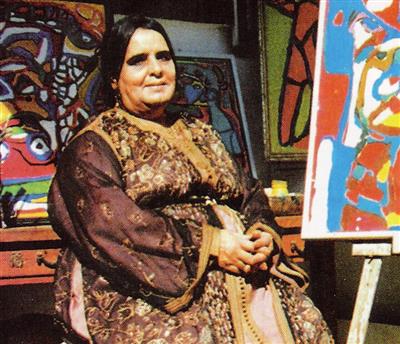
Biography
The start came from a dream, according to Talal's own account: strangers presented her with art materials, and she woke determined to use them. Her early canvases drew little enthusiasm from the Moroccan art establishment. The turn came in 1965[1], when her son Hocein, himself a painter, introduced her to Pierre Gaudibert, director of the Musee d'Art Moderne de Paris. Within a year she had shows at the Goethe-Institut in Casablanca and at the Musee d'Art Moderne itself. Between 1966 and 1980 she exhibited more than fifteen times across Paris, Copenhagen, Frankfurt, Barcelona, and Rotterdam.
Her work is sometimes categorised as naif or outsider art, labels she complicated by absorbing influences from the CoBrA movement's disruptive energy and colouring. Critics noted in her canvases a physicality and directness that institutional training tends to train out. She received a gold medal from the French Academic Society for Education and Encouragement in March 2003[1], the year before her death in Casablanca on 2 April 2004[1]. A biographical film, Chaibia, was released in 2015.
Timeline
- 1929Born in Morocco.
- 1942Married at 13 to a 70-year-old man.
- 1944Widowed at 15 and worked as a maid to support herself and her son.
- 1965Her son Hocein introduced her to Pierre Gaudibert, director of the Musee d'Art Moderne de Paris.
- 1966Exhibited at the Goethe-Institut in Casablanca and at the Musee d'Art Moderne in Paris.
- 1966Began exhibiting internationally, including shows in Paris, Copenhagen, Frankfurt, Barcelona, and Rotterdam, until 1980.
- 2003Received a gold medal from the French Academic Society for Education and Encouragement.
- 2004Died in Casablanca on 2 April, aged 75.
Notable Works
Tap to view larger.
Next stop
Browse the movements →
Every movement in the collection, from the Renaissance to Pop art.
Frequently Asked Questions
What is Chaibia Talal known for?
Chaibia Talal is known for her painting, and she became one of Morocco[1]'s most internationally exhibited painters. Her work gained recognition after her son introduced her to Pierre Gaudibert, leading to exhibitions in Casablanca and Paris.What is Chaibia Talal's most famous work?
It is difficult to name one single work as Chaibia Talal's 'most famous'. She produced a large body of work from the 1960s until her death in 2004[1], and her paintings are held in many public and private collections. Talal's paintings often depict scenes of everyday life in Morocco[1], and they are characterised by their bright colours and bold, simple forms. She is recognised as one of the most important Moroccan artists of the 20th century, and her work has been exhibited extensively both in Morocco and internationally. Her paintings can be seen as celebrating Moroccan women and culture. She has been called a naive or autodidact artist, as she had no formal training.What should I know about Chaibia Talal's prints?
Chaibia Talal (1929[1]-2004[1]) was a Moroccan painter whose work gained international recognition. Although she is best known for her paintings, prints of her work are also available. These prints offer a more accessible way to own a piece of her art. Talal's art is characterised by its spontaneous and colourful style. Her subjects often included scenes from her rural upbringing, women, animals, and spirits. Her work has been described as both naïve and modernist, blending traditional Moroccan imagery with a contemporary artistic vision. When considering a Chaibia Talal print, examine the print quality and provenance. Prints should accurately reproduce the colours and details of the original painting. Collectors should also research the publisher or distributor of the print to ensure authenticity. Talal's paintings are held in collections such as that of the Musée d’Art Moderne de la Ville de Paris; owning a print allows one to engage with her unique artistic perspective.What style or movement did Chaibia Talal belong to?
It is difficult to assign Chaibia Talal to a single artistic movement. Her work is often described as naïve or self-taught, placing her outside formal art historical categories. Some critics associate her with Art Brut, a European movement celebrating art created outside the boundaries of academic training. Art Brut, or "raw art", values authenticity and direct expression over conventional aesthetics. Chaibia's intuitive approach to painting, her bold use of colour, and her focus on personal experiences align with some aspects of this style. However, Chaibia's Moroccan identity also informs her art. Her paintings frequently depict scenes from Moroccan life, particularly the experiences of women. This cultural specificity distinguishes her from the primarily European context of Art Brut. Others view her as a modern artist, who synthesised international trends with her own visual language.What was Chaibia Talal known for?
Chaibia Talal (1929[1]-2004[1]) was a Moroccan painter. Although untrained, her works gained international recognition. Talal's art often features figures, particularly women and children, rendered in bold colours and simplified forms. Her style is often described as spontaneous and intuitive, reflecting her personal experiences and cultural background. She began painting in her thirties, without any formal instruction, and her work quickly attracted attention for its originality. She had solo exhibitions in many countries, including France and the United States. Her art is included in collections such as the Barjeel Art Foundation. Talal's work provides an important perspective on Moroccan art and the contributions of self-taught artists to the global art world.When did Chaibia Talal live and work?
Chaibia Talal was born in 1929[1] and died in 2004[1]. A self-taught artist, she began painting in her late thirties and is associated with the modernist art scene in Morocco[1]. Although details of her early life are scarce, she gained recognition in the 1960s, exhibiting her work in Morocco and internationally. Her paintings often feature figures, animals, and scenes inspired by her rural upbringing and personal experiences. Her style is characterised by bold colours, simplified forms, and a sense of spontaneity. Throughout her career, Chaibia's work was exhibited in galleries and museums around the world. Her art provides a unique perspective on Moroccan culture and society, as seen through the eyes of a woman artist.Where can I see Chaibia Talal's work?
Several museums and galleries exhibit Chaibia Talal's work. Mathaf: the Arab Museum of Modern Art in Doha has an encyclopaedic collection of modern art from the Arab world. The Barjeel Art Foundation in Sharjah, UAE, has a tightly curated collection of Egyptian Surrealists. In Cairo, the Al-Masar Gallery, Ebdaa Art Gallery, and Zamalek Art Gallery may hold examples. Agial Art Gallery in Beirut, Galerie Arthème in Paris, James Hyman Ltd in London, and Gallery Misr may also be sources. Finally, Doris Duke's Shangri La, in Honolulu, includes Moroccan woodwork, Iranian tile mosaics, Syrian inlaid stonework, and Indian pierced marble screens; these were acquired with the help of art dealers such as René Martin (S.A.L.E.M René Martin), Asfar & Sarkis in Damascus, and Ayoub Rabenou of Tehran.Who did Chaibia Talal influence?
It is difficult to name specific artists who directly emulated Chaibia Talal. The art world after the heyday of Cubism became so pluralistic that no single artist could dominate a group. However, some artists, such as Sandro Chia, shared certain qualities with earlier artists that might suggest influence. Chia, like Marc Chagall, contrasted earth tones with brilliant primaries. He also shared with Chagall a calculated clumsiness of drawing, and figures that defied gravity. Like Kazimir Malevich, Chia depicted ordinary subjects in spectral colours. Chia's work also has links to American Pop artists, especially Andy Warhol for his high-key colour, and Roy Lichtenstein for use of commonplace subject matter. Chia himself stated that he felt close to Michelangelo, Titian, and Tintoretto. Therefore, while no artists may be directly described as Chaibia Talal's followers, it is possible to draw parallels between her work and that of various other artists.Who influenced Chaibia Talal?
It is difficult to summarise the influences on an artist such as Chaibia Talal. Her work has been described as fitting into the broader category of Art Brut, or outsider art, because she was an untrained artist who began painting relatively late in life. This categorisation can be problematic, however, as it tends to place artists such as Talal outside the mainstream of art history. Talal's style has been compared to that of Jean Dubuffet, a French artist associated with Art Brut. However, Talal was also influenced by the Moroccan culture and traditions in which she was immersed. Her paintings often depict scenes from everyday life in Morocco[1], and they incorporate traditional Moroccan motifs and colours. Some observers have noted that her art shares certain qualities with children's art, in its directness and simplicity. This may be because Talal herself was self-taught, and she approached painting with a fresh, uninhibited perspective.Who was Chaibia Talal?
Chaibia Talal (1929[1]-2004[1]) was a Moroccan painter. She is considered one of the most important figures in Moroccan art. Talal was born in a rural area near Azemmour, Morocco[1]. She did not receive formal artistic training. Instead, she began painting in her thirties, developing a distinctive style characterised by bold colours and simplified forms. Her subject matter often included scenes from her own life and imagination, with recurring motifs of women, animals, and nature. She gained international recognition in the 1960s, with exhibitions in Europe and the United States. Her work has been compared to that of other self-taught artists, but her paintings also reflect her own cultural background and personal experiences. Talal's art provides insight into the world of a woman living in Morocco during a period of significant social and political change.Why are Chaibia Talal's works important today?
Chaibia Talal (1929[1]-2004[1]) was a Moroccan painter whose works offer a unique perspective on 20th-century art. As a self-taught artist, she broke from academic traditions, developing a distinctive style characterised by bold colours and simplified forms. Her art is important for several reasons. First, it provides a view into Moroccan culture through the eyes of a woman who did not receive formal training. Her paintings often depict scenes from her own life and surroundings, offering insights into everyday life in rural Morocco[1]. Second, Chaibia's success challenged conventional notions about who could be an artist. Despite lacking formal education, she achieved international recognition, exhibiting her work in Europe and the United States. Her story is one of perseverance and artistic vision triumphing over societal barriers. Finally, her art contributes to a broader understanding of modernism. While influenced by Western art movements, Chaibia synthesised these influences with her own cultural background, creating a unique and compelling body of work. Her paintings remain relevant in discussions about identity, representation, and the globalisation of art.
Sources
Editorial draws on the following primary and tertiary references for Chaibia Talal.
- [1] wikipedia Wikipedia: Chaibia Talal Used for: biography, birth dates, death dates, identifiers, movement attribution, nationality.
- [2] book guggenheim-guggenheimintern1958sven Used for: biography.
- [3] book guggenheim-italianartnowame00wald Used for: biography.
- [4] book Braun, Emily, 1957-; Asor Rosa, Alberto; Royal Academy of Arts (Great Britain), Italian art in the 20th century : painting and sculpture, 1900-1988 Used for: biography.
- [5] book 1892-1968, Panofsky, Erwin,, Tomb sculpture: four lectures on its changing aspects from ancient Egypt to Bernini Used for: stylistic analysis.
Editorial overseen by Solis Prints. Sources verified 2026-09-30. Click a source for details, or hover over [N] in the page above to preview.
Editorial standardsMethodologyCorrectionsAI disclosureAbout the editorial team