



Carlo Maria Mariani
Carlo Maria Mariani was born in Rome in 1931[1] and spent the 1970s defending painting itself at a moment when much of the art world had declared it obsolete. His response to Conceptualism was not to modernise his practice but to retreat further into the past: he adopted the highly finished, smooth-surfaced technique of eighteenth-century academic art and filled it with mythological allegory, ironic self-portraiture, and deliberate quotations from the Old Masters.
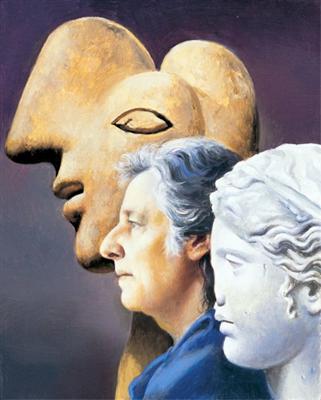
Biography
This position made him the central figure of *Pittura Colta*, cultivated painting, when the movement attracted international attention in the 1980s. His most discussed work from that period, *The Constellation of Leo* (1980[1]-1981[1], Galleria Nazionale d'Arte Moderna, Rome), presents key figures of the Roman art world as neoclassical allegorical characters, blurring the line between contemporary social portrait and academic pastiche. He also painted Andy Warhol as Napoleon, a juxtaposition that was either sharply ironic or a genuine act of art-historical reconciliation, depending on one's reading. The American critic Hal Foster placed Mariani's postmodernism in the category of "reaction" rather than resistance, a characterisation that stuck.
His career was divided between Rome and New York. A 1992[1] exhibition in Los Angeles drew praise for the seriousness with which he attempted to restore classical drawing as a living language rather than a nostalgic ornament. Mariani died in New York in November 2021[1], aged 90, having spent half a century in deliberate dialogue with three centuries of European painting.
Notable Works
Tap to view larger.
Next stop
Browse the movements →
Every movement in the collection, from the Renaissance to Pop art.
Related Artists


Frequently Asked Questions
What is Carlo Maria Mariani known for?
Carlo Maria Mariani is known as the central figure of *Pittura Colta*, cultivated painting, when the movement attracted international attention in the 1980s. His work *The Constellation of Leo* is his most discussed from that period, presenting key figures of the Roman art world as neoclassical allegorical characters.What was Carlo Maria Mariani's art style?
Carlo Maria Mariani adopted the highly finished, smooth-surfaced technique of eighteenth-century academic art. He filled it with mythological allegory, ironic self-portraiture, and deliberate quotations from the Old Masters.When was Carlo Maria Mariani born?
Carlo Maria Mariani was born in 1931[1].
Sources
Editorial draws on the following primary and tertiary references for Carlo Maria Mariani.
- [1] wikipedia Wikipedia: Carlo Maria Mariani Used for: biography, birth dates, death dates, identifiers, movement attribution, nationality.
- [2] book Andrew Graham-Dixon, Caravaggio: A Life Sacred and Profane, 2010 Used for: stylistic analysis.
- [3] book Horst Bredekamp;, Galileo's Thinking Hand Used for: stylistic analysis.
- [4] book Peter Robb, M Used for: biography.
- [5] book Peter Robb, M: The Man Who Became Caravaggio Used for: biography.
Editorial overseen by Solis Prints. Sources verified 2026-10-14. Click a source for details, or hover over [N] in the page above to preview.
Editorial standardsMethodologyCorrectionsAI disclosureAbout the editorial team