

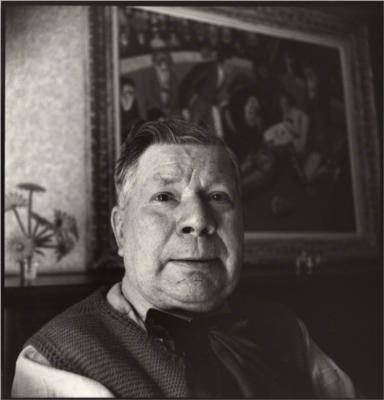
Camille Bombois
The son of a canal boatman, Camille Bombois grew up along the waterways of Burgundy and began sketching at sixteen, but the road to painting led him through the circus ring, the railway yard, and the trenches of the Western Front. He worked for years as a strongman in travelling circuses, then took jobs constructing railways and running night-shift newspaper presses in Paris, painting in the early morning hours before his shift began.
Biography
Called up in 1914[2], Bombois served at the front for four years and was decorated three times for bravery. He only began exhibiting in 1922, when he was thirty-nine, after critics and collectors discovered the accumulated work he had been quietly making for years. Once found, he was immediately placed within the tradition of self-taught painting that had grown in prestige since Henri Rousseau's death in 1910.
He painted from direct experience: townscapes where a square or street pulls the eye deep into the canvas, circus scenes, nudes, and still lifes. Scholars noted a resemblance between his urban scenes and those of Utrillo, whose portrait Bombois painted in 1940[2]. Documented works include "The Fortified Gate at Chatenois" (c.1927, 72.7 x 59.7 cm, oil on canvas) and "Stairway and Butcher Shop" (c.1928), both of which passed through Galerie Bing in Paris before entering the collection of American patron Evelyn Sharp via Klaus Perls's gallery in New York.
Timeline
- 1883Born, the son of a canal boatman, and grew up along the waterways of Burgundy.
- 1899Began sketching at 16.
- 1914Called up to serve at the front for four years, during which he was decorated three times for bravery; at 31.
- 1922Began exhibiting his accumulated work at 39, after being discovered by critics and collectors.
- 1927Painted "The Fortified Gate at Chatenois" (c.1927).
- 1928Painted "Stairway and Butcher Shop" (c.1928).
- 1940Painted a portrait of Utrillo at 57.
- 1970Died at 87.
Notable Works
Tap to view larger.
Next stop
Browse the movements →
Every movement in the collection, from the Renaissance to Pop art.
Related Artists


Frequently Asked Questions
What is Camille Bombois known for?
Camille Bombois is known as a self-taught painter whose work was discovered by critics and collectors in 1922[2]. He is known for townscapes, circus scenes, nudes, and still lifes, all painted from direct experience.What is Camille Bombois's most famous work?
It is difficult to identify one single "most famous work" by Camille Bombois, as his notability rests on his distinctive style and favoured subjects. However, several paintings are well-documented and representative of his oeuvre. Bombois (1883[2]-1970[2]) was a self-taught artist, sometimes described as "folk", "naive", or "primitive". He did not exhibit until 1922[2], at the age of 39. Before dedicating himself to art, he worked as a circus strongman, railway worker, and newspaper press operator; he also served in the military. His subject matter came from his immediate surroundings. He is known for lyrical still lifes, townscapes, nudes, and circus scenes. Examples of his townscapes include *The Fortified Gate at Chatenois* (circa 1927) and *Stairway and Butcher Shop* (circa 1928). These paintings often feature open squares or pathways with pedestrians, creating a sense of perspective. Bombois painted a portrait of Utrillo in 1940.What should I know about Camille Bombois's prints?
Printmaking gained traction among artists in the 1890s, as they recognised its potential to reach a broader audience. Art dealers such as Ambroise Vollard played a role in this shift. Vollard, who represented artists like Odilon Redon, encouraged younger artists to explore colour lithography albums. He could then sell these prints alongside paintings and drawings. This approach particularly appealed to artists from the Nabis group, including Paul Sérusier, Maurice Denis, and Pierre Bonnard. Heavily influenced by Paul Gauguin, the Nabis developed a style characterised by simplified forms and flat areas of colour. In addition to individual prints and albums, periodicals also helped promote artists and their aesthetic aims. *La Revue blanche*, a small art and literary magazine founded in 1891[2], publicised the endeavours of the Nabis.What style or movement did Camille Bombois belong to?
Camille Bombois (1883[2]-1970[2]) is usually categorised as a member of the Naive or Modern Primitives. This is not a formal group or school; rather, it is a descriptive label applied retrospectively to artists with particular qualities. Naive artists typically lack formal academic training and often work outside the established art world. Their style is characterised by simplified forms, a lack of conventional perspective, and bold use of colour. There is often a dreamlike quality to the works, or an interest in folklore. Bombois began painting later in life, after working as a farmhand, circus strongman, and railway worker. His paintings often depict scenes from his past, such as circus performers, rural life, and the Parisian streets. His style is distinctive for its strong outlines, flattened perspective, and attention to detail. These qualities link him to the broader category of Naive art.What techniques or materials did Camille Bombois use?
Camille Bombois was a self-taught artist, and information about his specific techniques and materials is scarce. However, some general observations can be made about the materials available to painters of his era. Oil paint was a common medium. Pigments were mixed with oil and applied to canvas with brushes. The surface of the canvas would often be prepared with a ground layer. The artist's touch, or "hand", influenced the colour effect, just as it changed the material qualities of a line. Artists might prepare preliminary drawings before painting. They might also apply colours in thin layers or thicker impasto. Varnish was sometimes applied as a final layer. The choice of materials is conditioned by the effect the artist intends to achieve. The formal vocation of a painting material has both its possibilities and its limits.What was Camille Bombois known for?
Camille Bombois (1883[2]-1970[2]) was a French[2] naive artist, a painter without formal training in fine art. He is best known for his depictions of circus performers, market scenes, and female nudes. Working as a manual labourer for many years, Bombois painted in his spare time and exhibited with the Société des Artistes Indépendants from 1911[2]. His work gained attention for its directness and bold colours, aligning with the early 20th-century Fauvist movement, where artists such as Henri Matisse explored the expressive potential of colour. Bombois's paintings often feature strong outlines and simplified forms, contributing to their distinctive and accessible style. Although he shared some aesthetic sensibilities with the Fauves, his self-taught approach set him apart. Bombois continued to paint throughout his life, and his art is now recognised as an important contribution to naive art.When did Camille Bombois live and work?
Camille Bombois (1883[2]-1970[2]) was a French[2] naïve painter. He was born in Venarey-les-Laumes, Côte-d'Or, France, on 3 February 1883[2]. He died in Paris on 11 June 1970. Bombois spent much of his working life in manual labour. He worked as a farmhand and then, after his marriage to Adèle in 1907, he joined the Parisian Métro as a railway worker. He began painting at night, in his own time, while still employed by the railway. Bombois exhibited his paintings in the streets of Paris, and he also showed them at the Salon des Indépendants from 1923 onwards. His work gained attention in the late 1920s, and he signed a contract with the art dealer Wilhelm Uhde in 1929. Bombois then devoted himself to painting full time. He is associated with other self-taught artists, such as Séraphine Louis and Henri Rousseau. Bombois's paintings often depict circus scenes, figures, and rural life.Where was Camille Bombois from?
Camille Bombois was a French[2] artist, born in 1883[2] and active until his death in 1970[2]. Though details of his early life are scarce, it is known that Bombois did not begin exhibiting his artwork until 1922[2], when he was 39 years old. Before dedicating himself to painting, Bombois worked a variety of jobs, including as a circus strongman, a railway worker, and a newspaper press operator. From 1914 to 1918, he served in the military, earning three medals for valour. Bombois's subject matter came from his immediate surroundings. He is known for still lifes, nudes, circus scenes, and townscapes, such as 'The Fortified Gate at Chatenois' and 'Stairway and Butcher Shop'. In 1940, Bombois painted a portrait of Maurice Utrillo.Who did Camille Bombois influence?
It is difficult to say with certainty who Camille Bombois influenced directly. Art history tends to focus on influences *on* an artist, rather than the reverse. However, we can consider Bombois's place in the artistic movements of his time. Bombois was associated with the Naïve or Primitive art movement. These artists often worked outside the formal academic system and developed individual styles. It is more likely that Bombois's work contributed to the broader appreciation of Naïve art, rather than serving as a direct model for specific artists. Looking at the other side of influence, Paul Cézanne, who died in 1906[2], had an impact on many early twentieth-century painters. Cézanne's art, with its use of colour and mysterious distortions, provided inspiration for young painters working in Europe. Cézanne was a particularly important influence in the formation of Cubism, even though the Cubists interpreted him in different ways.Who influenced Camille Bombois?
It is difficult to identify specific influences on Camille Bombois from the passages provided. However, the passages do offer some context regarding the artistic milieu of the late 19th and early 20th centuries in France. The passages mention various artists and movements, such as Impressionism, Post-Impressionism, Symbolism, and Fauvism. Artists like Gauguin, Matisse, and members of Les Nabis are mentioned, as well as figures like Henri Rousseau. These artists explored new approaches to colour, form, and subject matter, moving away from traditional academic styles. The Louvre museum also provided inspiration to artists, with masters like Rubens teaching about colour. Bombois emerged as a painter later, and these movements may have indirectly shaped his artistic sensibilities.Who was Camille Bombois?
Camille Bombois (1883[2]-1970[2]) was a French[2] self-taught artist, often described using the terms 'folk', 'naive', or 'primitive'. He did not begin exhibiting his work until 1922[2], at the age of thirty-nine. Before dedicating himself to painting, Bombois had a varied working life. He worked as a circus strongman, helped construct railways, and operated newspaper presses. He also served in the military from 1914 to 1918, earning three medals for valour during his service in the First World War. Bombois drew inspiration from his immediate surroundings. He is known for his paintings of townscapes, still lifes, nudes, and circus scenes. Examples of his townscapes include *The Fortified Gate at Chatenois* (c. 1927) and *Stairway and Butcher Shop* (c. 1928). These paintings often feature open squares or pathways with pedestrians, inviting viewers into the pictorial space and creating a sense of perspective. In 1940, Bombois painted a portrait of Maurice Utrillo, who also painted similar townscapes.Why are Camille Bombois's works important today?
Camille Bombois (1883[2]-1970[2]) was a French[2] painter and one of the major artists of the Naive school. He is known for his depictions of circus performers, domestic life, and the Parisian landscape. Bombois's work offers a direct, unsophisticated view of early 20th-century French life. His paintings often feature bold outlines, simplified forms, and bright colours, creating a distinctive style that is both charming and powerful. Bombois's focus on everyday subjects, such as market scenes and café interiors, provides a glimpse into the lives of ordinary people during this period. Bombois's work is also valued for its unique perspective. As a self-taught artist, he approached painting with a fresh eye, unburdened by academic conventions. This allowed him to develop a personal style that is both original and accessible. His paintings continue to appeal to audiences today because of their honesty, simplicity, and celebration of the everyday.
Sources
Editorial draws on the following primary and tertiary references for Camille Bombois.
- [1] museum Harvard Art Museums Used for: museum holdings.
- [2] wikipedia Wikipedia: Camille Bombois Used for: biography, birth dates, death dates, identifiers, movement attribution, nationality.
- [3] book Dorling Kindersley, Artists: Inspiring Stories of the World's Most Creative Minds Used for: biography.
- [4] book Linda Bolton, Art revolutions _ Impressionism Used for: biography.
- [5] book Anka Muhlstein, Camille Pissarro Used for: biography.
- [6] book guggenheim-byday00viol Used for: stylistic analysis.
- [7] book guggenheim-evelyns00solo Used for: biography.
- [8] book Post-impressionism : cross-currents in European painting Used for: biography.
Editorial overseen by Solis Prints. Sources verified 2026-08-30. Click a source for details, or hover over [N] in the page above to preview.
Editorial standardsMethodologyCorrectionsAI disclosureAbout the editorial team