

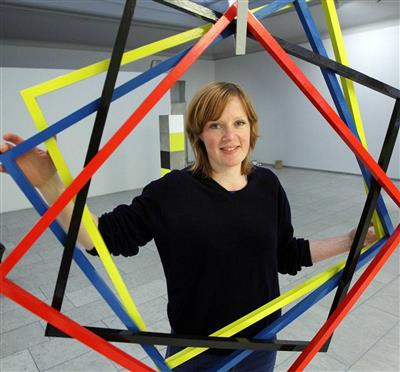
Camilla Low
A Norwegian[1] artist who spent her formative years in Glasgow, Camilla Løw built her practice around geometric sculpture through a sustained engagement with Scottish art culture. She graduated from Asker Kunstskole in Norway in 1998 before earning a BA in Fine Art from the Glasgow School of Art in 2001, where she studied Sculptured Environmental Art. She remained in Glasgow for the better part of a decade after graduating, absorbing a city she described as one where art and design are essentially one thing.
Biography
Her sculptures are abstract and graphic in character, working with hard-edged geometric forms that test relationships between shape, space, and balance. Some pieces occupy an ambiguous position between sculpture and functional object: forms that could serve as vases or stools without surrendering their autonomy as art. Context, for Løw, is not incidental but constitutive.
She received the Carnegie Art Award in 2010, one of the most significant prizes for Nordic art. Her work entered public collections early: the National Museum of Art, Architecture and Design in Oslo, the Arts Council Collection, the Government Art Collection (UK), and the Ruppert Collection of Concrete Art in Germany all hold examples. Solo exhibitions have included "Straight Letters" at Pier Arts Centre, Orkney, and Dundee Contemporary Arts in 2008, "The Space of Shape-Time" at the National Museum in Oslo in 2012, and "Eye in the Sky" at Kunstnerforbundet, Oslo, in 2016.
Timeline
- 1976Born in Norway.
- 1998Graduated from Asker Kunstskole in Norway, aged 22.
- 2001Earned a BA in Fine Art from the Glasgow School of Art, aged 25, studying Sculptured Environmental Art.
- 2008Solo exhibitions included "Straight Letters" at Pier Arts Centre, Orkney, and Dundee Contemporary Arts, aged 32.
- 2010Received the Carnegie Art Award, aged 34.
- 2012Solo exhibition, "The Space of Shape-Time", at the National Museum in Oslo, aged 36.
- 2016Solo exhibition, "Eye in the Sky", at Kunstnerforbundet, Oslo, aged 40.
Notable Works
Tap to view larger.
Next stop
Browse the movements →
Every movement in the collection, from the Renaissance to Pop art.
Related Artists

Frequently Asked Questions
What is Camilla Low known for?
Camilla Løw is known for her abstract and graphic sculptures. Her hard-edged geometric forms test relationships between shape, space, and balance; some pieces occupy an ambiguous position between sculpture and functional object.What is Camilla Low's most famous work?
It is difficult to name Camilla Low's "most famous work" with certainty, as fame is subjective and fluctuates. Without specific references to Low's body of work, one can only speculate. It is possible that Low is best known for a particular series of works, perhaps those exploring a specific theme or subject matter. Alternatively, a single painting might have received greater attention due to an exhibition, award, or critical acclaim. The scale, medium, and location of a work can also affect its visibility. A large public mural, for example, is likely to be seen by more people than a smaller watercolour in a private collection. Without further information, it is impossible to determine which of Camilla Low's creations has resonated most widely. Further research into her exhibitions, publications, and critical reception would be needed to answer this question definitively.What should I know about Camilla Low's prints?
Camilla Low's prints encompass a variety of subjects and styles, reflecting her interests and artistic development. As with many artists, understanding the context of her work and the techniques she employs can enrich one's appreciation. Some artists, such as Julia Margaret Cameron, explored different avenues for distributing their work. Cameron sold her photographs through dealers like P. & D. Colnaghi, a leading print seller in London. Colnaghi also mounted and possibly printed some of her photographs. Cameron sometimes offered discounts to friends who ordered directly from her, rather than through Colnaghi. She also used William Spooner, another print seller, to distribute her work. Cameron understood the value of signed portraits and often had notable sitters such as Alfred Tennyson and John Herschel sign her photographs. She also had signatures lithographed on the mounts of portraits. In 1875, she collaborated with the Autotype Company to create carbon prints of some of her most successful images. Carbon prints were valued for their permanence and quality.What style or movement did Camilla Low belong to?
Without specific information about Camilla Low's artistic affiliations, it is difficult to place her within a particular style or movement. Art history relies on detailed analysis of an artist's techniques, themes, and historical context to determine their place in the broader artistic sphere. However, if one had access to her body of work, one could look for common characteristics that define artistic movements. For example, examining the colour palettes, brushwork, subject matter, and compositional techniques used by Low could reveal connections to Impressionism, Expressionism, Surrealism, or other established styles. One could also consider the time period in which Low was active. This would help narrow down the possibilities, as certain movements were more prominent during specific eras. Further research into her biography, exhibition history, and critical reception would provide additional clues about her artistic identity and the movements with which she is associated.What techniques or materials did Camilla Low use?
Camilla Low uses traditional painting materials, such as natural and chemical pigments in oil paint. She prepares her own canvases, using gessoed MDF, primed canvas stuck to MDF, or primed cotton canvas. She applies three coats of acrylic gesso primer to each. For brushes, Low favours filberts and flats, ranging in size, made of hog hair. She avoids synthetic brushes, as she prefers the springy resistance of hog hair against the canvas. She also avoids newer brushes, as she prefers the broader, more expansive marks made by well-worn, blunt brushes. When creating tones, Low builds up successive coats of fluid colour applied in short strokes and light dabs. She uses a limited palette, and avoids muddy colours.What was Camilla Low known for?
Without specific information about Camilla Low's work, it is difficult to provide a detailed answer. Based on the provided texts, I can offer some general information about Tibetan art and tomb sculpture, but I cannot directly connect it to Camilla Low. Tibetan art, particularly within the Karma Gardri school, involves precise iconographic and iconometric principles. These principles dictate the representation of Buddhist deities and symbols, ensuring accuracy in religious depictions. Tomb sculpture, as a historical art form, has evolved from ancient Egypt to the Renaissance. Artists such as Michel Colombe and Girolamo da Fiesoli created notable examples, such as the tomb of Philibert of Savoy in the Chapel of Brou. These sculptures often served as elaborate memorials, reflecting cultural and religious beliefs about death and remembrance.When did Camilla Low live and work?
Camilla Low is a contemporary artist. Her work has been exhibited in group shows such as 'Northern Graduates' at the Brewery Arts Centre, Kendal (2005); 'The Manchester Academy of Fine Arts Autumn Exhibition' (2005); and 'MA Stars', at the Chinese Arts Centre, Manchester (2006). She had a solo show at the University of Salford in 2006. Low also participated in the 'New Lights' exhibition at various northern galleries, including the Mercer Gallery, Harrogate; the Whitworth Art Gallery, Manchester; and the Lancaster City Art Gallery (2012-2013[1]). She has participated in the 'Great North Art Show', Ripon Cathedral (2013), and the 'Royal Society of Marine Artists Annual Exhibition', Mall Galleries, London (2013).Where can I see Camilla Low's work?
It is difficult to provide a comprehensive list of places where Camilla Low's work can be viewed, as exhibition schedules change. However, museum collections and past exhibition catalogues offer some insight. The Cooper-Hewitt Museum of Decorative Arts and Design in New York and Teylers Museum in Haarlem jointly presented an exhibition titled "Piranesi as Designer" (2007-2008[1]). It is worth checking their websites or contacting their curatorial departments to enquire about any holdings of Low's work, or any records of her participation in group shows. Additionally, major museums such as the Vatican Museum in Rome, the Palazzo Giustiniani (also in Rome), the National Museum in Florence, and S. Miniato, also in Florence, may hold relevant works. Checking their online collections catalogues, or contacting the museums directly, might reveal further opportunities to view Low's pieces.Where was Camilla Low from?
Camilla Low's origins are not definitively detailed in the reference passages. However, the texts do offer some insight into the lives of British citizens living and working in colonial India and Ceylon (now Sri Lanka) during the 19th century. Many British families had long-standing connections to India through the East India Company and the Indian Civil Service. It was common for children born to British parents in India to be sent back to Britain for their education. Some families, like the Pattles, had multiple generations involved with India. Others, like General Robert Cornelis Napier, were born in Ceylon, where the British cultivated coffee plantations. These passages suggest a context for understanding the artist's background, even without specifying her exact birthplace.Who did Camilla Low influence?
Camilla Low's artistic lineage can be traced through various figures and movements in art history. Wilfrid Blunt, a collector and historian of botanical art, helped Low understand her place in this tradition. He showed her examples ranging from ancient Egyptian reliefs to 17th-century Dutch flower painting, illustrating a history of accuracy and beauty in botanical depiction. Blunt identified Low's work as a direct descendant of these refined painters, linking her Monash Banksia Project to the tradition of accurate and beautiful 18th-century flower books. He noted the influence of George Dionysius Ehret on later artists and considered the Bauer brothers and Redouté to represent the height of botanical illustration. Low herself analysed the work of Ellis Rowan, a popular flower painter. While acknowledging Rowan's skill, Low felt her compositions were often crowded and lacked clarity, a style Low attributed to Rowan's 19th-century training. Low's approach, in contrast, focused on isolating individual specimens to create unique patterns.Who influenced Camilla Low?
It is difficult to identify specific influences on Camilla Low from the passages provided. However, the texts do discuss various artists and movements that may have relevance. One passage mentions Jan Groth, a textile artist, who was influenced by Sonja Ferlov Mancoba, a Danish sculptor associated with the COBRA group, and her South African sculptor partner, Ernest Mancoba. Groth admired Sonja Mancoba's continuity of work. Another passage discusses Anni Albers, a textile artist and printmaker associated with the Bauhaus. Albers's approach was original, based on her own observations. She inspired many artists through her work, writing, and teaching. Other artists mentioned include David Hockney, associated with Pop art, and J. M. W. Turner, known for his distinctive style of painting light and weather. Barbara Hepworth's abstract forms explored the relationship between people and nature.
Sources
Editorial draws on the following primary and tertiary references for Camilla Low.
- [1] wikipedia Wikipedia: Camilla Low Used for: biography, birth dates, death dates, identifiers, movement attribution, nationality.
- [2] book Dorling Kindersley, Artists: Inspiring Stories of the World's Most Creative Minds Used for: biography.
- [3] book Artmarketissue64november2021 Used for: biography.
- [4] book downmagaz.net, downmagaz.net Used for: biography.
- [5] book 1892-1968, Panofsky, Erwin,, Tomb sculpture: four lectures on its changing aspects from ancient Egypt to Bernini Used for: biography.
Editorial overseen by Solis Prints. Sources verified 2026-08-31. Click a source for details, or hover over [N] in the page above to preview.
Editorial standardsMethodologyCorrectionsAI disclosureAbout the editorial team