



Bruno Schulz
The cycle of prints Bruno Schulz called the Book of Idolatry was made in the late 1920s and never intended for exhibition. Created using the cliché-verre technique, in which the artist scratches a drawing onto a glass plate coated with photographic collodion and uses the result as a photographic negative, the cycle depicts scenes of ritual humiliation and erotic submission: women in furs, men prostrate. They circulated privately among Schulz's circle in Drohobycz.
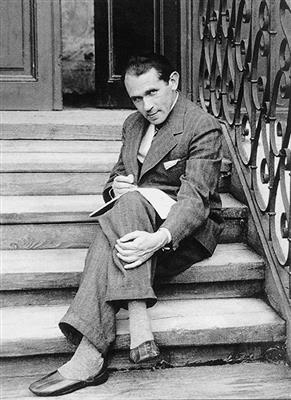
Biography
Born in 1892[1] in Drohobycz, then part of Austrian Galicia (now western Ukraine), Schulz taught drawing and crafts for most of his adult life at the same secondary school where he had been a pupil. He was also a prose writer, and his two published collections, The Cinnamon Shops (1934[1]) and Sanatorium Under the Sign of the Hourglass (1937), are written in a visual language so precise they read as accompaniments to the drawings: both are documents of a private mythology constructed from fabric, mannequins, and the smell of autumnal afternoons.
During the German occupation, Schulz worked under the informal protection of Gestapo officer Felix Landau, for whom he painted a series of fairy-tale murals in a Drohobycz villa. On 19 November 1942[1] he was shot in the street by a rival officer. He was fifty years old. The Polish Academy of Literature had awarded him its Golden Laurel in 1938[1].
His murals were rediscovered in 2001 and became the subject of an international dispute after Yad Vashem removed portions to Jerusalem. The manuscript of his novel The Messiah, which he was said to have been carrying when he was shot, has never been found.
Timeline
- 1892Born in Drohobycz, Austrian Galicia (now western Ukraine).
- 1920Started teaching drawing and crafts at a secondary school in Drohobycz, where he had once been a pupil.
- 1928Created the cycle of prints "The Book of Idolatry", using the cliché-verre technique.
- 1934Published his collection of short stories, "The Cinnamon Shops".
- 1937Published his collection of short stories, "Sanatorium Under the Sign of the Hourglass".
- 1938Awarded the Golden Laurel by the Polish Academy of Literature.
- 1942Shot in the street in Drohobycz by a German officer on 19 November, at 50.
Notable Works
Tap to view larger.
Next stop
Browse the movements →
Every movement in the collection, from the Renaissance to Pop art.
Frequently Asked Questions
What is Bruno Schulz known for?
Bruno Schulz is known for his prose writing and his cycle of prints called the Book of Idolatry. His two published collections, The Cinnamon Shops and Sanatorium Under the Sign of the Hourglass, are documents of a private mythology. The Book of Idolatry depicts scenes of ritual humiliation and erotic submission.What is Bruno Schulz's most famous work?
Bruno Schulz is most recognised for *The Street of Crocodiles*, a collection of short stories that explore his childhood in a small Polish town. Published in 1934[1], the stories blend reality and fantasy, creating a unique and dreamlike world. Schulz's writing style is characterised by its poetic language, rich imagery, and exploration of themes such as memory, identity, and the passage of time. While he also produced other notable works, including the short story collection *Sanatorium Under the Sign of the Hourglass*, *The Street of Crocodiles* remains his most famous and influential work. It has been translated into numerous languages and has had a significant impact on writers and artists around the world. Schulz's unique style and vision continue to captivate readers, solidifying his place as one of the most important Polish writers of the 20th century.What should I know about Bruno Schulz's prints?
Bruno Schulz, a Polish author and artist, is most recognised for his short stories. However, he also produced a small number of prints, primarily woodcuts and linocuts. In Polish art schools, printmaking is a core skill, with students learning painting, drawing, and all print techniques. After 1945, there was a high demand for posters, and many artists turned to printmaking for economic reasons. They brought their own artistic approaches to poster art, which was characterised by narrative qualities and an emphasis on drawing. Schulz's prints often show similar themes and imagery to his literary work. They are characterised by a dreamlike, sometimes unsettling atmosphere. His style frequently incorporates distorted figures and architectural elements, reflecting his interest in surrealism and expressionism. Due to the limited number of prints produced, they are relatively scarce.What style or movement did Bruno Schulz belong to?
Bruno Schulz's work resists easy categorisation. He did not belong to one specific movement, but his writing and visual art share characteristics with several Modernist styles. Some scholars see Schulz as an Expressionist. This is due to his focus on subjective experience, distortion of reality, and exploration of psychological states. Expressionism, as a literary mode, is characterised by heightened emotion and stylistic experimentation. Schulz's prose, with its dreamlike quality and symbolic imagery, aligns with these features. Others link Schulz to Surrealism, noting the presence of dream logic, the juxtaposition of incongruous elements, and the exploration of the unconscious in his work. His use of bizarre imagery and the blurring of boundaries between reality and fantasy are also typical of Surrealist aesthetics. Schulz's fiction also contains elements of Symbolism, with its emphasis on suggestion, atmosphere, and the use of symbols to evoke emotional states. His focus on myth and the past further connects him to Symbolist concerns. While not fitting neatly into any single category, Schulz's art occupies a space between Expressionism, Surrealism, and Symbolism.What techniques or materials did Bruno Schulz use?
Bruno Schulz is best known as a writer of short stories, but he also produced visual art, primarily in the media of drawing and printmaking. He favoured relatively accessible and inexpensive materials. Schulz trained in drawing and painting at Lwów Polytechnic. Later, he taught drawing in schools to earn a living. His early works included oil paintings, but these have not survived. Most of Schulz's surviving artwork consists of small-format drawings in pen, ink, and pencil. He sometimes added watercolour washes to his drawings. Schulz also produced a series of prints using the cliché-verre technique. This process involved drawing an image on a glass plate covered with a dark coating, then scratching away lines to allow light to pass through. The plate was then used as a negative to create photographic prints. These prints often depict scenes populated by distorted figures in claustrophobic settings, reflecting themes present in his literary work. His drawings and prints share a similar aesthetic, characterised by nervous linework and a dreamlike quality.What was Bruno Schulz known for?
Bruno Schulz, a Polish writer, is remembered for his short stories and his distinctive style. Although he was also a visual artist, his literary work has received more attention. Schulz's fiction often explores the imaginative world of childhood and the surreal aspects of everyday life in a provincial Polish town. His two major works are collections of short stories: *The Street of Crocodiles* (Sklepy cynamonowe, 1934[1]) and *Sanatorium Under the Sign of the Hourglass* (Sanatorium pod Klepsydrą, 1937). These stories are characterised by dreamlike imagery, metaphorical language, and a blurring of the boundaries between reality and fantasy. Schulz's writing style is highly poetic and evocative, creating a unique and unsettling atmosphere. His work has been compared to that of Franz Kafka and Marcel Proust, due to its exploration of psychological themes and its innovative narrative techniques. He was killed during the Second World War, and his untimely death cut short a promising literary career.When did Bruno Schulz live and work?
Bruno Schulz was born on 12 July 1892[1] in Drohobycz, Austria-Hungary (now Ukraine). He was a Polish-Jewish writer, fine artist, literary critic, and art teacher. Schulz spent almost his entire life in Drohobycz. From 1902[1] to 1910, he attended the Władysław Jagiełło Gymnasium in Drohobycz. After graduating, he studied architecture at Lwów Polytechnic. His studies were interrupted by illness and he returned to Drohobycz. In autumn 1911, he resumed his architectural studies. In 1915, Schulz studied art in Vienna for a short period. During World War I, he remained in Drohobycz. From 1924 to 1941, he taught manual training and drawing at the Władysław Jagiełło Gymnasium. Schulz is best known for his short stories, which were collected in *The Street of Crocodiles* (1934) and *Sanatorium Under the Sign of the Hourglass* (1937). He also produced drawings, paintings, and graphic art. During the Nazi occupation of Poland, Schulz was forced into the Drohobycz ghetto. He was shot and killed by a Nazi officer on 19 November 1942[1] in Drohobycz.Where can I see Bruno Schulz's work?
Bruno Schulz's works can be viewed in a number of collections and museums, primarily in Germany. These include the Briicke Museum and the Nationalgalerie, both in Berlin; the Kunsthalle and Sammlung Bottcherstrasse in Bremen; the Ludwig Museum and Wallraf-Richartz Museum in Cologne; the Folkwang Museum in Essen; the Gesellschaft Kruppsche Gemaldesammlung, also in Essen; and the Kunsthalle in Hamburg. Other German museums holding works by Schulz are the Niedersachsisches Landesmuseum in Hanover; the Stadtische Kunsthalle in Mannheim; the Bayerische Staatsgemaldesammlungen in Munich; the Stiftung Ada und Emil Nolde in Seebull; and the Von der Heydt Museum in Wuppertal. It is also possible that works are held in private collections such as that of Herr Bernhard Kaufmann.Where was Bruno Schulz from?
Bruno Schulz was born in Drohobych, a town then within the Austro-Hungarian Empire. Today, Drohobych is part of Ukraine, near the Polish border. Schulz's family had lived in the area for generations; the Jewish community there was well-established. During Schulz's lifetime, the region experienced considerable political change. After the First World War, Drohobych became part of Poland. This shift influenced Schulz's sense of identity, as he had to navigate different cultural and national affiliations. His writing often explored themes of displacement and the search for belonging, perhaps reflecting his own experiences with shifting borders and national identities. Though he considered himself Polish, Schulz was murdered by an officer of Nazi Germany during its occupation of Poland in 1942[1].Who did Bruno Schulz influence?
It is difficult to identify specific artists who were directly influenced by Bruno Schulz. Some scholars have noted thematic and stylistic similarities between Schulz and other artists, but influence is hard to prove. One might consider the work of Giorgio Morandi and Alberto Giacometti, along with Henri Michaux, as sharing certain sensibilities with Schulz. Groth stated, "He insists on art's metaphysical side, so-called, and so his quietness is not merely quiet. It gives me important reminders." Some scholars point to parallels between Schulz's dreamlike imagery and certain surrealist and magic-realist artists. However, these are more like affinities than direct influence. It is also worth noting that the colour-field movement, originating from an American sensibility, has had fewer disciples or outgrowths than other artistic movements.Who influenced Bruno Schulz?
Bruno Schulz was influenced by Rembrandt and Vincent van Gogh. He admired Rembrandt's drawings for their emotional force and psychological depth. Schulz felt his own drawings had an affinity with Rembrandt’s nervous sketches, perhaps because he lacked experience but wanted quick results. He was also impressed by the discoveries of psychoanalysis and found a foreshadowing of similar techniques in Rembrandt. Schulz was also drawn to Van Gogh's drawings more than his paintings. He learned from the analytical nature and texture of Van Gogh's ink drawings. He felt that line drawings should not be mixed with half tones and that three-dimensional quality should be expressed through line. He concluded that the quality of a picture is defined by the use of the medium in new visual relations, rather than the illusionistic rendering of nature.Who was Bruno Schulz?
Bruno Schulz (born 1892[1], died 1942[1]) was a Polish-Jewish writer, fine artist, literary critic and art teacher. He is remembered for his short stories, which often explore themes of family, memory, and the surreal, set in a provincial Polish town that resembles his birthplace, Drohobycz (now in Ukraine). His narratives are characterised by dreamlike imagery and a distinctive, metaphorical style that blends reality and fantasy. Schulz's most noted works include *The Street of Crocodiles* (1934[1]) and *Sanatorium Under the Sign of the Hourglass* (1937), collections of short stories translated into many languages. He also produced a number of drawings, paintings, and illustrations, often in a style reminiscent of Expressionism and Surrealism. His visual art complements the themes found in his writing. Schulz's life was tragically cut short during the Holocaust. He was killed by a Nazi officer in Drohobycz, and much of his artistic output was lost or destroyed during the war.
Sources
Editorial draws on the following primary and tertiary references for Bruno Schulz.
- [1] wikipedia Wikipedia: Bruno Schulz Used for: biography, birth dates, death dates, identifiers, movement attribution, nationality.
- [2] book Rosenthal, Nan, Anselm Kiefer : works on paper in the Metropolitan Museum of Art Used for: stylistic analysis.
- [3] book guggenheim-baselitz00wald Used for: stylistic analysis.
- [4] book guggenheim-guhe00solo Used for: biography.
- [5] book guggenheim-twopri00weis Used for: biography, stylistic analysis.
- [6] book Masterpieces of western art : a history of art in 900 individual studies from the Gothic to the present day Used for: biography.
Editorial overseen by Solis Prints. Sources verified 2026-08-31. Click a source for details, or hover over [N] in the page above to preview.
Editorial standardsMethodologyCorrectionsAI disclosureAbout the editorial team