



Bruno Cassinari
Bruno Cassinari came of age at the moment Italian[1] art was most urgently trying to decide what to do about Paris. Like his colleagues in the Fronte Nuovo delle Arti, the group that formed around Guttuso, Birolli, and others in the years immediately after the war, he gravitated towards Picasso's post-war Mediterranean period, the Antibes paintings in particular, as a model for a figurative art that could feel modern without abandoning the motif.
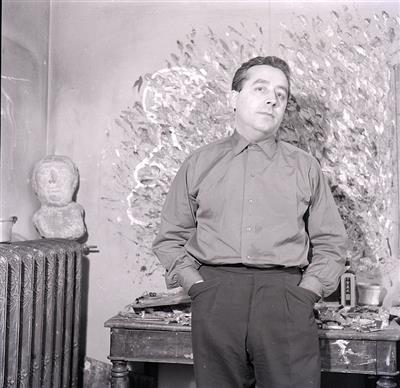
Biography
Born in Piacenza in 1912[1], Cassinari trained in Milan and established his reputation in the post-war years alongside a generation of painters including Birolli, Consagra, Morlotti, Sanfilippo, Turcato, Guttuso, Pizzinato, and Vedova. The critic Cesare Brandi saw this francophilia as a problem, arguing it masked the more original achievements of Italian[1] Futurism and Metaphysical painting. Cassinari's work, however, was less an imitation than a working through of Cubist spatial organisation, animated by a Mediterranean lightness that was felt rather than borrowed.
Through the 1950s and 1960s his painting grew increasingly expressive, the forms becoming more energetic and the palette warmer, while remaining grounded in still lifes, figures, and the coastal landscapes of Liguria and Provence. He exhibited widely in Italy and internationally, and his work entered major public collections.
Cassinari died in Milan in 1992[1]. His career is one of the more independent-minded navigations of the tension, persistent in Italian[1] post-war culture, between assimilating European modernism and finding a distinct pictorial voice.
Timeline
- 1912Born in Piacenza.
- 1945Established his reputation in the post-war years alongside painters including Birolli, Consagra, Morlotti, Sanfilippo, Turcato, Guttuso, Pizzinato, and Vedova.
- 1946Joined the Fronte Nuovo delle Arti with Guttuso and Birolli.
- 1950His painting grew increasingly expressive through the 1950s.
- 1960His painting grew increasingly expressive through the 1960s.
- 1992Died in Milan.
Notable Works
Tap to view larger.
Next stop
Browse the movements →
Every movement in the collection, from the Renaissance to Pop art.
Related Artists


Frequently Asked Questions
What is Bruno Cassinari known for?
Bruno Cassinari is known for his painting, which assimilated European modernism while retaining a distinct pictorial voice. He established his reputation in the post-war years alongside a generation of painters including Birolli, Consagra, and Guttuso.What is Bruno Cassinari's most famous work?
Among Bruno Cassinari's important paintings is *Card Players*, an acrylic on canvas. It measures 167 by 187 centimetres. The painting depicts two girls playing cards in a meadow, which evokes the Garden of Eden. In the background is a city at dusk, with lighted windows. Cassinari often combined disparate elements from different periods and cultures. He merged them within the chromatic atmosphere of the scene, which acts as an archetypical background. Mysterious allegories appear with dreamlike connotations, sometimes like a rebus. Ordinary objects from daily life, such as packs of cards, compasses, or spectacles, are placed side by side with mythological and symbolic depictions, or natural elements such as flowers, plants, or rocks, often set in Mediterranean settings. Cassinari also produced series of bronze and terracotta sculptures, such as the "Architectural Bronzes" (1959[1]), "The Beds" (1961-1962[1]), and "Beaches" (1967-1972).What should I know about Bruno Cassinari's prints?
Bruno Cassinari (1907-1992[1]) was an Italian[1] artist associated with the mid-20th century Milanese art scene. While primarily a painter, he also produced prints. Cassinari's prints are less well documented than his paintings, but they share similar themes and styles. He is known for a semi-abstract style, often incorporating elements of Cubism and Expressionism. His prints, like his paintings, often feature bold colours and simplified forms. Common subjects include figures, still lifes, and scenes inspired by the Italian countryside. Because information about Cassinari's printmaking is scarce, it is difficult to identify specific print series or techniques he favoured. Auction records and gallery catalogues are useful resources for identifying and authenticating Cassinari's prints. These sources may provide details about edition sizes, printing methods (such as lithography or etching), and paper types.What style or movement did Bruno Cassinari belong to?
Bruno Cassinari (1912[1]-1992[1]) was an Italian[1] artist associated with several movements during his career. Initially, he was linked to the anti-fascist Corrente group in Milan during the late 1930s. This group, which included artists and intellectuals, opposed the official art of the regime. After the Second World War, Cassinari's style moved towards a lyrical form of abstract art. He became associated with artists who sought to express emotions and inner states through non-representational forms. Later in his career, Cassinari's work incorporated elements of Expressionism. His paintings often featured bold colours and gestural brushstrokes, conveying a sense of energy. While his work evolved over time, Cassinari remained committed to exploring the expressive potential of colour and form. He engaged with various artistic tendencies, making him a versatile figure in 20th-century Italian art.What techniques or materials did Bruno Cassinari use?
Bruno Cassinari was an Italian[1] artist known for his work in painting and sculpture. He explored various techniques and materials throughout his career. As a painter, Cassinari primarily used oil paints on canvas. His application of paint involved mixing standard artist's oil colours with a medium of wax and turpentine. The wax medium was kept warm on a hot plate and mixed with the paint by brush immediately before applying colour to the canvas. The mixture was applied to the canvas with a brush and worked over so the medium and paint were thoroughly mixed and evenly covered the shape. The paint was then worked with a large painting spatula and a small painting knife until it arrived at a satisfactory state. He also worked with techniques such as scratching or displacement of the paint with the butt-end of the paintbrush, through which the brighter preparation was partially revealed and light effects created. Cassinari also created colour through loosely applied fine dabs, in no way covering the light-coloured preparation.What was Bruno Cassinari known for?
Bruno Cassinari (1912[1]-1992[1]) was an Italian[1] artist known for his painting, sculpture, and stage design. He was associated with several artistic movements during his career, including the Corrente movement and later, a form of abstract expressionism. Cassinari's early work engaged with the anti-fascist Corrente movement in Milan during the late 1930s. This group of artists opposed the official art of the regime, favouring a more expressive and socially conscious style. After World War II, Cassinari moved towards abstraction, developing a style that combined elements of cubism and expressionism. His paintings from this period often feature bold colours and dynamic compositions. In addition to painting, Cassinari also produced sculptures in bronze and other materials. These sculptures often reflected similar themes and styles to his paintings. He also worked in stage design, creating sets and costumes for theatrical productions. Cassinari exhibited widely throughout his career, both in Italy and internationally, securing his place as a significant figure in 20th-century Italian art.When did Bruno Cassinari live and work?
Bruno Cassinari was born in Piacenza, Italy, on 6 October 1912[1]. He died in Milan on 26 March 1992[1]. Cassinari was active as an artist for most of the 20th century. His career began during a period of intense political pressure and economic crisis in Italy. Despite these challenges, Cassinari participated in various exhibitions and movements, such as the First National Show of Contemporary Art in Bologna in 1947[1]. By the early 1950s, Italy's economy improved, and Cassinari continued exhibiting his work. His paintings were shown at Galleria del Naviglio, Milan, alongside artists like Lucio Fontana. Cassinari's involvement in groups such as the MAC (Movimento Arte Concreta) demonstrates his engagement with geometric abstraction. He explored different styles throughout his career, from organic painting to nuclear art, and signed manifestos related to these movements.Where can I see Bruno Cassinari's work?
Bruno Cassinari's paintings and sculptures are held in numerous public collections. These include museums in Italy and elsewhere in Europe. In Italy, his work can be found in the Galleria d'Arte Moderna in Milan, which holds examples of his paintings from different periods. The Museo del Novecento, also in Milan, has paintings and graphic works. Other Italian[1] museums with Cassinari works include the Galleria Nazionale d'Arte Moderna e Contemporanea in Rome and the Peggy Guggenheim Collection in Venice. Outside Italy, Cassinari's art has been acquired by museums in several countries. The Musée d'Art Moderne de la Ville de Paris holds paintings by Cassinari. Examples of his work are also in the collection of the Stedelijk Museum in Amsterdam. Public collections in Germany, Switzerland, and the United Kingdom also possess pieces by this artist. Major auction houses such as Christie's and Sotheby's also handle Cassinari's work, so seeing pieces in their sales is also possible.Where was Bruno Cassinari from?
Bruno Cassinari was an Italian[1] artist. He was born in Piacenza, in the Emilia-Romagna region of northern Italy. After his studies at the Academy of Fine Arts in Milan, Cassinari became part of the artistic scene in Brera, a Milanese district, during its cultural peak in the late 1940s. Although he arrived after what some consider its heroic period, he met masters of the previous generation, like Lucio Fontana, as well as younger artists. Cassinari's career developed during a period of significant change in Italian art, with debates between abstraction and figuration shaping artistic movements. He exhibited at the Venice Biennale in 1954[1], alongside artists such as Afro Basaldella and Giuseppe Santomaso.Who did Bruno Cassinari influence?
Bruno Cassinari (1912[1]-1992[1]) was an Italian[1] artist associated with both the Milanese branch of the Corrente movement and later, with European Informalism. Identifying specific artists who were directly influenced by Cassinari is difficult. His career developed alongside several major artistic trends, and his style incorporated elements of Cubism, Expressionism, and abstraction. Cassinari's work, particularly his gestural painting style and focus on colour, may have resonated with other artists working in the Informal style. This movement, which valued spontaneity and personal expression, included figures like Alberto Burri and Emilio Vedova. However, any influence would likely have been part of a broader exchange of ideas within that artistic milieu. It is more accurate to consider Cassinari as part of a network of artists who mutually informed each other's practices during a period of significant artistic change in Europe. His participation in groups and exhibitions would have placed him in contact with many artists exploring similar approaches to form and content.Who influenced Bruno Cassinari?
Bruno Cassinari's artistic development involved several influences. Matti Moreni, an expressionist painter, encouraged Cassinari to pursue art. Cassinari met Moreni in Turin, a city with an active art scene, and joined the Galleria d'Arte La Bussola. Cassinari was also familiar with world literature. As a boy, he read Kafka, and later encountered Cesare Pavese and Elio Vittorini, both anti-Fascist writers. His mother introduced him to Kafka, reflecting her broader cultural interests. During the Fascist era, Cassinari was exposed to German Expressionism through quasi-clandestine publishers. After 1945[1], he discovered previously unknown authors and a different world through cinema, including American films and Italian[1] neorealism. Although he lived in a provincial town without many art exhibitions, he learned about contemporary art through reviews. He cited Giorgio Morandi as an important early influence.Who was Bruno Cassinari?
Bruno Cassinari (1912[1]-1992[1]) was an Italian[1] artist, known for his painting and sculpture. Born in Piacenza, he studied at the Academy of Fine Arts in Milan. Cassinari was associated with several artistic movements. Early in his career, he joined the Corrente group, which opposed the official art of the Fascist regime. Later, he was linked to the neo-Cubist and expressionist styles. His work often featured figurative elements, but with an increasing move toward abstraction. After World War II, Cassinari participated in the Venice Biennale, and he exhibited internationally. His paintings often depict figures, still lifes, and scenes from nature, rendered in a style that combines bold colours with simplified forms. Cassinari also worked as a sculptor, creating bronze figures. He received various awards for his art. Cassinari's art is held in numerous public collections.
Sources
Editorial draws on the following primary and tertiary references for Bruno Cassinari.
- [1] wikipedia Wikipedia: Bruno Cassinari Used for: biography, birth dates, death dates, identifiers, movement attribution, nationality.
- [2] book guggenheim-metph00cela Used for: biography, stylistic analysis.
- [3] book Braun, Emily, 1957-; Asor Rosa, Alberto; Royal Academy of Arts (Great Britain), Italian art in the 20th century : painting and sculpture, 1900-1988 Used for: biography.
- [4] book Post-impressionism : cross-currents in European painting Used for: biography.
Editorial overseen by Solis Prints. Sources verified 2026-08-29. Click a source for details, or hover over [N] in the page above to preview.
Editorial standardsMethodologyCorrectionsAI disclosureAbout the editorial team