

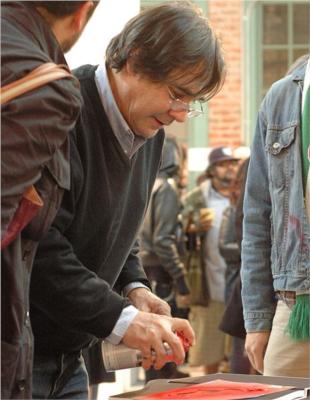
Blek le Rat
In 1981, Xavier Prou began spraying stencilled rats onto the walls of Paris. He chose the rat because it was the only free animal in the city, and because the word rat was an anagram of art. The rats appeared at night, life-size and moving in packs, creating a visual vocabulary that preceded, and directly informed, the global explosion of stencil street art that followed two decades later.
Biography
Born in Boulogne-Billancourt in 1951 and trained at the Beaux-Arts de Paris and the Ecole nationale superieure d'architecture, Prou was working from art-historical sources from the beginning. In 1991, while stencilling a reproduction of Caravaggio's Madonna di Loreto onto a Paris wall, he was arrested. The work was later rediscovered in Leipzig in 2012. The arrest prompted a shift in method: he began producing pre-made poster prints rather than painting directly, reducing exposure without abandoning the street as a venue.
His influence on Banksy is well-documented. Banksy has said that every time he thought he had painted something slightly original, he found that Blek le Rat had done it first, roughly twenty years earlier. The two collaborated on a San Francisco mural in 2011. From 2006 onwards, Blek le Rat produced a series of works focused on homelessness, using isolated figures rather than the rat motif. His first UK solo show was at Leonard Street Gallery, London, in 2006; his American debut came at Subliminal Projects Gallery, Los Angeles, in 2008.
Timeline
- 1952Born Xavier Prou in Boulogne-Billancourt, France.
- 1981Began stencilling rats on walls in Paris. He chose the rat as a symbol because it was the only free animal in the city, and because 'rat' is an anagram of 'art'.
- 1991Arrested while stencilling a reproduction of Caravaggio's Madonna di Loreto onto a wall in Paris.
- 1991Shifted from painting directly to producing pre-made poster prints, after his arrest.
- 2006Produced a series of works focused on homelessness, using isolated figures rather than the rat motif.
- 2006First UK solo show at Leonard Street Gallery, London.
- 2008American debut at Subliminal Projects Gallery, Los Angeles.
- 2011Collaborated with Banksy on a mural in San Francisco.
- 2012The Caravaggio reproduction he was arrested for creating in 1991 was rediscovered in Leipzig.
Notable Works
Tap to view larger.
Next stop
Browse the movements →
Every movement in the collection, from the Renaissance to Pop art.
Related Artists


Frequently Asked Questions
What is Blek le Rat known for?
Blek le Rat is known for his stencil street art, particularly his image of rats. He chose the rat because it was the only free animal in the city, and because the word rat was an anagram of art.What is Blek le Rat's most famous work?
Due to the anonymous nature of street art, pinpointing one single 'most famous work' is difficult. However, Blek le Rat is well known for his stencilled images of rats, which appeared on the streets of Paris beginning in 1981. His choice of the rat was deliberate; he saw them as symbols of urban life and of spreading art like a plague throughout the city. The rat image also functions as an anagram of 'art'. Blek le Rat's early work was influenced by the 1970s graffiti scene in New York City, but he adapted it to his own purposes and context. He is considered one of the earliest practitioners of stencil graffiti. His work has had an impact on later street artists.What should I know about Blek le Rat's prints?
Blek le Rat's prints, like all fine art prints, exist in a grey area between 'original' and reproduction. Printmakers usually create either open editions (unlimited copies) or limited editions (a specific number). The artist usually makes the decision to limit an edition, not the medium. A woodblock, properly cared for, can produce hundreds of thousands of prints. Thomas Bewick's wood engraving, *View of Newcastle*, was printed 900,000 times. Each print in a limited edition is numbered, titled, and signed in pencil. The edition number appears on the bottom left margin of the print (for example, 12/25, meaning print number 12 from an edition of 25). The title goes in the centre of the bottom margin, and the artist's signature on the bottom right. The letters 'A/P' signify an artist's proof, of which there can be up to 10% of the total edition. 'T/P' indicates early proofs, and 'V' indicates a variant edition using different colours or blocks. Prints marked 'Hors de Commerce' are not for sale.What style or movement did Blek le Rat belong to?
Blek le Rat is a French[3] graffiti artist who began his career in Paris in the early 1980s. He is considered one of the earliest practitioners of stencil graffiti. His work is associated with the early development of stencil graffiti and the broader street art movement. Many examples of this art appeared in urban settings during the 1980s. Though not formally aligned with any specific movement, his art shares characteristics with Pop Art and Situationism. Pop Art's influence can be seen in his use of popular imagery and mass production techniques (stencils). Situationism, a radical social and artistic movement of the mid-20th century, influenced his interventions in urban environments. He makes use of public space for artistic expression and social commentary. His work has, in turn, influenced later street artists.What techniques or materials did Blek le Rat use?
Blek le Rat, a graffiti artist, is known for using stencils to create his images. This technique allows for quick and precise application of his art in public spaces. The use of stencils is a common practice among graffiti artists, including Banksy, as it speeds up the process and allows for more controlled results. Spray paint, which became available in aerosol cans in 1949, is another material frequently employed by street artists due to its portability and rapid application. These materials and techniques align with the anti-establishment nature of street art, making it accessible to a wide audience by placing it directly on public buildings. Dubuffet also used unconventional materials like sand, glue, tar, gravel, lime, plaster, asphalt, and mud to create his art.What was Blek le Rat known for?
Blek le Rat is known as one of the early innovators of stencil graffiti. He began his street art in Paris in 1981, and his work influenced later stencil artists internationally. Inspired by early graffiti in New York, Blek le Rat adapted the approach by using stencils to create images quickly. He initially painted rats in the streets of Paris, which he considered a symbol appropriate to urban life. As he explained, rats could be found everywhere, and they spread art like an infestation. Later, Blek le Rat expanded his subjects beyond rats to include figures, often life-size. These were frequently portraits of individuals. His subjects included ordinary people as well as historical figures. One well-known image was a stencilled portrait of Caravaggio. Blek le Rat's work gained attention for its distinctive style and its engagement with public space. He has been credited as an influence on other street artists, most notably Banksy, who has acknowledged Blek's impact on his own art. Blek le Rat continues to create street art and exhibit his work in galleries.When did Blek le Rat live and work?
Blek le Rat, born Xavier Prou in Boulogne-Billancourt, France, in 1951, is one of the early innovators of stencil graffiti. He began his street art in Paris in 1981, and he continues to be active. Prou's initial stencil work featured rats, chosen, he has said, because "rat" is an anagram of "art", and also as an ironic symbol. Rats are ubiquitous in cities and can spread messages widely. His work was influenced by early graffiti art in New York City, but he chose stencils as a quicker method. He studied printmaking, architecture and fine art at the École des Beaux-Arts. His work has been exhibited in galleries internationally since the 1980s. He has inspired many other street artists, including Banksy, who has acknowledged Blek's influence. Blek le Rat's work can still be seen in urban environments, and he is considered a significant figure in the development of street art as a form.Where can I see Blek le Rat's work?
As a street artist, Blek le Rat's work is often site-specific and ephemeral. Tracing his outdoor pieces requires some exploration. However, a number of museums and galleries do hold examples of his studio work. In France, you might see pieces at the Musée National d’Art Moderne, Centre Georges Pompidou, or the Musée d’Orsay, both in Paris. Other French[3] museums with relevant holdings include the Musée des Beaux-Arts in Nantes, the Musée des Beaux-Arts in Lille, and the Musée d’Art Moderne in Strasbourg. Outside France, consider the Art Gallery of New South Wales in Sydney, the Kunsthistorisches Museum in Vienna, or the Koninklijk Museum voor Schone Kunsten in Antwerp. In Canada, the Art Gallery of Ontario in Toronto may have pieces available for viewing.Who did Blek le Rat influence?
Blek le Rat, the pseudonym of Xavier Prou, is a French[3] stencil graffiti artist. He began his street art in Paris in 1981, and his work has subsequently appeared internationally. Many street artists acknowledge Blek le Rat's influence on their work. He is credited with inspiring a later generation of artists who employ stencils in their practice. These artists include Banksy, Shepard Fairey, and Robbie Conal. Banksy has directly acknowledged Blek le Rat's impact. Banksy stated that "every time I think I've painted something slightly original, I find out that Blek le Rat has done it already, only twenty years earlier". This statement suggests a direct line of influence and inspiration from Blek le Rat to Banksy's well-known stencil art. Blek le Rat's early adoption of stencils as a means of street art is considered a significant contribution to the development of the medium. His influence can be seen in the widespread use of stencils in contemporary street art.Who influenced Blek le Rat?
Blek le Rat, born Xavier Prou in 1951, is considered one of the earliest graffiti artists in Paris. He began his street art in 1981, and his work has influenced later stencil graffiti artists. According to Blek le Rat, his artistic direction was partly shaped by early exposure to American art and culture. In 1971, he travelled to New York City and saw graffiti there. He has said that he was struck by the graffiti in New York, but he was more interested in its potential than its actuality. Blek le Rat has also cited the Italian artist Michelangelo Pistoletto as an important influence. Pistoletto is associated with the Arte Povera movement. This movement challenged traditional art materials and methods. Pistoletto's stencil-based work, which often incorporated mirrors, offered Blek le Rat a conceptual framework he adapted to his own practice.Who was Blek le Rat?
Blek le Rat is the pseudonym of Xavier Prou, a French[3] graffiti artist. He was one of the first graffiti artists in Paris, and has been described as the "father of stencil graffiti". Prou was born in Boulogne-Billancourt in 1951. He began his street art in 1981, after being inspired by early graffiti art he saw in New York City in 1971, and by the 1960s pochoir stencils of Gérard Fromanger. Blek chose his name partly from a comic book, "Blek le Roc", and partly as a pun on "rat", meaning "sewer rat" which he saw as an appropriate symbol for art that is disseminated throughout the city. His first stencils were of rats, which he placed on the walls of Paris. He expanded to other figures, often life-size, such as Charles Manson, the blind guitarist, and a businessman. His work often contains social commentary, and an awareness of art history; he has referenced Caravaggio, amongst others. He has influenced other street artists, such as Banksy, who has acknowledged Blek's influence by saying that every time he thinks he has painted something slightly original, he finds out that Blek le Rat has done it too, only twenty years earlier.Why are Blek le Rat's works important today?
Blek le Rat, active since the early 1980s, is considered one of the originators of stencil graffiti. His early street art in Paris influenced later practitioners of the form. Street art gained increased attention in the 1980s, when artists moved from the street to galleries. Figures such as Jean-Michel Basquiat and Keith Haring gained gallery representation and wider recognition. Basquiat, for example, first became known for street writings signed "SAMO" before his gallery debut. Haring's work was even preserved by New York City's Parks Department. Today, street art continues to generate discussion. A work by Basquiat sold for $110.5 million in 2017, yet the destruction of the 5Pointz graffiti site in Queens in 2013 shows the form's impermanence. Street art's move into mainstream culture raises questions about its original subversive nature. Blek le Rat's early work provides a point of comparison for contemporary debates around street art's role and value.
Sources
Editorial draws on the following primary and tertiary references for Blek le Rat.
- [1] museum Harvard Art Museums Used for: museum holdings.
- [2] museum Victoria and Albert Museum Used for: museum holdings.
- [3] wikipedia Wikipedia: Blek le Rat Used for: biography, birth dates, death dates, identifiers, movement attribution, nationality.
- [4] book Nia Gould, A History of Art in 21 Cats Used for: stylistic analysis.
- [5] book Dorling Kindersley, Artists: Inspiring Stories of the World's Most Creative Minds Used for: biography, stylistic analysis.
- [6] book guggenheim-invested00blis Used for: biography.
- [7] book guggenheim-rroseisr00bles Used for: biography.
- [8] book guggenheim-twopri00weis Used for: biography.
Editorial overseen by Solis Prints. Sources verified 2026-10-07. Click a source for details, or hover over [N] in the page above to preview.
Editorial standardsMethodologyCorrectionsAI disclosureAbout the editorial team