



Berthold Woltze
He painted one of the most immediately recognisable images of 19th-century German genre art: a young woman on a train, looking away from a man leaning too close. Der lästige Kavalier (The Annoying Gentleman), completed in 1874[1], hangs in the German Historical Museum in Berlin, and its appeal lies less in painterly pyrotechnics than in the precision with which Woltze captured an awkward social moment that has lost none of its currency.
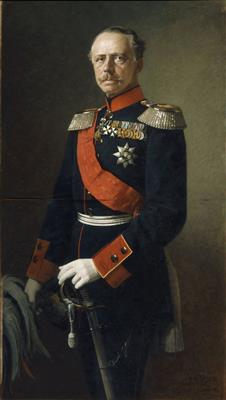
Biography
Woltze was born in Havelberg in 1829[1] and trained in the German academic tradition before securing a professorship at the Weimar Saxon Grand Ducal Art School, where he remained until his death in 1896[1]. Weimar at the time was one of Germany's more progressive cultural centres, a place where a painter of domestic subjects could find both institutional stability and an educated audience.
His output encompassed genre scenes, portraits, and illustration. Between 1871[1] and 1878 he contributed regularly to the Gartenlaube, Germany's most widely read illustrated magazine of the period, with a circulation that reached into the hundreds of thousands. Publication there brought his work to an audience no gallery exhibition could match. Among his other canvases is Ein Brief aus Amerika (c. 1860), a domestic interior of quiet tension, and Das Schnäppchen (The Bargain), which shares the social acuity of his more famous painting.
His son Peter Woltze (1860[1]-1925[1]) became an architectural painter, suggesting an environment in which art was both vocation and inheritance. Berthold Woltze died in Weimar in 1896[1].
Timeline
- 1829Born in Havelberg.
- 1860Painted "Ein Brief aus Amerika" (A Letter from America), a domestic interior.
- 1860His son, Peter Woltze, was born; he later became an architectural painter.
- 1871Began contributing regularly to the Gartenlaube magazine.
- 1874Completed "Der lästige Kavalier" (The Annoying Gentleman), now in the German Historical Museum in Berlin.
- 1878Stopped contributing to the Gartenlaube magazine.
- 1896Died in Weimar at 67.
Notable Works
Tap to view larger.
Next stop
Browse the movements →
Every movement in the collection, from the Renaissance to Pop art.
Frequently Asked Questions
What is Berthold Woltze known for?
Berthold Woltze is known for painting Der lästige Kavalier (The Annoying Gentleman), which hangs in the German Historical Museum in Berlin. He is also known for his contributions to the Gartenlaube, a widely read illustrated magazine.What is Berthold Woltze's most famous work?
It is difficult to name Berthold Woltze's single most famous work. He was a popular genre painter and illustrator in later 19th-century Germany. Woltze is best known for sentimental scenes of childhood, such as 'Difficult Lesson' (c. 1880[1]) and 'The Pet Bird' (date unknown). These paintings often depict interactions between children and their elders, or children and animals. His images were widely reproduced as prints and in books, making them accessible to a broad audience. Woltze's work appealed to middle-class tastes, and he achieved considerable commercial success during his lifetime. While he may not be a household name today, his paintings offer a glimpse into the values and aesthetics of his time.What should I know about Berthold Woltze's prints?
Berthold Woltze (1829[1]-1896[1]) was a German artist and academic. He is mostly known for figurative paintings and illustrations. Woltze taught at the Weimar Princely Free Drawing School, where he became a professor in 1876[1]. He later served as director. His work often depicted scenes of family life, childhood, and historical events. He also produced illustrations for books and periodicals. Prints of Woltze's work are generally reproductions of his paintings or drawings. These prints allow collectors to acquire examples of his art at a lower price than original works. They can offer insight into the artistic style and subject matter that Woltze explored during his career. His prints may appeal to those interested in nineteenth-century German art, genre scenes, or the history of illustration.What style or movement did Berthold Woltze belong to?
Berthold Woltze was a German painter and professor associated with late-19th-century academic realism. He is best known for genre paintings depicting scenes of everyday life, often with a sentimental or humorous tone. Woltze received his initial training at the Hanover Polytechnic, after which he enrolled at the Düsseldorf Academy. There, he studied with Wilhelm Schmurr and Karl Müller. Düsseldorf was a significant centre for realist painting during this period, and Woltze’s style reflects the influence of this artistic environment. Later in his career, Woltze became a professor at the Weimar Saxon Grand Ducal Art School, where he taught for many years. His academic position solidified his role within the established art world, and his work continued to reflect the conservative tastes of the period. While he incorporated elements of naturalism in his attention to detail, his paintings generally lack the social commentary or avant-garde experimentation associated with more radical movements like Impressionism or early Expressionism. Instead, Woltze focused on technically proficient depictions of anecdotal subjects, aligning him with the academic tradition.What techniques or materials did Berthold Woltze use?
Unfortunately, the provided texts do not contain information about Berthold Woltze's artistic techniques or materials. The passages discuss the methods of Brice Marden, glass painters of the Dürer/Holbein era, Caravaggio, and El Greco, none of whom are Woltze. Therefore, I cannot provide a specific answer to your question about Woltze's practices. However, I can offer some general information about artistic techniques. Oil paint consists of pigments diluted in a binding agent. The granular structure of glass paint means that it must be refined by grinding with a muller. For glass painting, watery binders must be alternated with oily substances. Soft brushes are used to achieve a smooth surface, while bristle brushes can create texture. Artists may also use tools such as palette knives, metal brushes, or wooden tools.What was Berthold Woltze known for?
Berthold Woltze (1829[1]-1880[1]) was a German genre painter and academic artist. He is best known for sentimental scenes of childhood and family life, often set in domestic interiors. Woltze trained at the Düsseldorf Academy, a centre for genre painting during the mid-19th century. He later became a professor at the Weimar Art School, where he promoted realistic depictions of everyday life. His paintings often feature children engaged in simple activities, such as playing games, reading, or helping with household chores. These works were popular for their naturalism and ability to evoke feelings of warmth and nostalgia. Although Woltze's style is rooted in realism, his paintings also contain elements of idealisation. His subjects are typically depicted in a positive light, and his compositions are carefully arranged to create a harmonious and pleasing effect. Woltze's work appealed to a broad audience, and his paintings were widely reproduced as prints and engravings.When did Berthold Woltze live and work?
Berthold Woltze was born in Havelberg, Germany, in 1829[1], and he died in Weimar in 1896[1]. He was a genre painter, associated with the Weimar School of Art. Woltze studied at the Berlin Academy from 1851[1]. He became a professor at the Weimar School of Art in 1868, where he taught until his death. His work often depicted scenes of everyday life, particularly those involving children and families. Examples include "The Examination" (c. 1889) and "Children's Holiday" (date unknown). These paintings are characterised by their realistic style and attention to detail. Woltze's position at the Weimar School made him an important figure in German art education during the second half of the 19th century. He influenced a generation of artists through his teaching and example. His paintings remain popular for their charming depictions of childhood and domestic life.Where can I see Berthold Woltze's work?
Berthold Woltze (1829[1]-1896[1]) was a German genre painter and professor at the Kunstakademie Düsseldorf. His works can be found in several German museum collections. The Hamburger Kunsthalle holds Woltze's painting *Vor dem Schulgang* (Before School, 1876[1]). This artwork depicts a scene of children preparing to go to school. The Kunsthalle's collection focuses on North German painting from the Middle Ages to the present. The Museum Kunstpalast in Düsseldorf possesses Woltze's *Alternder Gelehrter am Schreibtisch* (Aging Scholar at his Writing Desk). This museum has holdings of paintings, sculpture, graphic art, and applied art. The Städtische Galerie in Wuppertal includes Woltze's *Das kranke Kind* (The Sick Child) in its collection. The gallery's collection emphasises 19th- and 20th-century art. Smaller museums in Germany may also hold Woltze's works; however, the three museums listed above offer good starting points for viewing his art. Museum websites often provide collection catalogues, exhibition schedules, and visitor information.Who did Berthold Woltze influence?
Berthold Woltze (1829[1]-1896[1]) taught at the Weimar Saxon Grand Ducal Art School from 1876[1]. Woltze's students included Fritz Mackensen (1866-1953[1]), who studied there between 1884 and 1887. Mackensen became a co-founder of the Worpswede artists' colony outside Bremen. Hans Olde (1855-1917) studied with Woltze in Weimar from 1883 to 1885. Olde later became director of the Weimar Saxon Grand Ducal Art School, and then director of the School of Fine Arts in Kassel. The painter Otto Ubbelohde (1867-1922) studied at the Weimar Saxon Grand Ducal Art School from 1890 to 1893. Ubbelohde is known for illustrating the Brothers Grimm fairy tales. These artists absorbed Woltze's academic realism, but each developed individual styles. Mackensen moved toward a rural naturalism. Olde adopted elements of impressionism and symbolism. Ubbelohde combined realism with fantastical elements.Who influenced Berthold Woltze?
Berthold Woltze's influences are not well documented in the available sources, but some information can be gleaned about the artistic influences of his contemporaries in Germany. The painter Christian Rohlfs, for example, initially trained in the classicistic tradition at the Weimar Kunstakademie. However, Rohlfs later encountered French Impressionism, viewing works by Monet, Sisley, and Pissarro in Weimar during the 1890s. This led to a brighter palette, but Rohlfs did not fully adopt the Impressionist style of dissolving objective forms. He remained closer to the realism of Courbet. Later, Rohlfs saw paintings by Seurat, Signac, and Rysselberghe; their luminosity fascinated him. Subsequently, he began a dialogue with Munch and van Gogh. Similarly, Georg Baselitz was influenced by Fautrier's emphasis on matter and encrusted surfaces. He also drew inspiration from American artists such as de Kooning, Guston, Pollock, and Still, as well as Mondrian's compositions.Who was Berthold Woltze?
Information on Berthold Woltze is not available in the provided documents. However, the passages do discuss several other artists and movements from the same period in Germany. Fritz Mackensen (1866[1]-1953[1]) studied at the Diisseldorf Academy and later at the Akademie der Bildenden Künste in Munich. In 1889, he established an artist's colony in Worpswede, north of Bremen, with Otto Modersohn and Hans am Ende. Mackensen's painting Prayers on the Moor won a gold medal at the International Exhibition in Munich in 1895. He later directed the Hochschule für Bildende Kunst, Weimar, from 1908 to 1918, and the Nord Kunsthochschule, Bremen, in 1933-34. Another artist, Christian Rohlfs, began painting after an accident led to a long hospital stay. Theodor Storm recognised his talent and facilitated his studies in Berlin and Weimar. Rohlfs's early work focused on figurative art, but he later concentrated on painting the area around Weimar. He encountered French Impressionism in the 1890s, adopting a brighter palette, but did not fully embrace its principles. In 1901, Rohlfs moved to Hagen after meeting Karl-Ernst Osthaus and Henry van de Velde, where he explored Pointillism and engaged with the works of Munch and van Gogh.Why are Berthold Woltze's works important today?
Berthold Woltze (1829[1]-1917) was a German painter and academic. He is remembered today for his contribution to 19th-century German genre painting, particularly his depictions of childhood and family life. Woltze's works offer insights into the social customs, clothing, and settings of the period. Woltze taught at the Weimar Saxon Grand Ducal Art School. His emphasis on naturalistic representation and anecdotal storytelling was influential for a generation of artists. While his style may not align with later avant-garde movements, his paintings are valued for their historical and cultural documentation. They provide a window into the values and everyday experiences of middle-class society in Germany during the late 1800s. Woltze's work is a reminder of the diversity within 19th-century art beyond Impressionism and other more publicised styles.
Sources
Editorial draws on the following primary and tertiary references for Berthold Woltze.
- [1] wikipedia Wikipedia: Berthold Woltze Used for: biography, birth dates, death dates, identifiers, movement attribution, nationality.
- [2] book guggenheim-expger00neug Used for: biography.
- [3] book Palmer, Allison Lee, Historical Dictionary of Neoclassical Art and Architecture Used for: biography, stylistic analysis.
- [4] book Allison Lee Palmer, Historical Dictionary of Neoclassical Art and Architecture Used for: biography, stylistic analysis.
- [5] book Neoclassicism and romanticism : architecture, sculpture, painting, drawings, 1750-1848 Used for: biography, stylistic analysis.
- [6] book Post-impressionism : cross-currents in European painting Used for: biography.
- [7] book Post-impressionism : cross-currents in European painting Used for: biography.
Editorial overseen by Solis Prints. Sources verified 2026-08-31. Click a source for details, or hover over [N] in the page above to preview.
Editorial standardsMethodologyCorrectionsAI disclosureAbout the editorial team