

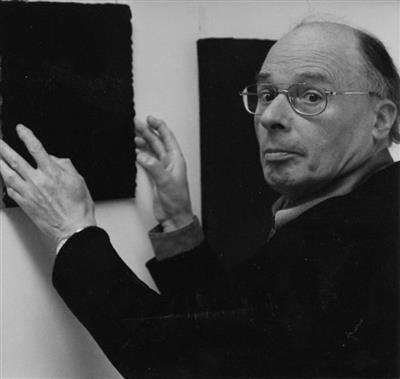
Bernard Aubertin
A chance encounter with Yves Klein in 1957[1] redirected Bernard Aubertin's practice entirely. The two met near Fontenay-aux-Roses, where Aubertin had grown up, and Klein's monochromes opened the question of whether painting could be reduced to a single material act. Aubertin answered it with red: from 1958 onwards he produced dense scarlet monochromes in which the surface was built up from paint and embedded nails, the heads left protruding to catch the light and generate texture within uniform colour.
Biography
By 1960[1] he had aligned himself with the ZERO movement, the West German network of artists (Heinz Mack, Otto Piene, Günther Uecker) who sought to strip art back to elemental forces: light, movement, space, fire. Aubertin contributed a text to Zero magazine's third volume in July 1961, articulating his theory of "the picturesque situation of red within a spatial concept." These were not decorative exercises in colour theory; they were propositions about energy and perception.
Fire became the logical extension of that proposition. Aubertin developed fire paintings and performance pieces in which sheets of paper or canvas were deliberately burnt, sometimes in public, the act of destruction itself constituting the work. He showed at Documenta 6 in Kassel in 1977[1] and continued working until late in his life: the 54th Venice Biennale in 2011 and a presentation at the Palais de Tokyo in 2012 came near the end of a career that had begun with a vivid red panel and a nail.
Aubertin was born in Fontenay-aux-Roses on 29 July 1934[1] and died in Reutlingen on 31 August 2015[1], aged 81.
Timeline
- 1934Born in Fontenay-aux-Roses on 29 July.
- 1957Met Yves Klein near Fontenay-aux-Roses. Klein's monochromes influenced Aubertin's practice.
- 1958Began producing scarlet monochromes, building surfaces with paint and embedded nails.
- 1960Aligned himself with the ZERO movement, a West German network of artists.
- 1961Contributed a text to Zero magazine's third volume, articulating his theory of "the picturesque situation of red within a spatial concept."
- 1977Showed at Documenta 6 in Kassel.
- 2011Participated in the 54th Venice Biennale.
- 2012Presented work at the Palais de Tokyo.
- 2015Died in Reutlingen on 31 August, aged 81.
Notable Works
Tap to view larger.
Next stop
Browse the movements →
Every movement in the collection, from the Renaissance to Pop art.
Related Artists


Frequently Asked Questions
What is Bernard Aubertin known for?
Bernard Aubertin is known for his dense scarlet monochromes, which he created from 1958[1] onwards. These works featured paint and embedded nails, with the nail heads protruding to catch light and create texture. He also developed fire paintings and performance pieces, sometimes burning paper or canvas in public as part of the artwork.What was Bernard Aubertin's art style?
Aubertin's art style involved dense scarlet monochromes, built up with paint and embedded nails. He aligned himself with the ZERO movement in 1960[1], which sought to reduce art to elemental forces like light, movement, space, and fire. He also created fire paintings and performance pieces involving burning materials.When was Bernard Aubertin born?
Bernard Aubertin was born in 1934[1].
Sources
Editorial draws on the following primary and tertiary references for Bernard Aubertin.
- [1] wikipedia Wikipedia: Bernard Aubertin Used for: biography, birth dates, death dates, identifiers, movement attribution, nationality.
- [2] book guggenheim-gauguindecorativ00gaug Used for: biography, stylistic analysis.
- [3] book Masterpieces of western art : a history of art in 900 individual studies from the Gothic to the present day Used for: biography.
- [4] book Post-impressionism : cross-currents in European painting Used for: biography, stylistic analysis.
- [5] book Post-impressionism : cross-currents in European painting Used for: biography, stylistic analysis.
Editorial overseen by Solis Prints. Sources verified 2026-08-30. Click a source for details, or hover over [N] in the page above to preview.
Editorial standardsMethodologyCorrectionsAI disclosureAbout the editorial team