



Ben
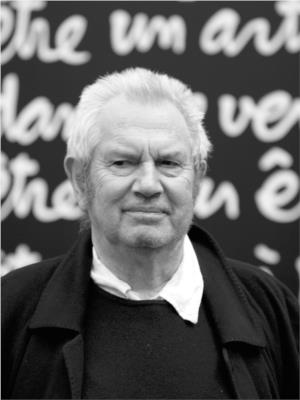
Ben Vautier spent the entire duration of the 1962 Festival of Misfits living in a London shop window. For two weeks at Gallery One, he ate, slept, and groomed himself in full public view while the glass bore his characteristic scrawled script demanding passers-by to 'look' and 'stop looking.' The work was later reconstructed for the Walker Art Center in Minneapolis in 1992-93, at 3.19 x 4.53 x 2.74 metres.
Biography
Born in Naples in 1935[3] to a Swiss father and an Irish mother, Vautier grew up across Turkey, Egypt, and Greece before settling in Nice in 1949, where he has remained. He started out dealing secondhand records; by 1958 he had opened the first of several shops conceived as total art environments. By 1960 he was signing money as art: roubles, dollars, francs, and marks. He nominated his Nice shop as a work of art, signed the deaths of Yves Klein and Piero Manzoni, and signed mummies and catacombs.
Vautier joined the Fluxus network in the early 1960s and organised the Fluxus Festival d'Art Total et du Comportement in Nice in 1963. Guggenheim scholarship frames his core position as this: ego is the true subject of creative expression. Lucy Lippard, documenting his work in Six Years (1971), noted his major acknowledged influence was Yves Klein, who had 'signed the world' in 1960 and whose mystical approach to non-object art ran through all of European Fluxus.
His painted text works from the 1960s and 1970s, small oil-on-wood panels inscribed with gestures such as Ecrire sur un mur (1960) and Regarder le ciel (1963), held in the Daniel Templon collection in Paris, are now his most widely reproduced images. He featured in Documenta V (1972), A Propos de Nice at the Centre Pompidou (1977), and the Walker Art Center's In the Spirit of Fluxus (1993).
Timeline
- 1935Born in Naples to a Swiss father and an Irish mother.
- 1949Settled in Nice.
- 1958Opened the first of several shops in Nice, conceived as total art environments.
- 1960Began signing money as art, including roubles, dollars, francs, and marks.
- 1960Created "Ecrire sur un mur".
- 1963Organised the Fluxus Festival d'Art Total et du Comportement in Nice.
- 1963Created "Regarder le ciel".
- 1972Featured in Documenta V.
- 1977Featured in A Propos de Nice at the Centre Pompidou.
- 1992Reconstructed his 1962 work for the Walker Art Center in Minneapolis.
Notable Works
Tap to view larger.
Next stop
Browse the movements →
Every movement in the collection, from the Renaissance to Pop art.
Frequently Asked Questions
What is Ben known for?
Ben is known for living in a London shop window for two weeks during the 1962 Festival of Misfits. He ate, slept, and groomed himself in public view while the glass bore his scrawled script demanding passers-by to 'look' and 'stop looking.'What techniques or materials did Ben use?
Ben primed cotton duck canvas with two coats of turps-thinned Flake White, sanding the surface when dry. For colour application, standard artist's oil paint was mixed with a medium of wax and turpentine. The medium was kept warm on a hot plate, and small amounts were mixed with the paint by brush just before application to the canvas. The mixture was applied to the canvas with a brush and worked over so the medium and paint thoroughly mixed and evenly covered the shape. The paint was then worked with a large painting spatula and a small painting knife until it reached a satisfactory state. Ben tried to keep the surfaces in one painting constant and total. Variables included extensive heating of the medium, which resulted in some evaporation, making the paint gummy and softer. Leftover paint, with wax added, was often used in mixing subsequent colours. Oil remained the primary binder, as opposed to encaustic, where wax is the binder.What was Ben known for?
Ben was known for his association with the Fluxus movement, beginning in 1963. He met the Korean artist Nam June Paik, as well as George Maciunas, and started exhibiting his own performance pieces. In addition to these 'actions', he produced sketches and plastic works, and he designed objects and environments. The symbolism in Ben's work often came from magical, religious, mythical, and archetypal contexts, along with personal experience. For example, his idea of felt as insulation against the cold, and fat as a source of energy, came from his own life. This represented a closeness to nature, which he felt was lost in contemporary culture. Ben also advocated creativity in all aspects of life; this led to his attempts to gain political influence.When did Ben live and work?
Ben Nicholson was born on 10 April 1894, in Denham, Buckinghamshire, England. Both of his parents were painters. He attended the Slade School of Fine Art, London, in 1910-11. Between 1911 and 1914, he travelled in France, Italy, and Spain. He briefly lived in Pasadena in 1917-18. His first solo show occurred at the Adelphi Gallery, London, in 1922. Shortly thereafter, he began abstract paintings influenced by Synthetic Cubism. By 1927, he had initiated a primitive style inspired by Rousseau and early English folk art. From 1931, Nicholson lived in London; his association with Henry Moore and Barbara Hepworth dates from this period. In 1932, he and Hepworth visited Brancusi, Arp, Braque, and Picasso in France. Nicholson moved to Ticino, Switzerland, in 1958 and began to concentrate once more on painted reliefs. In 1964, he made a concrete wall relief for the Doamioita 111 exhibition in Kassel, Germany. Queen Elizabeth awarded him the Order of Merit in 1968. Ben Nicholson returned to England in 1972, settling first in Cambridge and later in Hampstead. He died on 6 February 1982.Where can I see Ben's work?
Works by Ben can be found in several museums internationally. In the United States, you can view Ben's art at the Art Institute of Chicago; the Field Museum, Chicago; the High Museum, Atlanta; the J. Paul Getty Museum, Los Angeles; LACMA (Los Angeles County Museum of Art); the Metropolitan Museum of Art, New York; the Minneapolis Institute of Arts; the Museum of Fine Arts, Boston; the Museum of Modern Art, New York; the Shift Field Museum, Chicago; the Textile Museum, George Washington University, Washington DC; the Virginia Museum of Fine Arts, Richmond; and the Wolfsonian at Florida International University, Miami Beach. In Canada, Ben's pieces are held at the Royal Ontario Museum, Toronto. Within the United Kingdom, visit the Bakelite Museum, Williton; Brighton Museum & Art Gallery; the Burrell Collection, Glasgow; the Fitzwilliam Museum, Cambridge; the Geffrye Museum, London; Jersey Museum and Art Gallery, St Helier; Leeds City Art Gallery; Manchester Art Gallery; the National Gallery of Scotland, Edinburgh; the National Museum of Wales, Cardiff; the National Museums of Scotland, Edinburgh; Towneley Hall Art Gallery, Burnley; or the Victoria & Albert Museum, London. Other locations include the Beaux-Arts Museum of Arras, France; the Deutsches Historisches Museum, Berlin; the Kunsthaus Zurich; the Musée des Arts Décoratifs, Paris; the Museo Egizio, Turin; the Rijksmuseum, Amsterdam; and the St Gallen Textilmuseum, Switzerland.Who influenced Ben?
Ben drew influence from a range of sources, both artistic and natural. He acknowledged the impact of artists such as Lahey, Sloan, Matulka, and Graham. He also mentioned Davis, citing conversations over ale and coffee, and Davis's enthusiasm for Pine Top Smith. Beyond specific artists, Ben found inspiration in the natural world. He observed the movement of swallows, the way trees fall, and the shapes of rocks. The colour of a dry doe, the growth of bark, and the anatomy of turtles all provided creative stimulus. Even memories, such as the taste of turtle soup, played a role. Ben also found inspiration in the everyday, such as the patterns in the rafters of workshops, stacks of materials, and the tools used to shape them. The memory of places, such as 1 Atlantic Avenue, also contributed to his artistic vision.Who was Ben?
Ben Vautier was born in Naples in 1935[3] to a Swiss father and an Irish mother. He grew up across Turkey, Egypt, and Greece before settling in Nice in 1949.Why are Ben's works important today?
Ben's work has importance because it speaks to cultural exchange, colonialism, and identity. His participation in the First International Congress of Black Writers and Artists in Paris (1956) demonstrates his engagement with global dialogues around African art. At the conference, he presented "Problems of the African Artist Today". He challenged the authority of non-African critics and addressed the "humiliations" Africans experienced under colonial rule. Ben's artistic choices reflect a desire to find alternatives using time and space, remote places, and large-scale projects. He rethinks the art object, finding inspiration from similar ideas. His work invites reflection on communal and social diversities, as well as connectivities. His pieces also touch on the economic and cultural restructuring of world cities. Ben's art can be seen in the context of globalisation and cultural mixing. His work also participates in the questioning of traditional frontiers and hierarchies between forms of artistic expression.What was Ben's art style?
Ben's art style included painted text works from the 1960s and 1970s, small oil-on-wood panels inscribed with gestures. Examples include Ecrire sur un mur (1960) and Regarder le ciel (1963).When was Ben born?
Ben was born in 1935[3].
Sources
Editorial draws on the following primary and tertiary references for Ben.
- [1] museum Cleveland Museum of Art Used for: museum holdings.
- [2] museum Harvard Art Museums Used for: museum holdings.
- [3] wikipedia Wikipedia: Ben Used for: biography, birth dates, death dates, identifiers, movement attribution, nationality.
- [4] book Art, the ape of nature : studies in honor of H. W. Janson Used for: biography, stylistic analysis.
- [5] book guggenheim-guggenheimintern1964allo Used for: biography.
- [6] book guggenheim-guhe00solo Used for: biography.
- [7] book Masterpieces of western art : a history of art in 900 individual studies from the Gothic to the present day Used for: biography.
- [8] book F, Davidson, Bernice, Raphael's Bible: a study of the Vatican Logge Used for: biography.
- [9] book 1892-1968, Panofsky, Erwin,, Tomb sculpture: four lectures on its changing aspects from ancient Egypt to Bernini Used for: stylistic analysis.
Editorial overseen by Solis Prints. Sources verified 2026-10-16. Click a source for details, or hover over [N] in the page above to preview.
Editorial standardsMethodologyCorrectionsAI disclosureAbout the editorial team