



Behjat Sadr
Behjat Sadr (1924[1]–2009[1]) arrived in Rome on a scholarship from the University of Tehran in the early 1950s and abandoned academic painting almost immediately. The Accademia di Belle Arti introduced her to abstraction, and she had no interest in returning to the figurative work she had trained for in Iran. By 1958[1] she had her first major solo exhibition at Gallery La Bussola in Rome.
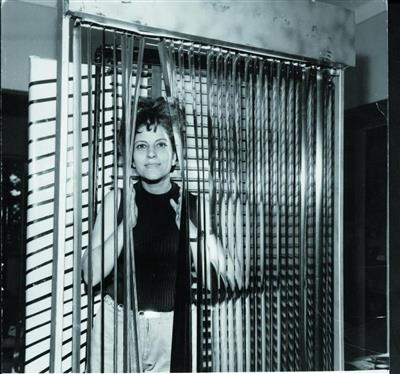
Biography
Her technique was distinctive: she worked with a palette knife directly onto canvas and sometimes onto metallic surfaces, building up textures that create visual rhythm and geometric movement without falling into the decorative. She participated in the Venice Biennale in 1956[1], 1957, and 1962, winning second prize at San Vito Romano, and took the Royal Grand Prize at the Tehran Biennale in 1962. She taught at the University of Tehran for nearly two decades before leaving Iran permanently after the 1979 revolution.
The move to Paris in 1980[1] marked the final chapter of her career. She continued working and exhibiting internationally until her death in Corsica in August 2009[1], from a heart attack while swimming. She was 85. A documentary portrait, Behjat Sadr: Time Suspended (directed by Mitra Farahani, 2006), examined her life and practice.
Sadr is often described as the first female contemporary painter in Iran to be taken seriously on equal terms with her male peers: a distinction that belongs to an era when such recognition was hard-won and rarely given.
Timeline
- 1924Born in Iran.
- 1950Arrived in Rome on a scholarship from the University of Tehran in the early 1950s.
- 1956Participated in the Venice Biennale.
- 1957Participated in the Venice Biennale.
- 1958Had her first major solo exhibition at Gallery La Bussola in Rome.
- 1962Participated in the Venice Biennale.
- 1962Took the Royal Grand Prize at the Tehran Biennale.
- 1979Left Iran permanently after the revolution.
- 1980Moved to Paris.
- 2009Died in Corsica at 85, from a heart attack while swimming.
Notable Works
Tap to view larger.
Next stop
Browse the movements →
Every movement in the collection, from the Renaissance to Pop art.
Related Artists


Frequently Asked Questions
What is Behjat Sadr known for?
Behjat Sadr is known for her distinctive painting technique. She worked directly onto canvas, and sometimes metallic surfaces, with a palette knife. This allowed her to build up textures that created visual rhythm and geometric movement.What is Behjat Sadr's most famous work?
It is difficult to name Behjat Sadr's single 'most famous work'. Sadr was a prolific artist who experimented with different styles and techniques throughout her career. Her body of work includes paintings, sculptures, and installations. Some of her better-known paintings include compositions using unconventional tools, such as combs and palette knives, to apply paint to canvas. She is also known for her abstract works that incorporate industrial materials, such as metal and glass. These pieces often explore themes of modernity, technology, and the relationship between humans and the environment. Sadr's work gained recognition both in Iran and internationally, and she participated in numerous exhibitions and art events during her lifetime.What should I know about Behjat Sadr's prints?
Behjat Sadr (1924[1]-2009[1]) was an Iranian[1] artist, whose work is associated with modernism and abstraction. When considering Sadr's prints, bear in mind that the study of Islamic art has historically focused on manuscripts showing manual skill, often overlooking printed works. This is due to a perception that printed material, particularly from the 19th century, represents a break from earlier artistic traditions. Some scholars suggest this view was influenced by a European fantasy of 'medieval' Islamic societies, which discouraged the study of Islamic art and architecture. However, there is a growing interest in the material aspects of book production and writing within the Islamic world, with attention shifting towards the artistic and intellectual significance of printed works, and a recognition of their place alongside scribal practices. This evolving perspective suggests a richer understanding of printmaking's role in Islamic art history.What style or movement did Behjat Sadr belong to?
It is difficult to assign Behjat Sadr to one specific movement; her practice engaged with several tendencies of post-war art. She is best known for abstract works, and she explored gestural abstraction, a style that emphasises spontaneous mark-making. Sadr's work shares characteristics with Informalism (also known as Art Informel), a European movement that rejected geometric abstraction, favouring instead an intuitive, process-based approach. This is visible in her use of unconventional tools and techniques, such as applying paint directly to the canvas with a palette knife. She also incorporated industrial materials into her compositions. Her emphasis on surface texture and tactile qualities aligns with aspects of Arte Povera, an Italian movement that sought to challenge traditional art values by employing everyday objects.What techniques or materials did Behjat Sadr use?
Behjat Sadr explored various techniques and materials in her art. One method involved a material exploration known as the boneless method. This began with the addition of pure water to specific areas of the paper, preparing the surface. This priming allowed subsequent brushstrokes to diffuse and lose directionality. The application of ink or pigment within the saturated surface examined the absorption qualities of the wetted areas compared to the unsaturated ones. For Sadr, the boneless method facilitated an investigation into the material characteristics of paper and water, rather than a simple assertion of the artist’s brush line. Artists are not always limited by the medium they use; they make important choices beyond the constraints of materials and techniques. Understanding the techniques and processes used by artists is necessary, as is understanding the relationship between the qualities of medium and technique, and the aesthetic decisions made by the artist.When did Behjat Sadr live and work?
Behjat Sadr was born in Arak, Iran, in 1924[1]. She is considered a significant figure in Iranian[1] modern art. Sadr received her Diploma in Painting from the Faculty of Fine Arts, University of Tehran, in 1947[1]. She then travelled to Europe to continue her studies. From 1954 to 1955, she attended the Academy of Fine Arts in Naples, Italy. Subsequently, she studied at the École Nationale Supérieure des Beaux-Arts in Paris from 1955 to 1957. Sadr returned to Iran and became a professor at the Faculty of Fine Arts, University of Tehran, in 1958, a position she held for many years. She exhibited widely, including at the Venice Biennale in 1956 and 1958. Sadr's work often explored abstraction, incorporating elements of nature and urban environments. She experimented with different materials and techniques, including using unconventional tools to apply paint to canvas. Behjat Sadr died in 2009[1] in Paris.Where can I see Behjat Sadr's work?
Behjat Sadr's work can be viewed in several public collections around the world. These include the British Museum in London; the Musée du Louvre in Paris; the Metropolitan Museum of Art in New York; the Los Angeles County Museum of Art (LACMA); the Royal Ontario Museum in Toronto; and the National Museums of Scotland in Edinburgh. Other locations include the Freer Gallery of Art and the Arthur M. Sackler Gallery at the Smithsonian Institution in Washington, DC; the Calouste Gulbenkian Museum in Lisbon; the Gemeentemuseum den Haag in The Hague; and the Honolulu Academy of Arts in Hawaii. Further afield, her art can be found at the Middle East Culture Centre in Tokyo; the Iran Bastan Museum and the Reza Abbasi Museum, both in Tehran. Additionally, works have been documented in private collections such as the Keir Collection in London and the Minassian Collection in New York (formerly).Who did Behjat Sadr influence?
It is difficult to name specific artists who were directly influenced by Behjat Sadr. However, the broader context of Iranian[1] modernism and its influences can be examined. Shakir Ali, writing in 1956[1], critiqued what he saw as a sharp division between Eastern and Western art. He appropriated the figure of Bihzad (a Persian painter) in conversation with Michelangelo and Matisse, drawing attention to unifying dimensions in both classical and modern art. By the early 1960s, the artist Sadequain was seen as pursuing a different project from Chughtai. Sadequain embraced transnational modernism, reworking calligraphic motifs. Some critics have seen Sadequain's turn to Qur'anic calligraphy as a negative development in relation to his earlier work. Sadequain addressed the problem of including his own persona as a co-contributor to Indo-Persian intellectual history, while working toward a modern subjectivity enacted by visual art.Who influenced Behjat Sadr?
It is difficult to identify particular artists who directly shaped Behjat Sadr's artistic vision. However, some general influences can be noted. The Bauhaus, where Anni Albers taught, affected many artists through its weaving and design principles. Albers emphasised the equal importance of machine-made and handmade items, as well as synthetic and natural materials. Her approach was based on personal observation rather than current trends. Some artists find inspiration in spiritual teachings. Shirazeh Houshiary, for example, draws on Sufi mysticism and the poetry of Rumi. Agnes Martin cited Chinese spiritual teachers such as Lao Tzu and Hui Neng as significant influences, believing that art should evoke memories of perfection. Gerhard Richter, despite initial assumptions, has stated that art is a realisation of religious feeling and a longing for God.Who was Behjat Sadr?
Behjat Sadr was an Iranian[1] painter who, after moving to Rome on a scholarship, abandoned academic painting for abstraction. She is often described as the first female contemporary painter in Iran to be taken seriously on equal terms with her male peers. She taught at the University of Tehran for nearly two decades.Why are Behjat Sadr's works important today?
Behjat Sadr (1924[1]-2009[1]) was an Iranian[1] artist whose career challenged conventions. Her work is important because it offers a non-Western perspective on modernism, and engages with abstraction. Sadr's practice demonstrates a consistent engagement with modernist principles. This approach opened up South Asian Muslim artistic expression to the possibilities inherent in abstraction. Her art encourages a re-evaluation of how Islamic artistic traditions can relate to modernism. Rather than focusing on surface-level borrowings from the past, critics are compelled to consider a more expansive and philosophical understanding of Islamic aesthetics. Sadr's work also participates in a broader conversation about artistic cosmopolitanism. This dialogue acknowledges the unifying aspects of both classical and modern art. Some artists are involved in a project of unity, deploying art in the service of human brotherhood.
Sources
Editorial draws on the following primary and tertiary references for Behjat Sadr.
- [1] wikipedia Wikipedia: Behjat Sadr Used for: biography, birth dates, death dates, identifiers, movement attribution, nationality.
- [2] book Beard, Lee, 1973- author, Butler, Adam, author; Van Cleave, Claire, author; Fortenberry, Diane, author; Stirling, Susan, author, Beard, Lee, 1973- author, Butler, Adam, author; Van Cleave, Claire, author; Fortenberry, Diane, author; Stirling, Susan, author - The Art Book_ New Edition, Mini Format Used for: biography.
- [3] book guggenheim-twopri00weis Used for: biography.
- [4] book Janson, H. W. (Horst Woldemar), 1913-1982, ed., Key monuments of the history of art : a visual survey Used for: stylistic analysis.
- [5] book Masterpieces of western art : a history of art in 900 individual studies from the Gothic to the present day Used for: biography.
- [6] book Lama Gega, Principles of Tibetan art_ Illustrations and explanations of Buddhist iconography and iconometry according to the Karma Gardri school Volume 2 Used for: biography.
- [7] book Lama Gega, Principles of Tibetan art_ Illustrations and explanations of Buddhist iconography and iconometry according to the Karma Gardri school Volume 2 Used for: biography.
- [8] book Nagel, Alexander, The controversy of Renaissance art Used for: biography, stylistic analysis.
Editorial overseen by Solis Prints. Sources verified 2026-10-07. Click a source for details, or hover over [N] in the page above to preview.
Editorial standardsMethodologyCorrectionsAI disclosureAbout the editorial team