



Beatriz González
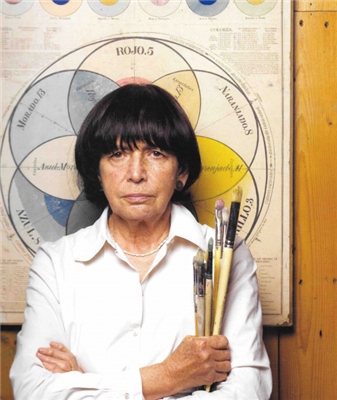
Beatriz González spent six decades producing some of the most politically charged art in Colombia, but she always resisted the label "pop artist." She preferred to describe her work as addressing "the joy of the underdeveloped," painting on cheap, mass-produced furniture, appropriating tabloid photographs, and pushing reproductions of Renaissance masterpieces into domestic settings where they became something unexpected and frequently unsettling.
Biography
Born in Bucaramanga in 1932 during La Violencia, Colombia's prolonged period of civil conflict, she studied fine arts at the University of Los Andes under Argentine critic Marta Traba and Spanish painter Joan Antonio Roda. Her breakthrough came with The Suicides of Sisga (1965), a triptych based on a newspaper photograph of a young couple who had drowned themselves rather than be separated. The jury initially dismissed it as "bad Botero," and only Traba's intervention secured it a special prize.
Throughout the 1960s and 1970s her work kept its sardonic brightness: da Vinci's Last Supper repainted on sheet metal and mounted on a dining table; the Mona Lisa placed where a mirror would be on an antique coat rack; three Colombian presidents depicted in Amazonian headdresses. After 1985 and the Palace of Justice siege, the palette darkened. The furniture remained, but the mood shifted entirely.
González died in Bogotá in January 2026 at ninety-three. In 2019 the Pérez Art Museum Miami mounted her first major US retrospective, showing nearly 150 works across six decades. Her work is held at MoMA, the Tate, and the Pérez Art Museum.
Timeline
- 1965Created "The Suicides of Sisga", a triptych based on a newspaper photograph. It initially received a negative reception.
- 1965Studied fine arts at the University of Los Andes under Marta Traba and Joan Antonio Roda.
- 1985Her palette darkened after the Palace of Justice siege.
- 2019The Pérez Art Museum Miami mounted a major US retrospective of her work.
- 2026Died in Bogotá at 93.
Notable Works
Tap to view larger.
Next stop
Browse the movements →
Every movement in the collection, from the Renaissance to Pop art.
Frequently Asked Questions
What is Beatriz González known for?
Beatriz González is known for addressing "the joy of the underdeveloped" in her art. She painted on cheap furniture, appropriated tabloid photographs, and pushed reproductions of Renaissance masterpieces into domestic settings.What is Beatriz González's most famous work?
It is difficult to single out one work as Beatriz González's most famous, but *Auras anónimas* (Anonymous Auras) is certainly among her most recognised. This project, begun in 2007, involved González's collaboration with a team of assistants to reproduce images of men carrying the dead. These images were based on press photographs taken during the years of political violence in Colombia. The reproductions were initially painted onto pre-fabricated niches in a columbarium; a space intended to house the ashes of the dead. González's work transformed this space of mourning into a site of collective remembrance. She aimed to give visibility to the anonymous victims of violence, acknowledging their suffering and honouring their memory. González's wider body of work often incorporates popular imagery and references to Colombian history and culture. Her art addresses themes of violence, memory, and social injustice. She appropriates and re-contextualises images from the media, creating works that are both visually striking and politically charged.What style or movement did Beatriz González belong to?
Beatriz González is associated with several art movements, though she defies easy categorisation. Her work often engages with social and political issues specific to Colombia, placing her within a Latin American context of socially conscious art. Some scholars relate González's practice to Mexicanness, a post-revolutionary intellectual and aesthetic movement in Mexico. This movement sought to define Mexico’s heritage, distinguishing its indigenous culture from European and US influences. Like artists associated with Mexicanness, González consciously adopts an unsophisticated painting style that emphasises a primitiveness associated with her national identity. Her art shares similarities with the Neo-primitive vocabulary used by Russian artists like Natalia Goncharova, who drew inspiration from indigenous Russian folk art. While González does not strictly adhere to any single movement, her work reflects a concern with national identity, social commentary, and the use of simplified forms.What techniques or materials did Beatriz González use?
Artists make important choices regarding materials and techniques. These choices often exist outside the constraints of the materials themselves. It is essential to understand the techniques and processes used by artists, as well as the relationship between the qualities of medium and technique and the aesthetic decisions made by the artist. Beatriz González's practice includes consideration of object, space, time, and colour. She often makes the objects that appear in her work. These objects appear in various forms on the canvas. Sometimes, it is a faithful drawing; other times, it is the object itself. González attempts to treat and manipulate reality in an ambiguous way, making it difficult to establish boundaries between the represented object and the real object. This creates a tactile feeling. Space is created as a cradle for the other elements. González intends for the space and the elements to communicate their identity in a continual dialogue, in a two-dimensional/three-dimensional relationship. Colour is treated in a sober manner. She attempts absolute fidelity of colour only in the object. Gray tones, with their gradations and transparencies, play an important role throughout the surface of the painting. Time is incorporated through the deterioration of the subject. The images used are petrified, volumetric, and static. Mobility is represented by the sequence of images in a defined space.What was Beatriz González known for?
Julio González (1876-1942[1]) was a Spanish sculptor and painter, best known for his pioneering work in welded iron sculpture. He moved to Paris in the early 20th century, where he befriended Pablo Picasso and Constantin Brâncuși. González initially trained in traditional metalworking techniques, learning from his father, a goldsmith. However, he moved away from traditional sculpture to explore the possibilities of iron as a medium. He began using welding and forging to create abstract, openwork sculptures. These sculptures often had a poetic quality, evoking the human form or natural elements through simple, elegant lines. His work influenced many artists; he is considered a major figure in the development of modern sculpture. His exploration of space and form, along with his innovative use of materials, helped to redefine the possibilities of sculpture in the 20th century. He also collaborated with Picasso on several projects, creating iron sculptures based on Picasso's designs.Where can I see Beatriz González's work?
Beatriz González's artwork can be viewed in several locations. Her work has been included in the Latin American Collection of The Solomon R. Guggenheim Museum. The museum has organised exhibitions that have travelled to venues such as the Honolulu Academy of Fine Arts, Haus am Lützow Platz in Berlin, the National Gallery of Canada in Ottawa, the John and Mable Ringling Museum in Sarasota, and the Museo Nacional de Bellas Artes in Buenos Aires. González's pieces have also been displayed at the Andrew D. White Museum at Cornell University in Ithaca, New York, the Dallas Museum of Fine Arts, the Krannert Art Museum at the University of Illinois in Champaign, and the Decordova Museum in Lincoln, Massachusetts. These exhibitions offer opportunities to see her paintings and other works.Who did Beatriz González influence?
Beatriz González's influence can be seen in the work of numerous artists across Latin America, although specific individuals are not always named in the available sources. Ratl Martinez, a Cuban artist, is one example. During the mid-1960s, Martinez moved from Abstract Expressionism toward Pop Art, a change that made him influential in Cuba and throughout Latin America. Armando Morales, a Nicaraguan painter, also demonstrates González's impact. In 1959, Morales received the Ernst Wolf Prize at the Sao Paulo Bienal in Brazil. His visual language was influenced by Robert Motherwell, Antoni Tapies, and Serge Poliakoff. Morales's painting *Guerrillo muerto I* (1958) shows the impact of Motherwell's "Spanish Elegy" series. The modernist group Los Once, which emerged in 1953 in Cuba, also shows this influence. The group opposed the Batista dictatorship and aimed to make Cuban art more internationalist. Paintings by Martinez, Llinds, and others in this group referenced U.S. Abstract Expressionism.Who influenced Beatriz González?
Beatriz González was affected by a range of artistic influences. In the 1940s, she looked at Henri Matisse's work and followed it closely. However, she felt more affected by Analytic Cubist drawing early in her career. By 1950-51, González considered Pollock, de Kooning, and Rothko, of the New York School, to be her mentors. She saw Arshile Gorky's exhibition at the Whitney in 1951, which impressed her greatly. The leap represented by Gorky made sense to her, as she had been drawn to Kandinsky. She also saw many of Pollock’s 1940s works during that period, as well as his later webbed enamel paintings. In the later 1950s and early 1960s, she was moved and intrigued by Louis's Veils and Unfurleds, and Noland's targets and chevrons. She had already made Mountains and Sea when she first saw those paintings.Who was Beatriz González?
Julio González was a sculptor, born in Barcelona on 21 September 1876. He began working in his father's metal workshop with his older brother Joan. During the evenings, both attended classes at the Escuela de Bellas Artes. González exhibited metalwork at the Exposition de bellas artes e industrias artisticas in Barcelona in 1892, 1896, and 1898; he also exhibited at the World's Columbian Exposition in Chicago in 1893. Around 1897, he frequented Els Quatre Gats, a cafe in Barcelona, where he met Pablo Picasso. In 1900, González moved to Paris, associating with Pablo Gargallo, Juan Gris, Manolo Hugue, Max Jacob, and Jaime Sabartés. His first embossed metalwork was produced in 1900. He exhibited with the Société Nationale des Beaux-Arts in 1903, 1909, and frequently during the early 1920s. González participated in the Salon des Indépendants in 1907 and occasionally thereafter. His first solo exhibition, including paintings, sculpture, drawings, jewellery, and objets d'art, was held in 1922 at the Galerie Povolozky in Paris.Why are Beatriz González's works important today?
Beatriz González is important for her engagement with national trauma and memory in Colombia. Born in 1938[1], González initially explored Pop art aesthetics, but shifted her focus in the 1970s. She began to address political violence and social issues, particularly the impact of Colombia's ongoing conflicts. González is recognised for appropriating images from newspapers and popular culture. She reinterprets these images in a style that is both direct and emotionally resonant. By using simple materials and techniques, such as screen printing and painting on metal beds, she makes her work accessible to a broad audience. Her art acts as a form of mourning and remembrance, offering a critical commentary on the human cost of conflict. González's work also explores the intersection of art and everyday life. She often incorporates furniture and domestic objects into her installations, blurring the boundaries between the museum and the home. This approach invites viewers to reflect on the ways in which violence permeates daily existence. Her practice provides a space for collective reflection and healing in a society marked by division.When was Beatriz González born?
Beatriz González was born in 1938[1].
Sources
Editorial draws on the following primary and tertiary references for Beatriz González.
- [1] wikipedia Wikipedia: Beatriz González Used for: biography, birth dates, death dates, identifiers, movement attribution, nationality.
- [2] book Fred S. Kleiner, Gardner's Art through the Ages Used for: stylistic analysis.
- [3] book guggenheim-latinamericanpai00catl Used for: biography.
- [4] book guggenheim-pifiron00gimn Used for: biography, stylistic analysis.
- [5] book guggenheim-twopri00weis Used for: biography.
- [6] book Patrick Frank, Readings in Latin American Modern Art Used for: biography.
- [7] book Untitled Used for: biography.
Editorial overseen by Solis Prints. Sources verified 2026-10-14. Click a source for details, or hover over [N] in the page above to preview.
Editorial standardsMethodologyCorrectionsAI disclosureAbout the editorial team