



Balthus
- New Objectivity
- Surrealism
In 1921[1], the poet Rainer Maria Rilke published a collection of drawings by a 13-year-old from a distinguished Polish émigré family in Paris, writing the introduction himself. The boy was Balthasar Klossowski de Rola, who had adopted the nickname "Balthus" and would become one of the 20th century's most singular and persistently contested figurative painters.
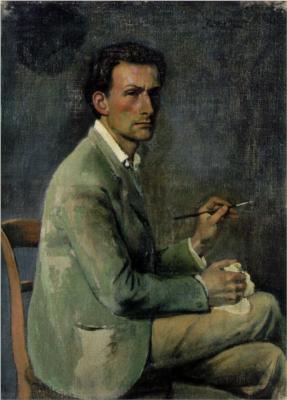
Biography
Self-taught through intensive study of the Old Masters, Balthus developed an approach drawing on Giotto, Caravaggio, and Piero della Francesca while remaining entirely independent of the modernist movements around him. By 1933[1] he had befriended Alberto Giacometti and Antonin Artaud, moving in Surrealist circles without ever committing to the movement's programme. His paintings of the period, scenes of adolescent girls in sparse interiors, caught in postures that made their first bodily self-consciousness explicit, generated controversy that followed him throughout his career. "Girl and Cat" (1937, oil on panel, 88 x 78 cm) places a young girl in a gloomy interior, the only light falling across her thighs, a contented cat at her feet. "The Game of Cards" (1948-50, 194 x 140 cm) pursues the same territory with two card-playing figures whose averted eyes and gestures suggest the moment before sexual self-awareness disrupts childhood. Critics who read these works as simply provocative, the scholar Wendy Beckett argued, were missing the point: Balthus was painting a specific psychological state, not performing transgression for its own sake.
In 1961[1] André Malraux appointed him Director of the Villa Medici in Rome, a post he held until moving to Switzerland in 1977. He was elected honorary member of the Royal Academy in 1981. His late work, including "The Artist and his Model" (1980-81), exchanged the erotic charge of the earlier paintings for a quality of stillness that critics described as allegorical withdrawal. He died in La Rossinière, Switzerland, in 2001[1].
Timeline
- 1908Born Balthasar Klossowski de Rola; he later adopted the nickname "Balthus". His family were Polish émigrés living in Paris.
- 1921At 13, a collection of his drawings was published with an introduction by Rainer Maria Rilke.
- 1933Befriended Alberto Giacometti and Antonin Artaud in Paris, moving in Surrealist circles.
- 1937Painted "Girl and Cat", depicting a young girl in an interior setting.
- 1948Began work on "The Game of Cards", completed in 1950.
- 1950Completed work on "The Game of Cards".
- 1961Appointed Director of the Villa Medici in Rome by André Malraux.
- 1977Moved to Switzerland after his tenure as Director of the Villa Medici.
- 1981Elected honorary member of the Royal Academy.
- 1981Completed "The Artist and his Model", begun in 1980.
- 2001Died in La Rossinière, Switzerland, aged 92.
Notable Works
Tap to view larger.
Next stop
Browse the movements →
Every movement in the collection, from the Renaissance to Pop art.
Related Artists



Frequently Asked Questions
What is Balthus known for?
Balthus is known for his figurative paintings, particularly scenes of adolescent girls in sparse interiors. These paintings often depict the girls in postures that make their bodily self-consciousness explicit, which generated controversy throughout his career.What is Balthus's most famous work?
Balthasar Klossowski de Rola (Balthus) is best known for his paintings of adolescent girls. These works often depict his subjects in ambiguous, dreamlike states. They can be unsettling, and have often been the subject of controversy. One of Balthus's most recognised paintings is "The Guitar Lesson", completed in 1934[1]. It depicts a young girl sprawled across a woman's lap; the woman's hands are positioned as if she is playing the girl like a guitar. The work's erotic overtones caused immediate outrage when it was first exhibited. Some critics view it as a disturbing exploration of innocence and corruption, while others see it as simply exploitative. Another notable painting is "Thérèse Dreaming" from 1938. It portrays a girl asleep, her pose somewhat unnatural, with one hand raised above her head. The painting is admired for its technical skill, but also criticised for its voyeuristic quality. Balthus's exploration of adolescence, combined with his distinctive style, has ensured his place in 20th-century art history, even as his subject matter continues to provoke debate.What style or movement did Balthus belong to?
Balthus's art resists easy categorisation within a single movement. While his career began after the height of movements such as Surrealism and New Objectivity[1], aspects of his work connect to both. Surrealism aimed to express the world of dreams and the unconscious in art. Some surrealists sought "concrete irrationality" in their naturalistic paintings, depicting dreamlike scenes. Balthus's paintings often have a dreamlike quality, and his subject matter can be unsettling. The New Objectivity movement arose after World War I, with artists focusing on depicting the realities of the world. While Balthus did not directly engage with the horrors of war like some New Objectivity artists, his work shares a certain objectivity in its rendering of figures and settings. Ultimately, Balthus remained an independent figure, drawing inspiration from various sources, including Renaissance art, and forging his own distinctive path.What techniques or materials did Balthus use?
Balthus's technique involved a slow, careful execution, reflecting his study of earlier masters such as Piero della Francesca and Nicolas Poussin. The intellectual intention behind his work is as important as the materials he employed. Technique, in this context, encompasses more than just the method of execution; it involves the manual and mechanical processes that shape raw materials according to artistic intentions. Balthus's approach can be seen as an exploration of what painting uniquely offers, particularly at a time when other media had taken over traditional roles of art. Painters often begin with ideas and feelings, then turn to the practical aspects of craft to express them. The durability of materials, once a primary concern, became less so for some twentieth-century artists, while mechanical operations gained significance.What was Balthus known for?
Balthasar Klossowski de Rola (1908[1]-2001[1]), known as Balthus, was a French[1]-Polish modern artist. He is known for figurative paintings, mainly of young female subjects. His first solo exhibition was in Paris in 1934[1]. By the 1950s, Balthus was gaining recognition. He became friends with artists such as Alberto Giacometti and Joan Miró. In 1961, André Malraux, France’s Minister of Culture, appointed him head of the French Academy in Rome; he held this post until 1977. Balthus's paintings often present adolescent girls in ambiguous, dreamlike states. These works can evoke unease because of their erotic undertones. Critics have often discussed the psychological complexity and possible interpretations of his compositions. His notable works include "The Guitar Lesson" (1934), "Therese Dreaming" (1938), and "The Mountain" (1937). Balthus aimed to capture a sense of timelessness in his art, often drawing inspiration from classical art and literature. He combined realism with a personal, sometimes unsettling, vision.When did Balthus live and work?
Balthasar Klossowski de Rola (Balthus) was born in Paris on 29 February 1908[1]; he died in Rossinière, Switzerland, on 18 February 2001[1], a few days before his 93rd birthday. Balthus spent much of his early life in Switzerland, in part because his mother's family came from there. His parents, Erich Klossowski and Elisabeth Dorothea Spiro, were both artists and intellectuals who moved in a circle of prominent cultural figures. The family left Paris for Berlin at the outbreak of World War One, then moved to Switzerland in 1917[1]. Although associated with the Parisian art world, Balthus spent considerable time in other locations. In 1937, he moved into his studio on the Rue de Furstemberg; later, from 1961, he lived and worked in the Château de Chassy, near Autun in the Burgundy region of France. From 1977 until his death, Balthus lived in the Grand Chalet in Rossinière. He was married twice: first to Antoinette de Watteville in 1937, and later to Setsuko Ideta in 1967.Where can I see Balthus's work?
Balthus's paintings and drawings are held in numerous collections around the world. In Paris, his work can be viewed at the Musée National d’Art Moderne, Centre Georges Pompidou; the Musée d’Orsay; the Musée du Louvre; and the Musée des Arts Décoratifs. Other French[1] museums that hold works by Balthus include the Musée des Beaux-Arts in Nancy; the Musée de l’Ecole de Nancy; and the Musée d’Art et d’Industrie in Roubaix. Outside France, museums with works by Balthus include the Musées Royaux des Beaux-Arts de Belgique in Brussels; the Kunsthistorisches Museum in Vienna; the Art Gallery of Ontario in Toronto; the Museo Nacional del Prado in Madrid; the Hermitage Museum in St Petersburg; and the Scottish National Gallery of Modern Art in Edinburgh.Where was Balthus from?
Balthasar Klossowski de Rola (Balthus) was born in Paris, France, on 29 February 1908[1]. His parents were Erich Klossowski, an art historian and writer, and Elisabeth Dorothea Spiro (known as Baladine Klossowska), a painter. The family had a Polish-German background; they were part of the European intellectual elite. Although born in France, Balthus maintained close ties to other countries throughout his life. His family was exiled to Berlin during the First World War. Later, he lived and worked in Switzerland and Italy. In 1977[1], he moved to Rossinière, Switzerland, where he resided until his death on 18 February 2001[1]. His international background and travels influenced his artistic development and exposed him to a range of cultural and artistic traditions. He is buried in the village cemetery at Rossinière.Who did Balthus influence?
Balthus, born Balthasar Klossowski de Rola, came from a Polish family that moved to Paris in the mid-19th century. Rainer Maria Rilke recognised and encouraged Balthus's talent early on, publishing a collection of the boy's panels in 1921[1]. Later, Balthus became acquainted with Surrealists such as Giacometti and Artaud. Balthus's art displays a knowledge of art history, with references to artists from Giotto to Caravaggio. He explored diverse subjects, including still lifes, portraits, and Paris street scenes. He is perhaps best known for his representations of young girls on the cusp of womanhood. One artist who felt Balthus's influence was Leland Bell. Bell admired painters of the past, such as Titian, Louis Le Nain, and especially Giotto. However, Balthus's "smooth ambiguities" also resonated with Bell. Balthus's paintings of children playing or reading, which suggest boredom and the human condition, are echoed in Bell's work. Bell sought to integrate light, drawing, colour, story, psychology, and the human condition into his art.Who influenced Balthus?
Balthasar Klossowski de Rola (Balthus) was an independent artist, but various influences are apparent in his work. He admired painters of the past, especially those from the early Renaissance. Masaccio, Piero della Francesca, and Poussin were important to him; he copied their paintings as a young man. These artists' sense of form and composition resonated with Balthus. Later in his life, Balthus expressed admiration for Courbet. Some have noted a connection to German Romanticism, specifically the work of Caspar David Friedrich, in Balthus's treatment of certain subjects. Literary figures also influenced Balthus. As a teenager, he created illustrations for *Wuthering Heights* by Emily Brontë. The writer Rainer Maria Rilke was a friend and mentor to the young artist. Balthus also maintained friendships with writers such as Albert Camus and Antonin Artaud. These relationships shaped his intellectual and artistic outlook.Who was Balthus?
Balthasar Klossowski de Rola (1908[1]-2001[1]), known as Balthus, was a French[1]-Polish modern artist. Born in Paris, he came from an artistic and intellectual background. His parents were both artists, and his brother was the writer Pierre Klossowski. The poet Rainer Maria Rilke was Balthus's stepfather for a time, an association that influenced his early artistic development. Largely a self-taught artist, Balthus is best known for his figurative paintings, particularly those depicting adolescent girls. These works often present unsettling and ambiguous narratives, exploring themes of sexuality, innocence, and the transition from childhood to adulthood. His style, while representational, incorporated elements of surrealism and classical art. Balthus resisted easy categorisation and rejected many of the prevailing artistic trends of his time. He preferred to work in isolation, developing a distinctive and personal style. His most recognised works include "La Rue" (1933[1]), "The Guitar Lesson" (1934), and "Thérèse Dreaming" (1938). He held the position of director of the French Academy in Rome, based at the Villa Medici, from 1961 to 1977.Why are Balthus's works important today?
Balthasar Klossowski de Rola (1908[1]-2001[1]), known as Balthus, was a French[1] painter of Polish descent. Rainer Maria Rilke recognised Balthus's talent early; in 1921[1], Rilke published a collection of the boy's panels. Later, in the 1930s, Balthus became acquainted with Surrealists such as Giacometti and Artaud. Balthus's art historical knowledge is evident in his paintings, which contain quotations from Giotto to Caravaggio. He painted still lifes, portraits, and street scenes. His representations of young girls are particularly notable, often set within a disturbing atmosphere. One such painting is *Girl and Cat* (1937), which presents an adolescent girl with a cat. The image has erotic overtones, capturing the disturbing quality of adolescence. Balthus's paintings often feature an erotic tension. He saw the arousal of desire and latent violence as a metamorphosis of Eros, similar to Caravaggio. In 1961, André Malraux appointed him director of the Villa Medici, the French academy in Rome. Since 1981, he has been an honorary member of the Royal Academy, London.
Sources
Editorial draws on the following primary and tertiary references for Balthus.
- [1] wikipedia Wikipedia: Balthus Used for: biography, birth dates, death dates, identifiers, movement attribution, nationality.
- [2] book Beard, Lee, 1973- author, Butler, Adam, author; Van Cleave, Claire, author; Fortenberry, Diane, author; Stirling, Susan, author, Beard, Lee, 1973- author, Butler, Adam, author; Van Cleave, Claire, author; Fortenberry, Diane, author; Stirling, Susan, author - The Art Book_ New Edition, Mini Format Used for: biography, stylistic analysis.
- [3] book Masterpieces of western art : a history of art in 900 individual studies from the Gothic to the present day Used for: biography, stylistic analysis.
- [4] book Nicola Vitale;, Sunniness in Paintings Used for: biography, stylistic analysis.
- [5] book Beckett, Wendy, The story of painting Used for: biography.
Editorial overseen by Solis Prints. Sources verified 2026-09-30. Click a source for details, or hover over [N] in the page above to preview.
Editorial standardsMethodologyCorrectionsAI disclosureAbout the editorial team