



Bahman Mohasses
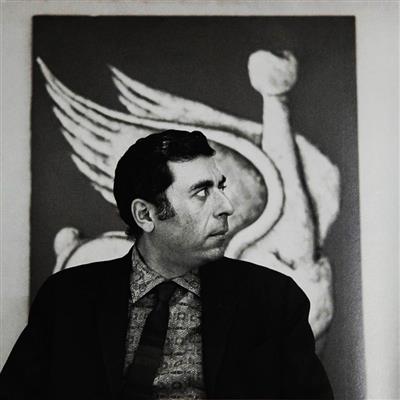
Bahman Mohasses spent his final decades in deliberate seclusion in Rome, refusing interviews and destroying work he considered unsatisfactory. He described himself as preaching alone in a desert, with no interest in leaving a legacy. When he died in 2010[1], his passing went largely unnoticed until documentary filmmaker Mitra Farahani began tracking him down in his final months; her film Fifi Howls from Happiness (2013) introduced him to a new international audience and drove a rapid reappraisal of his work at auction.
Biography
Born in 1931[1] in Rasht, Iran, Mohasses studied at Tehran University's Faculty of Fine Arts before moving to Rome in 1954[1], following the CIA-backed coup against Prime Minister Mossadegh. He trained at the Accademia di Belle Arti di Roma under Ferruccio Ferrazzi, then returned briefly to Iran in the 1960s, where he participated in the Venice and Sao Paulo Biennales, directed Ionesco and Pirandello for Tehran theatre, and translated Italo Calvino and Jean Genet into Persian. In 1968, he left Iran permanently.
His canvases are populated by stone-coloured figures stripped of hands, feet, and faces, and by minotaurs the size of monuments. He described the amputations as a visual expression of condemnation of humanity. Fish appeared throughout as symbols of alienation, always depicted out of water. After the Islamic Revolution of 1979[1], public sculptures he had made for Tehran were removed and destroyed; he responded by destroying all his remaining works in the country. The Tate holds five of his prints from 1966.
In 2021, Minotauro sulla riva del mare (1977[1]) sold at Sotheby's London for £1,007,200, more than double its high estimate, in a sale that also included works by Munch and Hockney. Works featuring nudity remain stored at the Tehran Museum of Contemporary Art but have never been publicly exhibited since the Revolution.
Timeline
- 1931Born in Rasht, Iran.
- 1954Moved to Rome, Italy, following the coup against Prime Minister Mossadegh.
- 1960Studied at the Accademia di Belle Arti di Roma under Ferruccio Ferrazzi.
- 1966Five of his prints were produced; these are now held at the Tate.
- 1968Left Iran permanently.
- 1977Created "Minotauro sulla riva del mare".
- 1979Public sculptures he created for Tehran were removed and destroyed after the Islamic Revolution.
- 1979Destroyed all his remaining works in Iran after the Islamic Revolution.
- 2010Died in Rome.
Notable Works
Tap to view larger.
Next stop
Browse the movements →
Every movement in the collection, from the Renaissance to Pop art.
Related Artists


Frequently Asked Questions
What is Bahman Mohasses known for?
Bahman Mohasses is known for his canvases populated by stone-coloured figures stripped of hands, feet, and faces, and by minotaurs the size of monuments. He described the amputations as a visual expression of condemnation of humanity; fish appeared throughout as symbols of alienation, always depicted out of water.What is Bahman Mohasses's most famous work?
It is difficult to identify one single "most famous work" by Bahman Mohasses, as his output was varied and spread across painting, sculpture, and theatre design. He is perhaps best known for his paintings and sculptures that often incorporate mythological themes and distorted human figures. Mohasses's style frequently involved a combination of surreal and expressionistic elements. Recurring motifs in his work include hybrid creatures and fragmented forms, reflecting a sense of unease and alienation. He often reworked or destroyed his own pieces, adding to the complexity of assessing his complete body of work. Without a single piece that eclipses all others in recognition, Mohasses's wider artistic approach, characterised by its iconoclasm and unique visual language, is what has secured his place in Iranian modern art history.What should I know about Bahman Mohasses's prints?
Bahman Mohasses (1931[1]-2010[1]) was an Iranian painter, sculptor, and translator, known for his modernist and surrealist works. He is sometimes called "the Picasso of Iran". Mohasses produced a number of prints, often featuring recurring motifs from his paintings and sculptures. These include fragmented figures, mythological creatures, and distorted human forms. His prints share the same themes of alienation, isolation, and social critique found in his other works. Mohasses's prints are often characterised by bold lines and strong contrasts, reflecting his sculptural background. He frequently employed etching and lithography, allowing him to create complex textures and tonal variations. The prints offer a more accessible way to engage with Mohasses's artistic vision, as his paintings and sculptures are less readily available. They represent an important aspect of his overall artistic output, demonstrating his skill across different media. Collectors value his prints for their unique aesthetic and their connection to the broader scope of his art.What style or movement did Bahman Mohasses belong to?
It is difficult to assign Bahman Mohasses to a single style or movement. His career spanned several decades and continents, and his work absorbed a range of influences. Some observers have noted a connection between his work and Surrealism, because of its dreamlike imagery and juxtaposition of unexpected elements. Others see the influence of Expressionism, citing the emotional intensity and distorted forms in his paintings and sculptures. Mohasses lived and worked in Iran and Italy, which exposed him to different artistic traditions. Some scholars consider his art a synthesis of Eastern and Western aesthetics, blending Persian motifs with European modernist styles. He resisted easy categorisation, and his individualistic approach makes it challenging to place him neatly within any established movement.What techniques or materials did Bahman Mohasses use?
Without specific details about Bahman Mohasses's methods, I can offer a general overview of artistic techniques and materials. Artists employ a wide array of techniques, from traditional methods to experimental approaches. Drawing involves materials such as pencils, charcoal, and pastels. Painting utilises diverse media like oil, watercolour, and acrylic on surfaces such as canvas or paper. Printmaking encompasses techniques like etching, lithography, and screen-printing, each yielding unique effects. Sculpture involves materials such as stone, metal, wood, or clay, shaped through carving, modelling, or casting. Mixed media combines various materials and techniques in a single artwork. The choice of technique and materials depends on the artist's vision and the desired aesthetic.What was Bahman Mohasses known for?
Bahman Mohasses (1931[1]-2010[1]) was an Iranian painter, sculptor, and translator, often called "the Iranian Picasso". His artistic output included paintings, sculptures, and collages. He is also known for his translations of works by playwrights such as Eugène Ionesco and Luigi Pirandello. Mohasses's paintings frequently featured fragmented human and animal figures, often set against stark or abstract backgrounds. His style incorporated elements of surrealism and cubism. Recurring themes included mythology, history, and social commentary. His sculptures, many of which were created from bronze or stone, often echoed the themes and styles found in his paintings. He destroyed some of his own works later in life. Mohasses spent many years living and working in Italy after leaving Iran in the 1960s.Where can I see Bahman Mohasses's work?
Bahman Mohasses's works appear in several public collections. These include the Metropolitan Museum of Art in New York, the Los Angeles County Museum of Art (LACMA), and the Royal Ontario Museum in Toronto. Other museums that hold relevant works are the National Museums of Scotland in Edinburgh, the British Museum in London, and the Victoria & Albert Museum, also in London. Additionally, the Freer Gallery of Art/Arthur M. Sackler Gallery within the Smithsonian Institution in Washington, DC, and the Seattle Art Museum also maintain relevant collections. Some works are held in private collections like the Keir Collection in London. The Los Angeles County Museum of Art has benefited from gifts, such as the Nasli M. Heeramaneck collection gifted by Joan Palevsky.Where was Bahman Mohasses from?
Bahman Mohasses was an Iranian artist. He was born in Rasht, a city on the Caspian Sea, in 1931[1]. Mohasses is considered a significant figure in Iranian modern art. He spent a considerable portion of his life in Italy, and his work often reflects a combination of Iranian and European artistic influences. He studied at the Faculty of Fine Arts, University of Tehran. Mohasses moved to Rome in the 1960s, where he continued his artistic career. He became known for his paintings, sculptures, and collages, often characterised by distorted figures and surreal themes. His work engaged with both Iranian mythology and Western modernism. He gained recognition in both Iran and Europe. Despite his success, he sometimes destroyed his own works and was a controversial figure. Mohasses died in Rome in 2010[1].Who influenced Bahman Mohasses?
Identifying specific influences on Bahman Mohasses is challenging, but we can discuss the artistic environment and movements that affected many artists of his time. Henri Matisse was a significant figure for numerous artists. Some artists admired Matisse's surface-oriented figurative work, using it to move beyond abstract expressionism. Matisse's impact extended to the use of colour and a move towards abstraction. Some German artists also studied with Matisse. Paul Klee, with his diverse body of work that combined figurative and abstract elements, also influenced many. Klee aimed to create his own style, devoid of preconceptions. Other important figures include Mondrian, Malevich and Albers. Moholy-Nagy, Calder, Duchamp and Gabo are also important to note.Who was Bahman Mohasses?
Bahman Mohasses (1931[1]-2010[1]) was an Iranian painter, sculptor, and translator. Often called 'the Iranian Picasso', he is known for his unique style that blended elements of Cubism, Surrealism, and ancient Persian art. Mohasses studied painting in Tehran before moving to Italy in the 1950s. There, he became involved with the avant-garde art scene. He participated in the Venice Biennale, exposing his work to international audiences. His art often explored themes of mythology, human suffering, and social commentary, using distorted figures and symbolic imagery. In addition to his visual art, Mohasses translated works by playwrights such as Pirandello and Genet into Persian. Facing censorship and disapproval in Iran, he eventually returned to Italy, where he lived until his death. Despite his artistic contributions, Mohasses remains a somewhat elusive figure. He destroyed many of his own works, contributing to the mystery surrounding his life and career.Why are Bahman Mohasses's works important today?
Bahman Mohasses (1931[1]-2010[1]) was an Iranian painter, sculptor, and translator. He is remembered for his modernist approach to art, blending European influences with Iranian themes. Mohasses's works often feature distorted human figures and mythological creatures. These elements express alienation and social commentary. He was nicknamed "The Iranian Bacon" because of the similarities between his figurative distortions and those of Francis Bacon. Mohasses destroyed many of his own works later in his life. This act of self-destruction has contributed to his mystique. It also makes the surviving pieces all the more valuable. His art provides insight into the cultural and political atmosphere of mid-20th century Iran. He challenged traditional artistic norms. His unique style continues to influence contemporary artists from the Middle East. His pieces are now in international collections. They offer a perspective on Iranian modernism that is both personal and universal.
Sources
Editorial draws on the following primary and tertiary references for Bahman Mohasses.
- [1] wikipedia Wikipedia: Bahman Mohasses Used for: biography, birth dates, death dates, identifiers, movement attribution, nationality.
- [2] book guggenheim-berriarei00bilb Used for: biography.
- [3] book guggenheim-refigur00kren Used for: biography.
- [4] book Masterpieces of western art : a history of art in 900 individual studies from the Gothic to the present day Used for: biography.
Editorial overseen by Solis Prints. Sources verified 2026-10-16. Click a source for details, or hover over [N] in the page above to preview.
Editorial standardsMethodologyCorrectionsAI disclosureAbout the editorial team