



Aurelio Tiratelli
Tiratelli arrived at landscape painting by way of the sculptor's studio. Born in Rome in 1842[1], he trained at the Accademia di San Luca under Minardi, Alessandro Capalti, and Francesco Podesti, while also studying sculpture under Giulio Tadolini and Pietro Tenerani. He produced sculpture in his early career, then abandoned it entirely in favour of the Roman campagna and the animals that populated it.
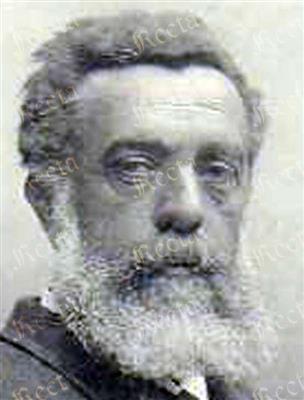
Biography
From the 1870s onwards he worked as a painter of country life on an ambitious scale, returning repeatedly to the marshlands and grazing ground around Rome. He was drawn particularly to cattle and buffalo: A Cattle Herd at Ostia was acquired by King Vittorio Emanuele, and a canvas of buffalo hauling a cart through the Pontine Marshes entered the Museo Revoltella in Trieste. These were not decorative animals but working ones, painted with the weight of daily use.
His international presence was consistent through the 1880s. He exhibited at the Paris Salon in 1878[1], 1880, and 1886, and Un carro alla Marchegiana (known locally as Mambrucca, depicting the surroundings of Rome) appeared at the 1889 Universal Exposition in Paris. He was knighted and received the Order of the Crown of Italy. His son Cesare followed him into landscape painting, making the Tiratellis one of the few Roman painting dynasties of the late nineteenth century.
Timeline
- 1842Born in Rome.
- 1870Started working as a painter of country life, focusing on marshlands around Rome.
- 1878Exhibited at the Paris Salon.
- 1880Exhibited at the Paris Salon.
- 1886Exhibited at the Paris Salon.
- 1889His work "Un carro alla Marchegiana" was displayed at the Universal Exposition in Paris.
Notable Works
Tap to view larger.
Next stop
Browse the movements →
Every movement in the collection, from the Renaissance to Pop art.
Related Artists


Frequently Asked Questions
What is Aurelio Tiratelli known for?
Aurelio Tiratelli is known for his paintings of country life, particularly his depictions of cattle and buffalo in the marshlands around Rome. His painting, A Cattle Herd at Ostia, was acquired by King Vittorio Emanuele. He exhibited internationally, including at the Paris Salon and the Universal Exposition in Paris.Who was Aurelio Tiratelli?
Aurelio Tiratelli was an Italian[1] painter who was born in Rome in 1842[1]. He trained at the Accademia di San Luca, studying under Minardi, Alessandro Capalti, and Francesco Podesti, while also studying sculpture under Giulio Tadolini and Pietro Tenerani. He abandoned sculpture in favour of painting the Roman campagna and the animals that lived there.What was Aurelio Tiratelli's art style?
From the 1870s onwards, Aurelio Tiratelli painted country life on an ambitious scale. He repeatedly returned to the marshlands and grazing ground around Rome, focusing on working animals rather than decorative ones. He painted them with the weight of daily use.How did Aurelio Tiratelli die?
Aurelio Tiratelli died in 1900[1] at the age of 58.
Sources
Editorial draws on the following primary and tertiary references for Aurelio Tiratelli.
- [1] wikipedia Wikipedia: Aurelio Tiratelli Used for: biography, birth dates, death dates, identifiers, movement attribution, nationality.
- [2] book Giovanni Battista Piranesi; Sarah E Lawrence; Exhibition Piranesi as Designer (2007, Giovanni Battista Piranesi; Sarah E Lawrence; Exhibition Piranesi as Designer (2007 - 2008, New York, NY; Haarlem); Cooper-Hewitt Museum of Decorative Arts and Design (New York, N.Y.); Teylers Museum - Piranesi as designer ; [on the occasion of Used for: biography, stylistic analysis.
- [3] book Braun, Emily, 1957-; Asor Rosa, Alberto; Royal Academy of Arts (Great Britain), Italian art in the 20th century : painting and sculpture, 1900-1988 Used for: biography.
- [4] book Masterpieces of western art : a history of art in 900 individual studies from the Gothic to the present day Used for: biography.
- [5] book Post-impressionism : cross-currents in European painting Used for: biography.
- [6] book 1892-1968, Panofsky, Erwin,, Tomb sculpture: four lectures on its changing aspects from ancient Egypt to Bernini Used for: biography, stylistic analysis.
Editorial overseen by Solis Prints. Sources verified 2026-10-14. Click a source for details, or hover over [N] in the page above to preview.
Editorial standardsMethodologyCorrectionsAI disclosureAbout the editorial team