



Asano Takeji
Few artists sustain a career as long as Asano Takeji, who was still teaching woodblock printing techniques at ninety-seven, stopping only because he found it increasingly difficult to walk. Born in Kyoto in 1900[1]-1999[1]","used_for":"biography, birth dates, death dates, identifiers, movement attribution, nationality"}">[1], he trained at the Kyoto City School of Fine Arts, graduating in 1919, then completed further study in Japanese-style painting under Tsuchida Bakusen in 1923.
Biography
The decisive turn came in 1928[1], when Hiratsuka Un'ichi, one of the founders of the sosaku hanga (creative print) movement, gave a course at a Kyoto gallery and Asano enrolled. The following year he helped establish the Kyoto Sosaku-Hangakai printmakers' collective, and from that point his output focused almost entirely on the woodblock medium. His early series Sosaku Hanga Shin Kyoto Junikagetsu (1930) recorded the seasonal rhythms of his home city, setting a pattern that would define his work for decades.
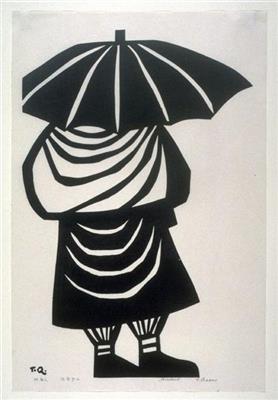
Asano's subjects rarely strayed far from the Kansai region: temple gates, mountain paths, riverbanks, and seasonal flowers recur across his long career, each block cut and printed by his own hand in keeping with the sosaku hanga emphasis on full personal authorship. In the 1960s he broadened his scope, producing series documenting Hokkaido, Kyushu, and the Seto Inland Sea. The American artist Ben Shahn became a close friend after visiting Japan in 1964[1]; Shahn's works, along with most of Asano's blocks, tools, and sketchbooks, are now held by Kyoto Seika University. Asano died in February 1999[1]","used_for":"biography, birth dates, death dates, identifiers, movement attribution, nationality"}">[1].
Timeline
- 1900Born in Kyoto.
- 1919Graduated from the Kyoto City School of Fine Arts at 19.
- 1923Completed further study in Japanese-style painting under Tsuchida Bakusen.
- 1928Enrolled in a course given by Hiratsuka Un'ichi at a Kyoto gallery.
- 1929Helped establish the Kyoto Sosaku-Hangakai printmakers' collective.
- 1930Created the early series "Sosaku Hanga Shin Kyoto Junikagetsu", recording seasonal rhythms of Kyoto.
- 1964Befriended the American artist Ben Shahn after Shahn visited Japan.
- 1999Died in February, at 98.
Notable Works
Tap to view larger.
Next stop
Browse the movements →
Every movement in the collection, from the Renaissance to Pop art.
Frequently Asked Questions
What is Asano Takeji known for?
Asano Takeji is known for recording the seasonal rhythms of his home city, setting a pattern that would define his work for decades. His subjects rarely strayed far from the Kansai region: temple gates, mountain paths, riverbanks, and seasonal flowers recur across his long career.What is Asano Takeji's most famous work?
It is difficult to name one single "most famous work" by Asano Takeji, as his notability arises from his wider contributions to the *sosaku-hanga* (creative print) movement and his woodblock print designs. Takeji (1900[1]-1999[1]","used_for":"biography, birth dates, death dates, identifiers, movement attribution, nationality"}">[1]-1998) was a printmaker associated with the *sosaku-hanga* style, in which the artist controls all stages of print production: drawing, carving, and printing. He is known for his scenes of Kyoto, landscapes, and bird-and-flower prints (*kacho-e*). While no individual work overshadows his others, certain series and subjects recur in discussions of his art. His images of Kyoto often depict famous sites in a modern style. His *kacho-e* prints show a sensitivity to natural forms. These themes appear consistently throughout his career, and are represented in collections internationally.What should I know about Asano Takeji's prints?
Asano Takeji (1900[1]-1999[1]","used_for":"biography, birth dates, death dates, identifiers, movement attribution, nationality"}">[1]-1998) was a Japanese artist who worked in the woodblock print tradition. Japanese graphics have a long history; the traditional Japanese print flourished from the late seventeenth century until about 1910. Modern Japanese graphics reached early maturity around 1919, when the Japan Print Association (Nihon Hanga Kyokai) was founded. Woodblock prints use a variety of Japanese papers, each with slightly different characteristics that suit certain types of print. Kizukihosho is regarded as one of the finest Japanese papers and has cultural importance, traditionally used for ceremonial purposes. Kizuki means it is made from pure fibre; in this case, kozo. It is ideal for printmaking, as it is thick and strong enough for repeated printings but has a soft surface to take the colour. Some of the best hosho comes from Echizen in Fukui prefecture, north of Kyoto. Masagami paper, a type of hosho, was often used for ukiyo-e prints because it was relatively cheap. It is whitish in colour and fairly soft.What style or movement did Asano Takeji belong to?
Asano Takeji (1900[1]-1999[1]","used_for":"biography, birth dates, death dates, identifiers, movement attribution, nationality"}">[1]-1998) is associated with the *sosaku hanga* movement (creative prints). This artistic approach, which began in the early 20th century, was defined by the artist's involvement in all stages of printmaking. Unlike the *shin hanga* movement (new prints), where artists, carvers, printers, and publishers worked separately, *sosaku hanga* artists controlled the entire creative process. The *sosaku hanga* artists believed that this approach allowed for greater individual expression. They saw printmaking as a form of fine art, not just a commercial enterprise. This movement embraced both traditional Japanese subjects and modern, Western-influenced styles. The *sosaku hanga* artists moved away from the earlier *ukiyo-e* tradition. They wanted to emphasise the artist's unique vision.What techniques or materials did Asano Takeji use?
Asano Takeji worked within the Japanese woodblock printing tradition. This involved a division of labour: the artist would create a drawing in ink on thin paper, known as a *hanshita*. After approval, a carver pasted the *hanshita* face down onto a smooth cherry wood block. The carver cut away the wood, leaving only the artist's lines. The key block was then printed in black ink on sized paper, creating impressions. The artist indicated colour areas on these impressions, either with dabs of colour or written instructions. The carver then produced a separate block for each colour. The printer used these blocks to produce *nishiki-e* (polychrome prints), applying one colour at a time. This process created defined areas of flat colour, a characteristic of *ukiyo-e nishiki-e*. Takeji would have used *sumi* (Japanese black ink made from soot) and *baren* (a printing pad made from a coil, back and cover). *Torinoko* (smooth-surfaced paper made from a mixture of fibres) was also used.What was Asano Takeji known for?
Asano Takeji (1900[1]-1999[1]","used_for":"biography, birth dates, death dates, identifiers, movement attribution, nationality"}">[1]-1998) was a Japanese artist known for his woodblock prints. He worked in the *sosaku-hanga* (creative print) style, where the artist is involved in all stages of the printmaking process: drawing, carving the woodblocks, and printing. Asano's work often featured scenes of Kyoto, where he lived and worked for much of his life. His prints captured the city's temples, gardens, and traditional architecture, often in atmospheric conditions such as rain or snow. He is also known for his prints of birds and flowers, as well as his *kuchi-e*. *Kuchi-e* (mouth pictures) are frontispiece illustrations included as folded inserts in books and magazines. They were popular during the Meiji (1868-1912) and Taisho (1912-1926) periods. These prints often depicted scenes from the stories they accompanied, and were a way for artists to gain recognition. Many artists produced these prints, including Mizuno Toshikata, Kajita Hanko and Takeuchi Keishu.When did Asano Takeji live and work?
Asano Takeji was born in Kyoto in 1900[1]-1999[1]","used_for":"biography, birth dates, death dates, identifiers, movement attribution, nationality"}">[1]. He is known as one of the Sosaku-hanga ("creative print") artists. This was a 20th-century artistic movement, which promoted the idea that the artist should be in complete control of the creation of a print, from the first sketch to the final printing. Asano Takeji graduated from the Kyoto School of Fine Arts in 1919. He then began work as a designer of textiles, while also studying painting. His first prints were not made until the early 1930s. He is particularly recognised for his images of Kyoto, and for his bird and flower prints (kachō-e). He produced many woodblock prints until his death in 1998.Where can I see Asano Takeji's work?
Asano Takeji's woodblock prints can be viewed in several locations. The Tokyo National Museum has a collection of 14,000 prints, including ukiyo-e. This collection includes 112 surimono (a type of print): 73 by Hokusai, 20 by Shunman, 10 by Kuniyoshi, two each by Choki and Hiroshige, one each by Kiyonaga and Shigenobu, and three by Hokkei. The museum's catalogue is in both Japanese and English. Other museums with significant surimono collections include the Rijksmuseum in Amsterdam, and the Museum für Kunst und Gewerbe in Hamburg. The Fogg Museum at Harvard University has the largest surimono collection in the world; however, it has not yet been catalogued. The Museum Boymanns van Beuninggen in Rotterdam held a surimono exhibition some years ago and printed a catalogue in Dutch.Where was Asano Takeji from?
Asano Takeji was born in Kyoto in 1900[1]-1999[1]","used_for":"biography, birth dates, death dates, identifiers, movement attribution, nationality"}">[1]. He was interested in art from an early age. He initially trained in dyeing techniques at his family's business, which likely influenced his later printmaking work. Kyoto, a city with a rich artistic heritage, provided a stimulating environment for Takeji's artistic development. He studied at the Kyoto School of Fine Arts and Crafts, where he honed his skills in traditional Japanese painting and design. This formal training gave him a solid foundation in artistic principles and techniques. He would later become known for his woodblock prints, which often depicted scenes of Kyoto and its surroundings. His work reflects a deep connection to his birthplace and its cultural traditions.Who did Asano Takeji influence?
It is difficult to identify individuals directly influenced by Asano Takeji. However, some context can be provided regarding artistic influence in Japan during his lifetime. Around 1920[1], many young Chinese artists went to Japan to study, some attending the Tokyo School of Fine Arts. While Kuroda Seiki's style was viewed as fundamental, teachers such as Fujishima Takeji and Nakamura Fusetsu encouraged students to explore modern art movements, rather than being constrained by representational academicism. These students were exposed to Impressionism, Post-Impressionism, Cubism, and Fauvism. Some of the Chinese oil-painting students who gained prominence were Chen Baoyi (1893-1945[1]), Ni Yide (1901-1970), Guan Liang (1900[1]","used_for":"biography, birth dates, death dates, identifiers, movement attribution, nationality"}">[1]-1986), Zhu Jizhan (1892-1996), and Xu Xingzhi (1904-1994). Guan Liang recalled that the Japanese art world was in transition during his studies in Tokyo. The Sosaku Hanga (Creative Print) movement saw a revival of interest in woodblock printing in the 20th century. Artists of this movement were influenced by European ideas of the print as an artistic method. Two well-known artists of this period were Onchi Koshiro (1891-1955) and Munakata Shiko (1903-1975).Who influenced Asano Takeji?
It is difficult to say with certainty who influenced Asano Takeji. However, some context can be provided. During the Meiji period (1868-1912[1]-1999","used_for":"biography, birth dates, death dates, identifiers, movement attribution, nationality"}">[1]), artists such as Watanabe Seitei, Suzuki Kason and Kajita Hanko worked for the Kiryu Kosho Gaisha, a company that exported high-quality art objects to Europe. Hayashi Tadamasa, the company's Paris representative, was instrumental in promoting ukiyo-e prints in Europe. Literary and artistic movements such as Dadaism and Constructivism also gained traction in Japan during the early 20th century. Murayama Tomoyoshi, for example, was aware of the writings of Lajos Kassák and quoted him in articles and books. He also reproduced a cover illustration from Kassák's magazine MA. Murayama mentioned his affinity for the work of Theo van Doesburg as well.Who was Asano Takeji?
Asano Takeji (1900[1]-1999[1]","used_for":"biography, birth dates, death dates, identifiers, movement attribution, nationality"}">[1]-1998) was a Japanese artist associated with the *sosaku-hanga* (creative print) movement. Born in Kyoto, he studied design at the Kyoto School of Fine Arts. He initially focused on textile design after graduation. Asano's printmaking career began in the late 1920s. He is known for his woodblock prints of Kyoto, landscapes, and birds. His early works show the influence of the *shin-hanga* (new print) style, with its emphasis on collaboration between artist, carver, and printer. However, Asano moved toward the *sosaku-hanga* approach, where the artist controls all aspects of production. His prints often feature subtle colour gradations and textures achieved through careful carving and printing. He employed a range of techniques, including *bokashi* (tonal gradations) and *gauffrage* (embossing). Asano's work is held in numerous public collections, including the British Museum. He continued to produce prints until his death in 1998.
Sources
Editorial draws on the following primary and tertiary references for Asano Takeji.
- [1] wikipedia Wikipedia: Asano Takeji Used for: biography, birth dates, death dates, identifiers, movement attribution, nationality.
- [2] book guggenheim-guggenheimintern1964allo Used for: biography.
- [3] book guggenheim-guhe00solo Used for: biography.
- [4] book guggenheim-masterp00solo Used for: biography.
- [5] book Scanned using Book ScanCenter 5022 Used for: biography, stylistic analysis.
- [6] book Helen Merritt; Nanako Yamada, Woodblock Kuchi-e Prints _ Reflections of Meiji Culture Used for: biography.
Editorial overseen by Solis Prints. Sources verified 2026-09-02. Click a source for details, or hover over [N] in the page above to preview.
Editorial standardsMethodologyCorrectionsAI disclosureAbout the editorial team